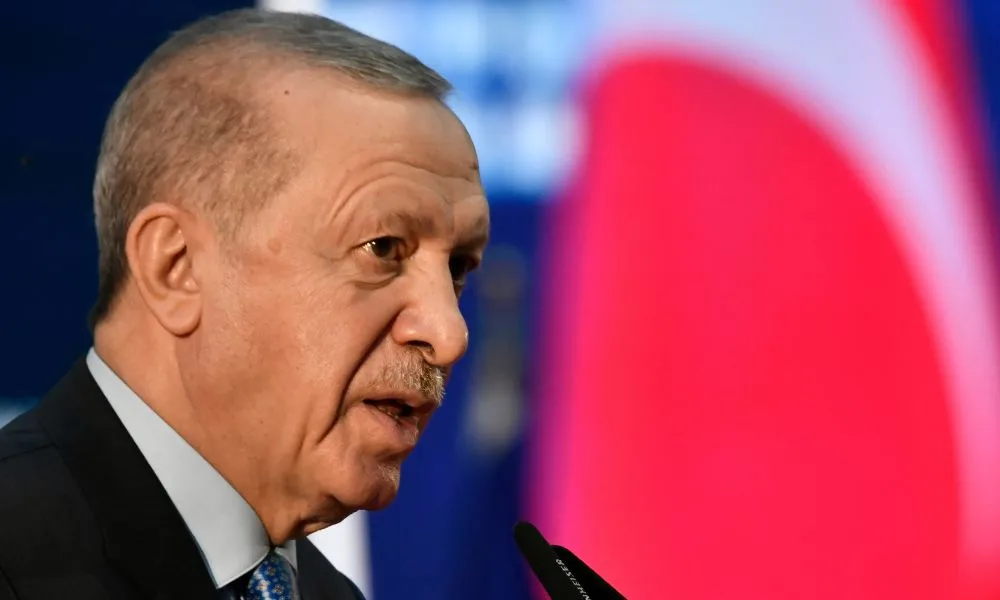

President Recep Tayyip Erdoğan’s rare meeting this week with Ecumenical Patriarch Bartholomew has accelerated efforts to reopen the historic Halki Theological School after more than five decades, while a separate agreement signed days earlier has paved the way for the restoration of the landmark Greek Orthodox Orphanage on Istanbul’s Büyükada island.
The June 16 meeting at the Presidential Complex in Ankara is widely seen as the strongest indication yet that Turkish authorities and the Ecumenical Patriarchate are nearing agreement on a legal framework that would allow the seminary on Heybeliada to resume operations as early as this autumn.
Although Turkish officials released only a brief statement following the meeting, diplomatic, church and education sources said discussions focused primarily on the final administrative and legal arrangements needed to reopen the school, which has remained closed since 1971.
Halki moves from aspiration to implementation
The meeting came as Patriarch Bartholomew publicly confirmed that extensive restoration work at the Halki campus is nearing completion and that preparations are underway for a reopening ceremony later this year.
“We hope that the work will be completed by September and that we will be able to celebrate the reopening in a fitting manner,” Bartholomew said during a recent visit to Athens, remarks he later repeated in interviews with Turkish media.
The Halki Seminary, long regarded as one of the most important theological institutions of the Orthodox world, ceased operations following a Constitutional Court ruling that effectively prohibited private higher education institutions in Türkiye. Since then, successive governments have explored various legal formulas that would allow the Patriarchate to resume the training of clergy while remaining within the framework of Turkish law.
Officials familiar with the current discussions said several options remain under consideration. These include establishing the institution under a special higher education framework supervised by the Council of Higher Education (YÖK), creating a theology faculty affiliated with a foundation structure, or granting the school a unique legal status designed specifically for its historical and religious mission.
Education authorities and legal experts have reportedly intensified work in recent months to reconcile constitutional requirements with the Patriarchate’s longstanding request to maintain authority over the education and formation of its clergy.
Diplomatic momentum before the NATO summit
The renewed momentum surrounding Halki also has an important international dimension.
The issue has featured prominently in discussions between Ankara and Washington for decades and has frequently been raised by successive American administrations as a matter relating to religious freedom and minority rights. According to diplomatic sources, the subject was discussed during Erdoğan’s visit to Washington in September 2025, when U.S. President Donald Trump personally urged progress on the reopening of the school.
With Trump expected to attend the NATO Leaders’ Summit in Ankara on July 7-8, Turkish officials view movement on the Halki file as an opportunity to demonstrate progress on a longstanding international issue while underscoring Ankara’s broader commitment to the protection of minority religious heritage.
Diplomats note that progress on Halki would also help separate questions relating to religious freedoms and cultural rights from the more contentious disputes that continue to affect relations among NATO allies in the Eastern Mediterranean and Aegean regions.
Historic orphanage secures new future
While discussions over Halki gathered pace in Ankara, another historic project involving the Ecumenical Patriarchate reached a major milestone in Istanbul.
On June 15, the Patriarchate signed a landmark redevelopment agreement for the historic Greek Orthodox Orphanage on Büyükada, widely regarded as Europe’s largest wooden building and one of the world’s most remarkable surviving timber structures.
The agreement was concluded at the Maraslios School in Fener between the Patriarchate and a joint venture bringing together Turkish and Greek investors. The consortium includes Bilgili Holding, headed by Turkish businessman Serdar Bilgili, and Greek tourism investment company ENSOFI Holding, led by Costantza Sbokou-Konstantakopoulou.
Under the agreement, the long-abandoned structure will undergo a comprehensive restoration and be transformed into a luxury eco-hotel designed to preserve its unique architectural character while generating the revenue necessary for its long-term maintenance.
From abandoned landmark to sustainable restoration
The project carries considerable historical symbolism. Designed by renowned architect Alexandre Vallaury and completed in 1898, the building was originally intended to operate as the Prinkipo Palace hotel. Sultan Abdulhamid II declined to authorize its opening as a luxury casino resort, leading to its acquisition by the Ecumenical Patriarchate in 1903 and its conversion into an orphanage.
The institution served thousands of children before closing in 1964 during a period of heightened tensions between Türkiye and Greece. After decades of legal disputes, ownership of the property was ultimately restored to the Patriarchate, but the enormous cost of preserving the aging wooden structure continued to frustrate restoration efforts.
Community representatives welcomed the redevelopment project, arguing that commercial sustainability offered the only realistic path to preserving a building of such scale and historical significance.
A week of breakthrough decisions
The Halki and Büyükada developments represent one of the most important periods of progress in recent years concerning the institutions of Türkiye’s Greek Orthodox community. For the Patriarchate, the prospect of reopening Halki addresses a longstanding concern regarding the education of future clergy, while the Büyükada agreement offers a practical solution for preserving one of the country’s most significant historic structures.
The developments showcase a broader effort by the Turkish government to balance cultural heritage preservation, legal reform and international engagement. Whether the final legal formula for Halki can be completed in time for an autumn reopening remains to be seen.