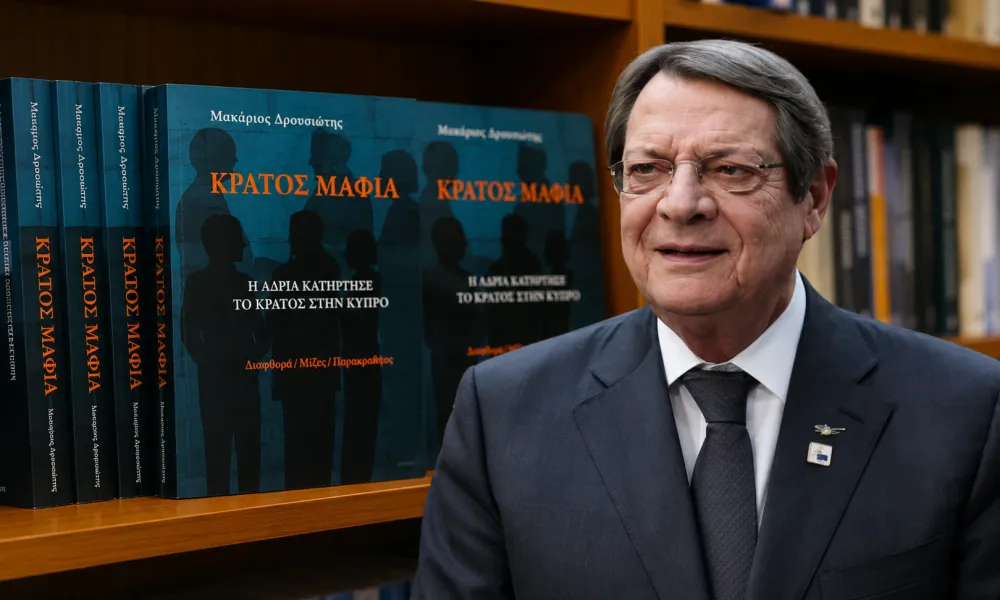
The findings of the report into the book State Mafia should be placed immediately under independent criminal investigation, two prominent lawyers have said, as the government prepares the next steps following the Legal Service’s decision to send the material to the police and the Council of Ministers.
Christos Clerides said an independent criminal investigator, or a team of investigators, must be appointed urgently, either from Cyprus or abroad. Achilleas Demetriades welcomed the government’s intention to appoint an investigative team, but said the officers who prepared the report should also be brought in as advisers because of their detailed knowledge of the case.
Their comments came after the Prosecutorial Council of the Legal Service announced the immediate forwarding of the Anti-Corruption Authority’s report and the final report of the inspection officers to the police and the Council of Ministers. The aim, according to the announcement, is to ensure the fastest possible start to a criminal investigation into possible offences.
Clerides: The Decision Cannot Wait
Clerides said there was no doubt that independent criminal investigators should be appointed. Whether they should come from Cyprus or abroad, he said, depends on what the authorities want to achieve.
He said appointing someone from abroad could help strengthen the perception of independence and impartiality. However, he added that any foreign investigator should work alongside a Cypriot lawyer who understands the country’s criminal procedure and court practice.
What matters most, Clerides said, is speed. He warned that every day of delay keeps the issue in the political and public arena, which does not serve the interests of justice.
Once a criminal investigation begins, he said, the public commentary, party-political exchanges and wider politicisation of the issue would give way to a formal legal process that could lead to criminal proceedings.
Clerides also raised a potential problem over what happens if criminal investigators recommend prosecutions against former president Nicos Anastasiades or other individuals.
Under the Constitution, he said, the decision on whether to prosecute and the drafting of any charges fall under the authority of the Attorney-General. The difficulty, according to Clerides, is that the Attorney-General and the Assistant Attorney-General have already said they do not wish to have any involvement in the matter.
If that recusal also covers the final decision on prosecutions, he warned, the state must find a solution in advance.
“The worst thing that could happen is to have a report by criminal investigators left in drawers, without being taken forward one way or another,” Clerides said.
Referring to Anastasiades’ press conference on Tuesday, Clerides said he was not in favour of public statements by potential suspects, suspects or defendants in cases that may enter the criminal process.
“What they have to say, they should say where they are supposed to say it, before the competent court,” he said.
He added that any complaint by the former president that specific statements were not taken during the inquiry can be raised before the criminal investigators, who can assess whether this affected the conclusions of the report.
Clerides said the main issue was whether Anastasiades addressed the substance of the matters raised in the report. In his view, the former president did not give specific answers with details and evidence, but remained at the level of general statements.
If the aim of the press conference was to undermine the report on the points concerning him, Clerides said, that objective was not achieved. On the contrary, he said, more questions were created than answered.
Demetriades: Independent Prosecutor Should Be Appointed
Demetriades said the case now requires action on four fronts: an independent criminal investigator, an independent public prosecutor, amendments to the law governing the Anti-Corruption Authority, and, if necessary, constitutional changes.
Speaking after the Government Spokesperson announced the Council of Ministers’ intention to appoint an investigative team as soon as possible, Demetriades described the move as “very important and positive”.
He said, however, that the government should also consider appointing the inspection officers who prepared the report as advisers to the team. They spent two years investigating the case, he noted, and have direct knowledge of the material.
Demetriades also said an independent private prosecutor or public prosecutor should be appointed to guide the investigation. In ordinary cases, he said, the police work with the prosecution service on how to proceed. In this case, an independent prosecutor could advise the investigative team on what steps to take, how to build the evidence and how any charge sheet should be prepared.
He was sharply critical of the current law governing the Anti-Corruption Authority, saying it has left the institution without the powers it needs.
According to Demetriades, the Authority should be given the power to take investigative statements. Without that, he warned, the state risks spending more time and money repeating work that has already taken years.
He said the law should be amended and, if necessary, the Constitution should also be changed to give the Authority stronger powers, including prosecutorial powers if that is the political decision.
Demetriades also referred to Article 113 of the Constitution, questioning why the government had not brought forward a bill to amend it, despite what he said was a pre-election commitment by President Nikos Christodoulides.
Asked how an independent public prosecutor could be appointed given the recusal of the Attorney-General, Demetriades said this could be done by the Prosecutorial Council, which was established by the Attorney-General.