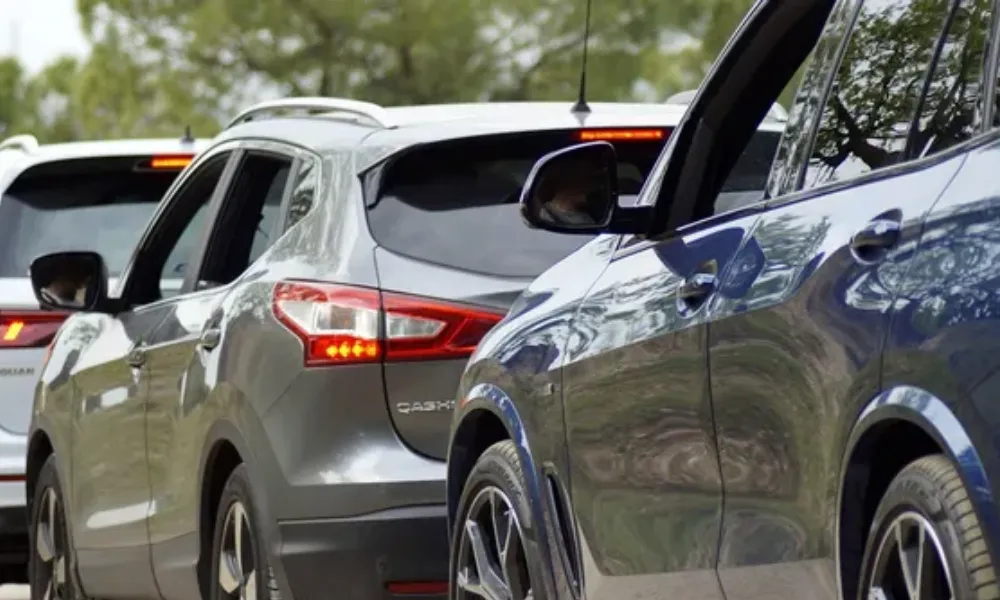

European cities could face even greater pressure on parking and road safety as new cars, led by the continued rise of large SUVs, keep growing in size, according to a new report by Transport & Environment and Clean Cities.
The study warns that cities could lose between 8.5% and 14% of their on-street parking spaces by 2040 if current trends continue. The loss would be driven by the increasing length and width of vehicles, which reduces the number of cars that can fit into existing street parking areas.
London is projected to lose between 72,000 and 118,000 on-street parking spaces by 2040, while Berlin could lose between 71,000 and 117,000. Rome could see a reduction of between 58,000 and 95,000 spaces, with further losses expected in Madrid, Warsaw and Paris.
Cars keep getting bigger
According to the report, the average length of new cars sold in Europe has increased by 1.2 cm every year since 2000. Their height has risen by 0.5 cm annually, while previous analysis found that vehicle width has also been increasing by around 0.5 cm a year.
Transport & Environment says the trend has continued despite falling family sizes and lower average car occupancy. The organisation argues that manufacturers have increasingly shifted away from smaller cars towards larger, more profitable models.
The report says the expansion of vehicle size is not only a parking issue, but also a growing safety concern. Larger and higher-fronted vehicles pose greater risks to vulnerable road users, including pedestrians, cyclists, motorcyclists and users of mopeds or electric scooters.
Children face higher risks
Under the current trend, the report projects around 2,570 additional deaths among vulnerable road users across Europe and the UK between 2026 and 2040 compared with a scenario in which vehicle sizes are brought back towards 2015 levels. That figure includes 79 children.
By 2040, the number of child pedestrians killed in collisions could be 40% higher under the current trend than under the “right-sizing” scenario examined in the study.
A key concern is bonnet height. The report projects that the average bonnet height of the vehicle fleet could reach 86.2 cm by 2040 if no action is taken. Higher bonnets increase the risk that adults are struck in the torso or vital organs, while children are more likely to be hit in the head or chest because of their height.
Calls for EU action
Transport & Environment and Clean Cities are calling for European and national measures to limit the growth of vehicle dimensions. Their proposals include a cap of 85 cm on bonnet height and a width limit of 1.92 metres for new cars.
The report also calls for vehicle dimensions to be included in registration documents, for national tax systems to discourage the purchase of oversized cars, and for parking charges to vary according to vehicle size and weight.
It further urges Euro NCAP to update its safety testing to assess how well drivers can see small children from behind the wheel. The groups also argue that regulatory support should prioritise small electric cars, particularly models under 4.2 metres long, rather than large electric SUVs.
The report says that without policy intervention, Europe risks allowing larger vehicles to take up more public space, increase road danger and place further pressure on cities already struggling with congestion, parking and safety.
Source: AMNA