
Before United Nations Secretary-General António Guterres has even arrived in Cyprus, the familiar machinery of pessimism has begun operating at full speed.
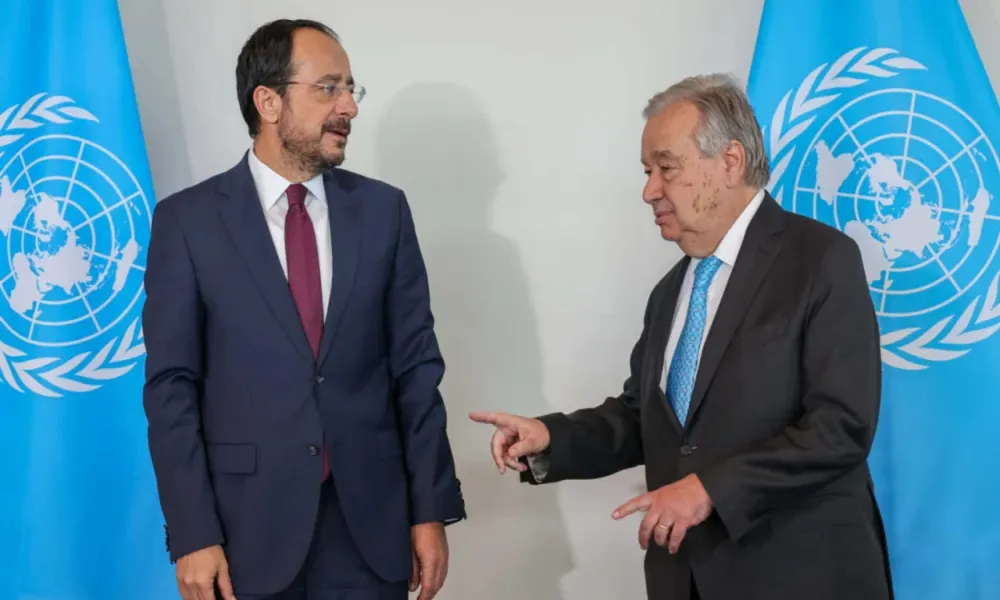
His July 27-29 visit is intended to inject political authority into an increasingly fragile effort to revive the Cyprus process. Guterres is expected to meet Turkish Cypriot leader Tufan Erhürman and Greek Cypriot leader Nikos Christodoulides separately before bringing them together to assess whether sufficient common ground exists for a broader informal conference.
Yet sections of the Greek Cypriot political establishment appear determined to transform the visit itself into a crisis.
At the centre of the controversy is DIKO leader Nikolas Papadopoulos, whose party supports the Christodoulides government. Papadopoulos has reportedly objected strongly to the possibility that Guterres might meet Erhürman at the Turkish Cypriot presidential offices in northern Nicosia, arguing that such a visit would somehow “elevate” the status of the Turkish Cypriot state.
This is not diplomacy. It is political theatre constructed around protocol, symbols and fear.
A visit is not recognition
Guterres would not be the first UN secretary-general to enter the Turkish Cypriot presidential offices. Ban Ki-moon met Turkish Cypriot leader Mehmet Ali Talat there during his February 2010 visit, provoking almost precisely the same manufactured outrage. Kofi Annan also travelled to Cyprus and met Turkish Cypriot leader Rauf Denktaş during his official visit in 2003.
Nor have such contacts been limited to UN officials. Numerous senior foreign dignitaries have crossed into northern Cyprus and met Turkish Cypriot leaders. Joe Biden, then vice president of the United States, did so in May 2014, meeting Derviş Eroğlu during the highest-level American visit to Cyprus in decades.
None of these visits produced international recognition of the Turkish Republic of Northern Cyprus. None altered Security Council resolutions, established diplomatic relations or changed the internationally accepted legal position.
The Turkish Cypriot state was not “elevated” when Ban Ki-moon or Joe Biden entered its presidential offices. Nor was it “degraded” when European Commission President Ursula von der Leyen looked north through the barrels and observation points along the Green Line without engaging directly with the Turkish Cypriot leadership.
Recognition is a legal and political act. It is not conferred by crossing a checkpoint, entering a building or sitting in an elected leader’s office.
Guterres would be meeting Erhürman because the Turkish Cypriot leader represents one of the two indispensable parties to any settlement. That is not a concession to statehood. It is an acknowledgement of political reality.
Equality cannot exist only in negotiating documents
Greek Cypriot leaders repeatedly declare support for a bizonal, bicommunal federation based on political equality. Yet the same political system reacts with alarm whenever that equality acquires a visible or practical form.
Political equality is accepted in speeches but resisted in protocol. It is endorsed in negotiating documents but treated as dangerous when it produces consequences.
A settlement will require far more difficult compromises than deciding where Guterres should sit. It will involve power-sharing, effective participation, executive arrangements, property remedies, territorial adjustment, security mechanisms, EU law and transitional guarantees.
If Greek Cypriot politics cannot tolerate the UN secretary-general entering a Turkish Cypriot institutional building, how will it tolerate Turkish Cypriots exercising an effective voice in a shared government?
If a meeting venue is portrayed as an intolerable elevation of status, what will happen when Turkish Cypriots seek meaningful participation in decisions concerning foreign affairs, European policy, natural resources, federal appointments and constitutional questions?
Those claiming to defend the Republic of Cyprus are instead demonstrating how little practical space they are prepared to allow for the political equality they formally support.
Negotiating while denying the other
The underlying expectation appears to be that Turkish Cypriots should negotiate as a community but never act as a political entity; accept equality in theory but never display it institutionally; dismantle their existing structures before a new partnership has been secured; and trust that their rights will later be protected by the side that refuses to acknowledge their present political legitimacy.
Northern Cyprus is not a political zoo to be observed across the Green Line by visiting dignitaries such as Ursula von Leyen, with expressions of sympathy offered from a safe distance while direct engagement with Turkish Cypriots is treated as taboo.
That is not a formula for reunification. It is a demand for pre-emptive submission.
The Turkish Cypriot electorate has already delivered a remarkably clear message. In October 2025, Erhürman won nearly 63 percent of the vote after campaigning on the revival of the UN process, serious negotiations and a negotiated settlement.
Turkish Cypriots did not vote for permanent isolation or for closing the door to Greek Cypriots. They chose a leader promising engagement. The Greek Cypriot establishment can no longer credibly claim that no Turkish Cypriot partner willing to negotiate exists.
The question is whether it is prepared to negotiate with that partner as a political equal rather than as the representative of a subordinate minority expected eventually to dissolve its institutions into the existing Republic.
Beyond constitutional labels
Turkish Cypriots are increasingly less interested in ideological labels than in whether a settlement can function.
Federation, confederation, decentralised federation, cooperative partnership or an association between two politically equal constituent entities are ultimately names. The decisive issue is whether the arrangement can survive disagreement, prevent domination and protect the security, dignity and effective participation of both peoples.
Greek Cypriots will inevitably possess demographic and economic superiority. But numerical majority cannot be permitted to become permanent political supremacy. Turkish Cypriots must enjoy meaningful participation in common institutions and decision-making, not merely consultation on a narrow category of identity or security issues.
This is not an artificial minority veto. It is the institutional price of reconstructing a partnership between two communities whose original power-sharing order collapsed more than six decades ago.
A sustainable system must prevent both domination and paralysis. That balance cannot be created within a political culture that treats every Turkish Cypriot safeguard as an illegitimate privilege.
The external balance
The internal balance must be accompanied by an external one.
The Republic of Cyprus’s entry into the European Union in 2004 fundamentally changed the equilibrium established in 1960. Greece and the Greek Cypriot side gained the institutional advantages of EU membership, while Türkiye remained outside and Turkish Cypriots were excluded from many of membership’s practical benefits.
The Greek Cypriot side consequently acquired leverage over Türkiye’s European relationship, including customs, visas, defence cooperation and accession matters.
Any settlement must therefore address Türkiye’s strategic and security concerns while responding equally to Greek Cypriot concerns about sovereignty and military presence. This does not mean granting Ankara control over Cyprus or preserving every feature of the current security system indefinitely.
It means recognising that no settlement can endure unless Türkiye is confident that Turkish Cypriot security and its own legitimate interests are protected. Greece, the European Union and the wider international community must similarly contribute to arrangements reassuring the Greek Cypriot side.
Without an external equilibrium, even carefully designed constitutional provisions will eventually come under unbearable pressure.
Manufactured pessimism
A familiar pattern is once again shaping the Greek Cypriot debate. Greek Cypriot domestic constraints are treated as understandable political realities, while Turkish Cypriot concerns are described as obstruction. Greek Cypriot maximalism is explained; Turkish Cypriot caution is condemned.
Turkish Cypriot demands for direct trade, flights and international contacts are portrayed as attempts to obtain recognition through the back door. Even neutral diplomatic engagement is framed as an unacceptable elevation of status.
This vocabulary does not prepare society for compromise. It prepares it to reject compromise.
It teaches voters that equality means defeat, engagement means recognition and accommodation means capitulation. No leader can negotiate successfully within such an environment.
Rejectionists, of course, also exist in the north and in Türkiye. Some prefer permanent separation to the risks of partnership. Those voices should be challenged. But Turkish Cypriot maximalism cannot excuse Greek Cypriot obstruction, just as Greek Cypriot rejectionism cannot justify maximalism in the north.
Christodoulides must choose
Christodoulides now faces a defining choice. He can allow DIKO and the rejectionist wing of his coalition to determine the limits of diplomacy, turning protocol disputes into national red lines and entering every negotiation fearful of accusations that he has “elevated” the Turkish Cypriot side.
Or he can explain that peace requires engagement with the elected leadership, institutions and political reality of the other community.
Leadership is not the art of following public fears. It is the responsibility to confront them and prepare society for unavoidable compromises.
If a government crisis can be threatened over Guterres entering Erhürman’s offices, what will happen when negotiations reach territory, property, guarantees, power-sharing and effective participation?
Unless the rejectionist reflex is challenged now, it will later be mobilised against every compromise capable of producing a viable settlement.
Peace requires courage
Cyprus does not need another process designed merely to demonstrate that meetings occurred. It needs an agreement capable of functioning and surviving the inevitable disputes of implementation.
Such an agreement will require Greek Cypriots to accept that Turkish Cypriots are not merely a protected numerical minority within an exclusively Greek Cypriot state. They are one of two politically equal partners whose consent and effective participation are indispensable.
It will require Turkish Cypriots to accept that partnership brings obligations as well as rights. Türkiye and Greece will have to adapt their traditional roles, while the European Union must provide incentives, legal flexibility and credible reassurance rather than simply issuing demands from the sidelines.
Territorial adjustments, property arrangements and transitional mechanisms will inevitably be painful. Final territorial transfers must remain conditional upon approval of the complete settlement in simultaneous referendums. Neither side should be required to surrender its principal assets irreversibly before the entire package and its safeguards have been approved.
Guterres’s visit should therefore be treated as an opportunity, not an existential threat. Erhürman’s election should be recognised as an opening, not dismissed as a tactical trap. Any new framework should be judged by its balance and capacity to function, not strangled by disputes over buildings, titles and protocol before substantive negotiations begin.
The people of Cyprus have spent more than half a century paying the price of fear, nationalism and failed leadership. They deserve leaders capable of explaining that a common future cannot be built by denying the existence, dignity or equality of the other community.
It can be built only through a balanced agreement in which both sides make painful concessions, both obtain credible safeguards and neither is expected to surrender before the new partnership has been created, approved and secured.