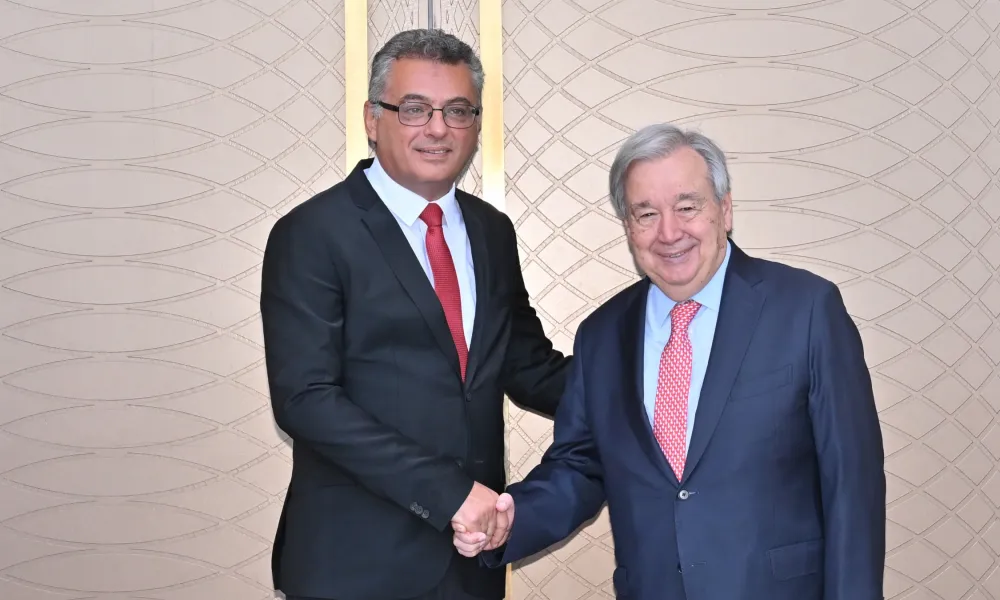

Turkish Cypriot leader Tufan Erhurman said on Wednesday he was more optimistic than before UN Secretary-General Antonio Guterres' visit to Cyprus, arguing that although no tangible agreements had been reached, the meetings had produced a clear road map that could lead to a renewed political process.
Speaking to reporters for nearly an hour, Erhurman described Guterres' visit as significant for four main reasons. He noted that it was the Secretary-General's first visit to Cyprus in 16 years, which he said demonstrated the importance the United Nations attaches to the Cyprus issue. He also highlighted the presence of a large delegation of senior UN officials.
Two equals
Erhurman further pointed to Guterres' separate meetings with President Nikos Christodoulides in the south and with himself in the north, saying this reflected the UN's treatment of the two leaders "as equals" under its auspices. Finally, he said the Secretary-General had travelled to Nicosia to facilitate direct discussions between the two sides, supporting his long-held view that many issues could be resolved through dialogue on the island if sufficient political will existed.
Although no agreement was reached on opening new crossing points or on other concrete measures, Erhurman said the overall outcome of the meetings was positive because it established a framework for future engagement.
He reiterated his longstanding position that confidence-building measures (CBMs) should be implemented before the resumption of formal negotiations in order to address the lack of trust between the two communities. He welcomed Guterres' emphasis on adopting a different methodology, saying this reflected proposals he had advocated for some time.
Technical Committees
Erhurman said the UN chief's meetings with the bicommunal Technical Committees also demonstrated the importance attached to confidence-building measures, noting that Guterres had specifically referred to the issue in his public remarks.
He said he did not support negotiations "for the sake of negotiations", nor a broader five-plus-one meeting simply to hold another conference. Instead, he argued that any expanded talks should only take place if there was a realistic prospect of achieving concrete results. He noted that Guterres had similarly stressed that "this time must be different", recalling comments the UN chief made after the collapse of the Crans-Montana conference in 2017.
According to Erhurman, the key difference from previous negotiation rounds in 2004 and 2017 should be agreement on the methodology before substantive negotiations begin.
"Let's first agree on the methodology, and then sit down at the negotiating table," he said.
He added that the UN's recent approach appeared to confirm, at least in part, the Turkish Cypriot side's emphasis on confidence-building measures and a phased negotiating process.
Erhurman also welcomed the fact that no date had yet been set for a five-plus-one meeting involving the two communities, the three guarantor powers and the United Nations. He argued that this would encourage further progress on confidence-building measures and negotiating methodology before such a conference is convened.
Guarantor powers
Erhurman said another important element was Guterres' close coordination with the guarantor powers throughout the process.
He noted that the Secretary-General had expressed confidence in their continued support and had said they agreed that a five-plus-one meeting should only be held after adequate preparations had been completed.
Erhurman said he also wanted any future conference to produce tangible results and confirmed that he would continue consulting closely with Turkey in its capacity as a guarantor power.
'More optimistic'
The Turkish Cypriot leader said he was now "more optimistic than before the Secretary-General's arrival".
"I have my reasons. I'm not saying it as a slogan," he said, adding that both Guterres' public statements and his comments during private meetings demonstrated that the UN was prepared to remain actively engaged until the end of the process.
"The possibility of fruitless, purely formal meetings has been eliminated. I see that as a positive development," he added.
Erhurman said he had also raised a number of issues during his meetings with Guterres and President Christodoulides.
Undermined trust
These included the recent questioning by Cyprus Police of Turkish Cypriot businessman Yasa Yesilada in connection with property-related investigations. Erhurman said the case had generated significant concern among Turkish Cypriots and warned that such actions undermined trust between the two communities.
He said the incident did not involve an arrest warrant but noted that the request for Yesilada to give a statement coincided with Guterres' visit. He also referred to a similar incident involving the UN Secretary-General's Personal Envoy, María Ángela Holguín.
Erhurman argued that if Greek Cypriots believed similar legal action could not be taken in the north against Greek Cypriots living in or using Turkish Cypriot-owned properties, "that is not impossible". He warned that such developments risk discouraging people from crossing between the two sides at a time when efforts were under way to discuss opening additional crossing points.
Children mixed marriages
He also raised the issue of children of mixed marriages, describing it as a matter concerning the freedom of movement of children born on the island.
In addition, he discussed what he described as the "isolation" of Turkish Cypriots, including restrictions affecting sport, referring to previous recommendations by former UN Secretary-General Kofi Annan as well as references by the European Union and the Council of Europe.
Erhurman also criticised recent defence agreements concluded by the Greek Cypriot side, claiming they weakened the sense of security among both Turkish Cypriots and Greek Cypriots.
Looking ahead, he said he would meet European Union Special Representative Raffaele Fitto in the coming days, having already spoken with him by telephone. Erhurman said he had made clear that the EU could not participate in a future five-plus-one meeting as either a sixth participant or a second guarantor.
Shaping the road map
Responding to questions about media reports suggesting discussion of a transitional period before a comprehensive settlement, Erhurman acknowledged that the idea had been raised but stressed that no negotiations had taken place on its details and no agreement had been reached.
Asked what would constitute a successful outcome from a future five-plus-one conference, Erhurman said that, for the first time, he could see a clear road map emerging.
"There must first be progress on confidence-building measures and methodology. You will discuss internal issues. You will have something substantive in your hands. Then come. The guarantor powers are ready to attend under those circumstances. I see that as a road map," he said.
He added that attending a five-plus-one meeting "empty-handed" was no longer an option.
Asked whether such a conference could take place before Antonio Guterres' term as UN Secretary-General ends, Erhurman said he did not wish to commit to a specific timetable but believed it was achievable.
He concluded by saying that no formal plan had been presented to either side, although a number of ideas had been discussed.
Source: CNA