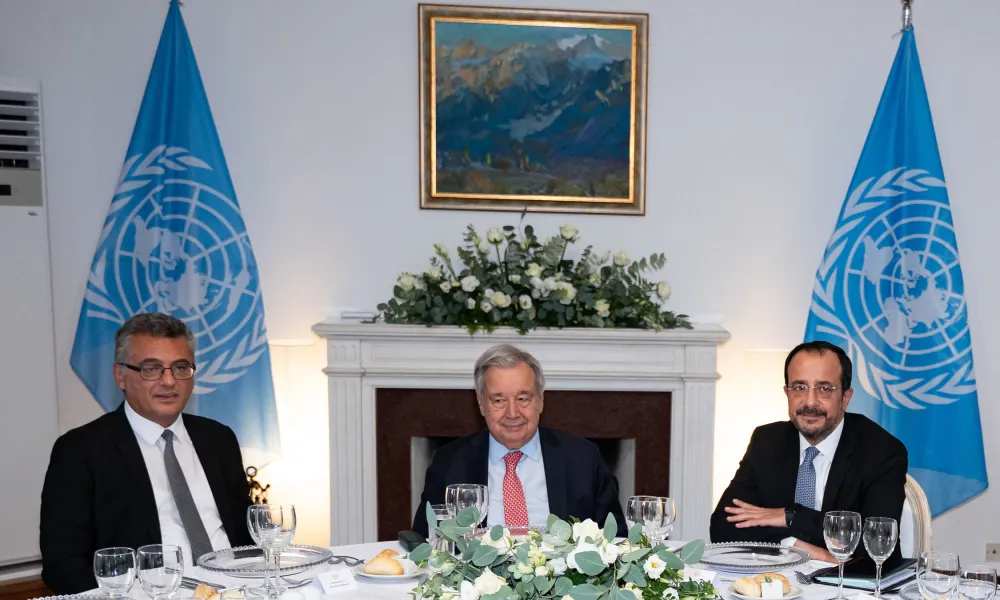

UN Secretary-General António Guterres came to Cyprus asking President Nikos Christodoulides and Turkish Cypriot leader Tufan Erhürman to "go the last mile" towards resolving the Cyprus problem. His departure "empty-handed", without the slightest step forward, left the two Cypriot leaders spending the following days exchanging accusations over who was to blame.
The negative outcome revived a fundamental question that the United Nations has always faced regarding Cyprus: perhaps the obstacle is not the substance of the problem, but the leadership.
The Cyprus issue is a unique case in international diplomacy. While the world is shaken by wars and human suffering, a UN Secretary-General continues to devote attention to Cyprus after five decades of failure. He came to Cyprus to push for an agreement, but found no sense of readiness or urgency among the leaders. He insisted on the "last mile", without endless procedures. But he realised that nothing had changed since Crans-Montana in 2017: a historic opportunity was lost just short of a strategic agreement because the UN cannot find leaders willing to sign it.
Routine
Christodoulides has for some time been engaged in an informal campaign for re-election in the 2028 presidential election. As soon as Guterres departed, his strategy became obvious. On Thursday (Aug. 6), he reshuffled his cabinet and set his plans in motion.
It suits him to maintain a minimal process of meetings on the Cyprus issue, regardless of the outcome. Progress, in this context, is simply another meeting that feeds the media with behind-the-scenes stories and deliberate leaks to create the impression that discussions are taking place.
In reality, Christodoulides relies primarily on domestic political forces that oppose a bi-zonal, bi-communal federation and reject every UN proposal, including those put forward by Guterres. Once the Secretary-General departs, Christodoulides will be fully immersed in his election campaign, claiming that he fulfilled his duty on the Cyprus issue without having been charged with making any "concessions".
Under pressure
Erhürman was elected last October with more than 60% of the vote, promising to end the isolation of the Turkish Cypriots. Those expectations have not been fulfilled, and he now finds himself under mounting criticism.
"Parliamentary" elections are due in December, when Erhürman's Republican Turkish Party will be tested at the ballot box to determine whether it can form a "government". Power currently remains in the hands of the Turkish Cypriot nationalist right and opponents of a federal reunification.
The deadlock over the Cyprus issue is already working against the electoral prospects of the more moderate Turkish Cypriot forces that favour reunification of the island. Erhürman has reacted erratically and, unfortunately, has also turned his criticism towards the European Union, which is seeking a role in contributing to efforts on Cyprus.
Efforts
It is unlikely that Guterres will convene another informal five-party conference. For at least five years, he has been asking for modest confidence-building steps.
The leaders committed themselves to opening four new crossing points but have failed to honour that commitment, trapped by incomprehensible tactical calculations.
However, the Secretary-General has not focused solely on confidence-building measures. For years, he has sought to restart substantive negotiations, but the attitude of the leaders has been destructive. While in Nicosia, he recalled that since 2018 he has sent three personal envoys to Cyprus. He convened three five-party conferences and organised a series of trilateral meetings with the Cypriot leaders.
He has tried every possible combination of leaders, but has never found two leaders at the same time who were prepared to assume the historic responsibility of moving forward and reaching a strategic agreement.
The past
Deadlocks are broken when leadership changes. That happened in the Cyprus issue when Rauf Denktash was sidelined in 2003.
The impasse following the referendum was broken when Tassos Papadopoulos lost the election. Under Demetris Christofias and Mehmet Ali Talat, in 2010, notable convergences were achieved that remain valid today.
Progress became even more significant when Mustafa Akıncı was elected Turkish Cypriot leader in 2015. It came to an end when Nicos Anastasiades walked away from Crans-Montana, undermined Akıncı and Ersin Tatar was subsequently elected.
Today, the leaders are producing no progress and are unable to achieve even the most basic and self-evident steps. Deadlocks continue to multiply.
Time for action, not talks
At the same time, the dilemma facing the leaders has become clearer and more significant, and they can no longer afford to play for time. Guterres is no longer asking merely for talks, but for the signing of a strategic agreement.
Christodoulides often presents himself rhetorically as a politician committed to resolving the Cyprus issue, recently describing it in his speeches as his "life's mission". He was present at Crans-Montana as a close associate of Anastasiades and was involved in the decisions that followed. He is very well known to the United Nations. Based on the reports Guterres has submitted to the Security Council, neither he nor his predecessor has, at any point, convinced the UN that they possess the leadership needed to go the last mile.
Nor has Erhürman, so far, managed to do so.
Guterres may ultimately decide that the UN should keep the prospect of a renewed effort on the Cyprus issue alive. He may also have in mind the possibility that Cyprus could produce a different combination of leaders in 2028.
That, however, will depend primarily on the choices made by Greek Cypriot voters at the ballot box.