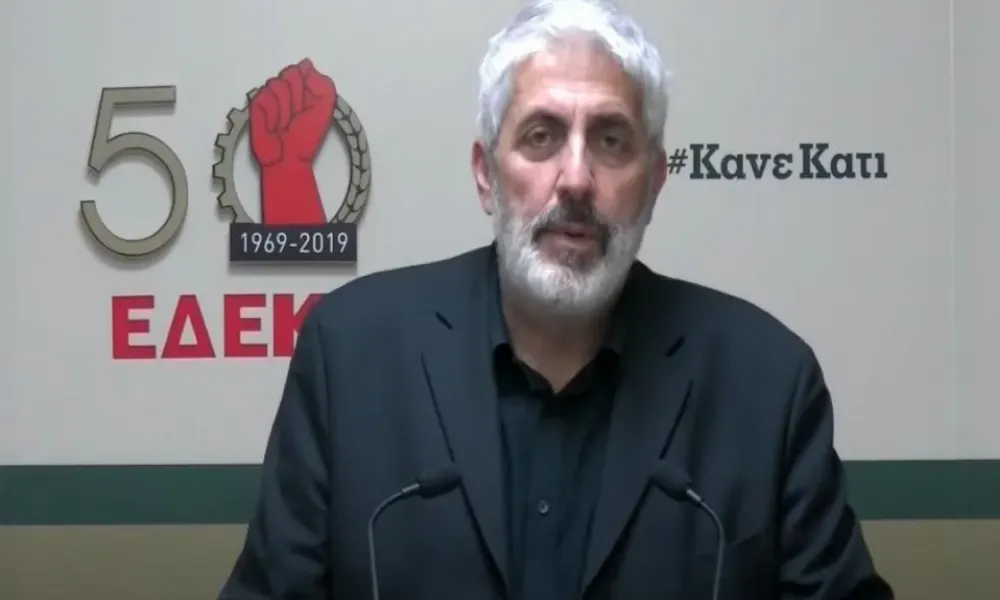

Former EDEK MP and senior party figure Costis Efstathiou has warned that the party remains trapped in a prolonged period of internal conflict following its exit from parliament, arguing that continued infighting is preventing it from reconnecting with society and producing meaningful policy.
Speaking on Politis Radio's Morning Briefing programme, Efstathiou said he would not take part in the presidential election because he is no longer a member of the party.
"Impossible. I am not a member of the party, therefore I cannot vote."
"Everyone interprets decisions as they wish"
Referring to discussions about the possible return of expelled members, Efstathiou argued that one of EDEK's fundamental problems is how decisions of collective party bodies are interpreted.
"Everyone interprets decisions however they wish. One of the party's biggest problems is precisely that."
According to him, inadequate record-keeping allows multiple interpretations of party decisions.
"When minutes are not kept and there is no proper record, everyone interprets decisions in the way that suits them. Then whichever majority emerges at a given moment decides what happens next."
"Leaving parliament was a shock"
Efstathiou described EDEK's failure to retain parliamentary representation as a major blow.
"Leaving parliament was a shock. We should have carefully examined the reasons that led us there."
In his view, the resignation of Nikos Anastasiou and the launch of a new leadership race came before a meaningful assessment of what had gone wrong.
"For the past month EDEK has been in a prolonged internal election campaign, which is anything but healthy."
"Five months of continuous introspection"
The former MP said the problem extends beyond the leadership race itself.
"We are seeing practices where a political opponent is treated almost as an enemy."
According to Efstathiou, constitutional and electoral congresses due to follow the leadership election are likely to prolong internal tensions.
"That means we will have a period of around five months of continuous introspection. Instead of trying to reconnect with society, EDEK will continue dealing with its internal affairs."
He argued that a different course could have been followed after Anastasiou's resignation.
"These elections could have been avoided or, if they were held, they could have led immediately to a congress and a comprehensive restructuring process. A prolonged election period and prolonged uncertainty help no one."
"When you don't produce policy, you're outside society"
Efstathiou said EDEK has become disconnected from society because it remains focused on internal disputes.
"When you are constantly dealing with your own internal problems, you do not produce policy. And when you do not produce policy, you are outside society."
He also argued that EDEK faces a more difficult challenge than other political parties because it is now outside both parliament and the National Council.
"Other parties still have a platform, representation and the ability to produce policy. EDEK needs an even greater effort to return."
"The impression is that there is hatred"
Efstathiou described the atmosphere within the party as deeply troubling.
"One only has to read what party officials and members are writing on social media."
He said the image being created is one of hostility between people who are supposed to be political colleagues.
"The impression created is that there is hatred between people who are supposed to be comrades and companions in the same political space."
He added:
"It is tragic to see language and behaviour that resemble confrontation with one's worst political enemy."
"The issue is not age"
Asked what qualities the next EDEK president should possess, Efstathiou said age should not dominate the discussion.
"The issue is not age, nor whether someone is old or young. The question is what policies the new president will pursue. What is the plan for the party and for society?"
He argued that meaningful political debate is currently absent.
"Old does not necessarily mean bad and new does not necessarily mean good. What matters is for EDEK to reconnect with society and present a political proposal."
Calls for transparency
Efstathiou stressed that the leadership election must be fully transparent.
"A lot has been said over the years. There have been testimonies and complaints about previous processes. I will not go into details. What I am saying is that the process must be absolutely transparent."
He also described the presence of election observers as self-evident.
"I do not understand it. The presence of observers is something obvious if there is to be confidence in the process."
He additionally raised concerns about accessibility at some polling stations.
"We are talking about a party with a membership that is, to a large degree, elderly. These issues should be taken into account."
"We are still waiting for the doors to open"
Regarding a possible return to EDEK, Efstathiou said the issue goes beyond his own situation.
"There are people who have contributed far more than I have and who remain outside."
He added:
"We have heard many times that the doors would open. We are still waiting to see when that will actually happen."
Government participation and party assets
Commenting on EDEK's relationship with the government, Efstathiou argued that the appointment of individuals linked to the party to state positions does not necessarily amount to genuine participation.
"For me, participation means influencing political decisions and political direction."
He also referred to party assets, noting that:
"EDEK still possesses significant real estate assets."
According to him, their management requires particular attention.
On financial oversight, he said:
"One of the main points of friction at the last congress was precisely the decision to carry out a financial and accounting audit."
Adding:
"Beyond that, everyone can draw their own conclusions."
"I cannot be optimistic"
Efstathiou ended on a pessimistic note about the party's prospects if meaningful change does not occur.
"I cannot be optimistic when I do not see a change in mentality."
He concluded:
"If the same behaviour, the same arbitrary practices and the same introspection continue, then obviously the future cannot be positive."