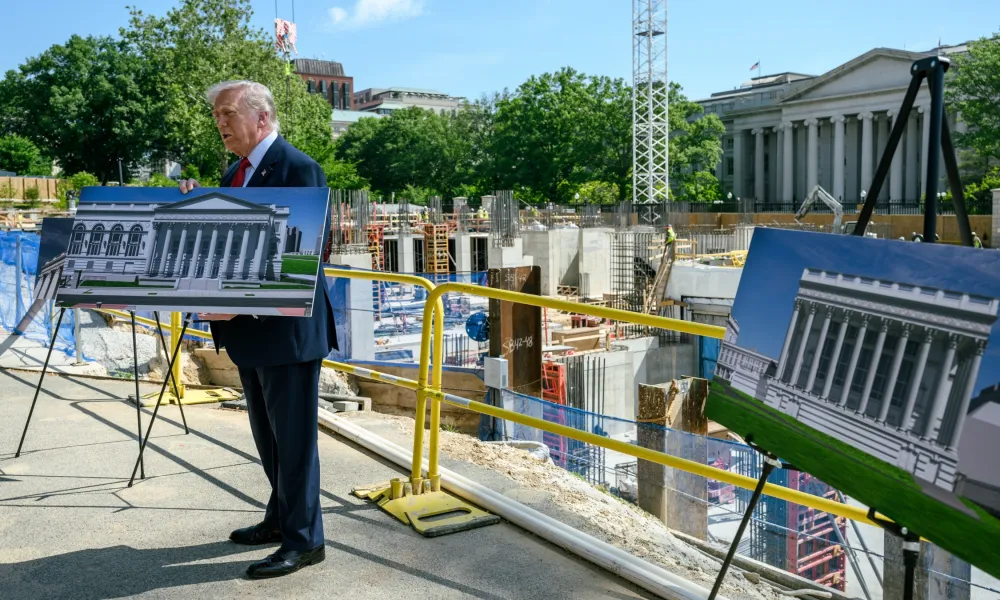



A divided Supreme Court on Monday allowed construction to continue on President Donald Trump's luxury White House ballroom, which has been steadily rising in place of the East Wing the president demolished last autumn, The New York Times reported.
In a 5-4 vote, the court found that the preservationists who challenged the 90,000-square-foot project, estimated to cost $400 million, lacked the legal standing to bring their lawsuit because they had not been directly harmed by it. The majority stressed that the order addressed only who could sue, not the project's legality, but in practical terms it dealt a serious blow to the most significant legal challenge the ballroom has faced, making it likely Trump will be able to complete construction. Halting the project now would probably require a fresh lawsuit from a party with standing, such as Congress, an unlikely scenario while Republicans control both chambers.
An unusual dissent
Chief Justice John G. Roberts Jr. joined the court's three liberal justices in dissent, arguing the construction was likely unlawful. Roberts wrote that the distinctive nature of the White House meant a preservationist's documented interest in viewing it could count as a concrete legal injury, drawing on precedent that recognises aesthetic interests as valid grounds to sue.
Monday's ruling reversed lower-court decisions that would have halted aboveground construction, after judges found the administration had exceeded its authority by pursuing major changes to the White House campus without congressional approval.
Part of a broader pattern
The ballroom, which includes a secure military bunker underneath, is one of several ways Trump has been reshaping Washington during his second term. He has also proposed a 250-foot triumphal arch near the city's border with Arlington, Virginia, and allies have pushed to add his name to the John F. Kennedy Center for the Performing Arts, even after a judge ordered it removed from the building. The ballroom, however, has been especially personal for Trump, who has said for years that the White House needed a larger space to host guests without erecting a tent on the South Lawn.
Monday's order was the second time in under two weeks that the court weighed in on the project. On 21 August, Chief Justice Roberts issued a brief administrative stay allowing construction to continue while the full court considered the administration's request more fully. Monday's ruling reflects the position of all nine justices.
In a social media post, Trump celebrated the decision, saying it cleared the way for the project's completion by the summer of 2028 and calling the ballroom and adjoining complex something "the entire Country is very proud of."
Who brought the challenge
The case was brought by the National Trust for Historic Preservation, a nonprofit chartered by Congress to protect public buildings, on behalf of longtime member Alison K. Hoagland, a Washington resident and architectural historian who argued she had been personally and professionally harmed by the loss of one of the country's most prominent public buildings. Brent Leggs, president of the trust, called the ruling "deeply disappointing" and noted the majority had not addressed whether the project itself was legal, adding that the case's central argument, that a president cannot unilaterally redesign the White House without congressional approval, remains unresolved.
In its unsigned order, the court rejected the trust's claim of aesthetic, cultural and historical harm as a basis for standing, writing that the justices had repeatedly held that mere disagreement or distaste does not amount to a concrete injury. The majority also indicated the administration had made a persuasive case that halting construction could harm national security, a framing that has grown more prominent as the project, now referred to by the president's lawyers as the "military/ballroom complex," has expanded to include a major upgrade to the underlying Presidential Emergency Operations Center, a Second World War-era bunker.
The path through the lower courts
District Judge Richard J. Leon initially halted construction and rejected the administration's arguments, while allowing work to continue temporarily pending appeal. He wrote in March that any security concerns around a "large hole" beside the White House were a problem "of the president's own making." In August, the DC Circuit Court of Appeals ruled 2-1 against the administration, finding that Congress retains control over federal property and had not ceded authority to the president to redesign the White House to suit "a particular president's desires."
The administration then asked the Supreme Court to intervene, arguing it was effectively too late to stop the project and that doing so would endanger the president and his family. According to government filings, a team of 250 workers has been working 20 hours a day, seven days a week, with construction now 65% complete.
Trump had said the ballroom would be funded through private donations, but in June the administration transferred about $350 million in taxpayer money from the Secret Service for what it described as "security enhancements" to the ballroom and bunker. The Secret Service has said it plans to spend $220 million to harden the partially built structure against attack, including bulletproof glass, drone detection technology, and chemical and other threat filters, alongside a separate $180 million taxpayer-funded visitor screening facility.
Source: The New York Times