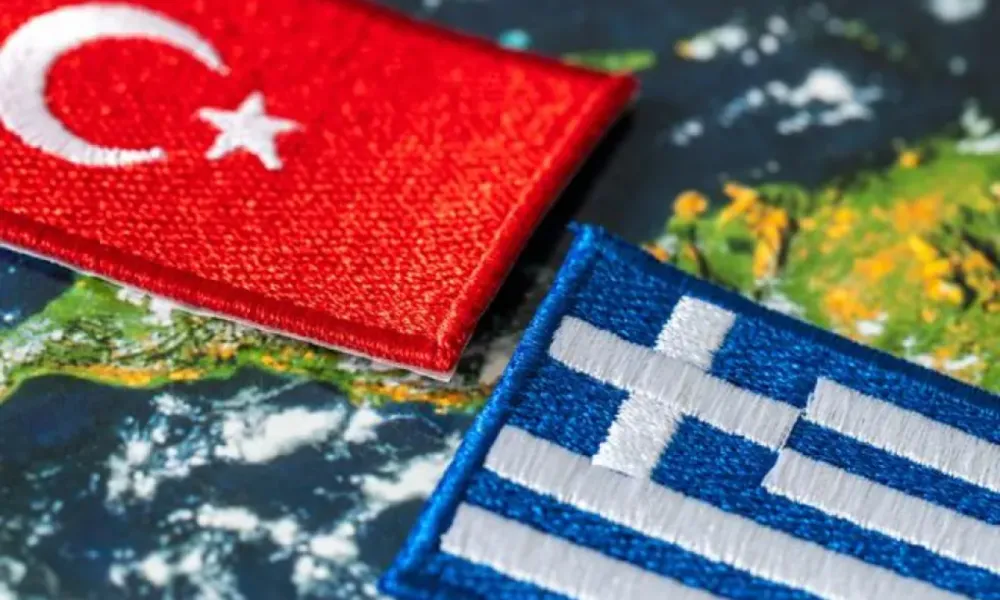

Geostrategic analyst Savvas Kalenteridis has warned of rising tensions in the rhetoric between Greece and Turkey, pointing to the Greece-Cyprus electricity interconnection and proposed Turkish legislation on the “Blue Homeland” as key factors that could determine the course of relations.
Speaking to the Cyprus News Agency, Kalenteridis said the tabling of the proposed legislation would create a new landscape in Greek-Turkish relations.
Tensions rise over maritime planning
Kalenteridis said Turkey had stepped up its confrontational rhetoric following several moves by Greece.
“We had three announcements by the Turkish Foreign Ministry in response to the publication of the corresponding spatial plans for the Aegean by the relevant Greek government ministries,” he said.
Turkey subsequently declared two marine parks extending beyond its territorial waters.
According to Kalenteridis, the move came in response both to the two marine parks declared by Greece and to Greek spatial plans that include 152 islands over which Turkey disputes Greek sovereignty.
After examining Turkey’s maps and related information, Greece lodged a strongly worded protest with Ankara. Turkey then went a step further by submitting its own formal protest over Greece’s three spatial plans.
Kalenteridis said Turkey had also intensified its activity in the area, with an increase in violations and flights by Turkish unmanned aerial vehicles, particularly over the Northern Aegean marine park.
“This has therefore raised tensions,” he said.
Athens adopts tougher rhetoric
Kalenteridis also identified a shift in the Greek government’s rhetoric.
“There has been an increase in the intensity of the rhetoric from both the prime minister and the Greek foreign minister,” he said.
He noted that some observers viewed Athens’ change in tone as a response to Turkish actions, while others linked it to Greece’s entry into a pre-election period.
Asked whether Greece was in a position of strength compared with Turkey, Kalenteridis said: “I believe that Greece is currently in a better position than Turkey in terms of strategic weapons.”
“I am not talking about the quantity of weapons or unmanned systems. I am talking about strategic weapons,” he clarified.
‘Achilles Shield’ offers strategic advantage
Referring to the Greece-Israel agreement on the “Achilles Shield”, Kalenteridis said it gave Greece an advantage at both operational and geopolitical levels.
Operationally, he said, it could counter missile, aerial and unmanned aircraft threats.
At the geopolitical level, Greece’s air defence shield connects with that of Cyprus’ National Guard and Israel’s system, while the three also offer interoperability.
“Turkey sees this as encirclement because it creates a secure corridor through which IMEC can pass, and Turkey wants to undermine IMEC,” he explained.
He added that Turkey viewed the Greece-Cyprus electricity interconnection, known as the Great Sea Interconnector, as part of IMEC.
Cable and legislation seen as decisive
Asked whether Greek-Turkish relations were likely to improve or deteriorate, Kalenteridis said the electricity cable would play a crucial role. He suggested that a solution may have been found that satisfied Turkey to some extent.
He said the second decisive factor would be the tabling of legislation on the “Blue Homeland”, which he described as “blue schizophrenia”, arguing that it would create a new arena in which Greek-Turkish relations would develop.
The legislation would assign missions and responsibilities to several Turkish ministries.
“Given that this ‘blue schizophrenia’ map covers a vast area, if these Turkish state agencies attempt to carry out the missions included in the legislation, Greece will have to take action on the ground,” Kalenteridis said.
“This would create a continuous climate of tension, and we cannot say at this stage where it might lead.”
“I believe this legislation could change everything in Greek-Turkish relations,” he concluded.
Source: CNA