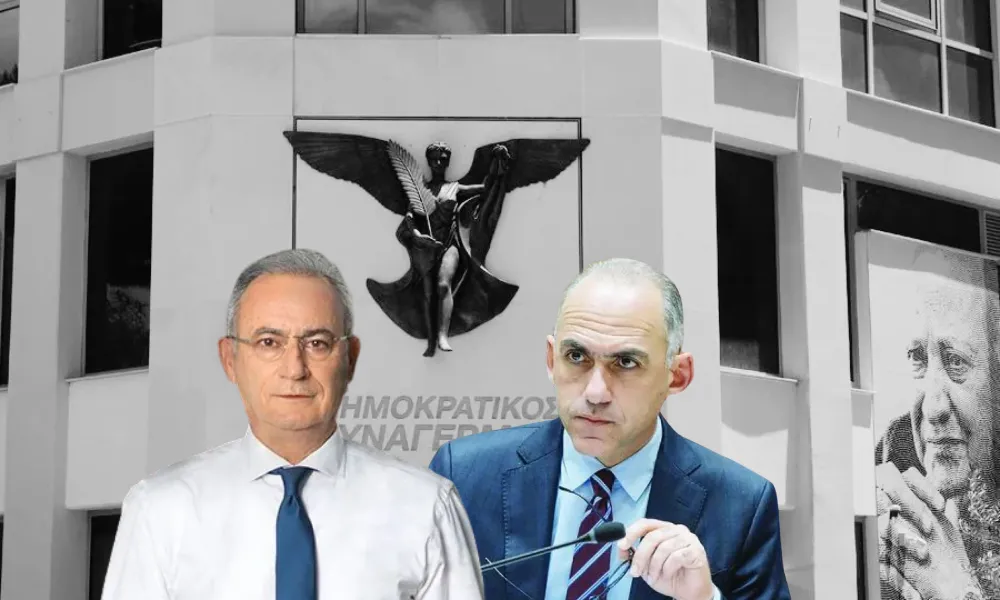

Democratic Rally (DISY) leader Anita Demetriou has rejected Haris Georgiades’ offer to resign as president of the Glafkos Clerides Institute, as renewed internal tensions expose divisions over the party’s political direction and its candidate for the 2028 presidential election.
In a statement published on Tuesday evening, Demetriou said she would not accept the resignation, arguing that disagreements should be resolved through dialogue rather than resignations. She pledged to pursue discussions aimed at addressing the dispute and maintaining party unity.
Her response came after Georgiades, a former finance minister, sent a letter to the party leadership declaring that, for the first time, he would not take part in DISY’s election campaign if former party leader Averof Neofytou were selected as its presidential candidate.
Georgiades also placed his position as head of the Glafkos Clerides Institute at Demetriou’s disposal.
The development came a day after Neofytou and fellow contender Giorgos Pamboridis formally submitted their candidacies in the party’s internal selection process.
Earlier on Tuesday, reports had suggested that Demetriou was expected to accept Georgiades’ resignation. Her eventual decision not to do so indicated that discussions may have taken place within the party leadership in the intervening hours.
Dispute over party unity and internal procedures
According to reports by Phileleftheros, Georgiades’ letter and its publication had not been coordinated with Demetriou, who reportedly expressed dissatisfaction to close associates.
The party leadership also took issue with what it viewed as a direct challenge to Demetriou’s public account of her decision to withdraw from the presidential race, which she has maintained was voluntary and made without pressure.
In her statement, Demetriou reiterated that her sole motivation had been to protect party unity and called on all members to respect the membership’s decision.
Georgiades, meanwhile, has insisted that he is not leaving DISY. Speaking on Philenews’ Vidcast, he rejected accusations that he was seeking to split the party, saying he had neither suggested running as an independent candidate nor challenged the party’s internal procedures.
His criticism of Neofytou centres on three main issues: political conduct, policy positions and potential political alliances.
Georgiades sets out three objections to Neofytou
The first concerns what Georgiades described as political ethics. He argued that the circumstances surrounding the withdrawal of Demetriou’s candidacy had created a fait accompli under pressure and what he called “blatant political blackmail”.
He linked his criticism to the possibility of an independent candidacy by Neofytou, which the former party leader had left open until the final stages of the process.
Georgiades also cited a party announcement on 12 October, which said Demetriou’s withdrawal had ensured that all candidates could participate in democratic procedures.
He argued that political manoeuvring, behind-the-scenes negotiations and excessive ambition had taken precedence over a measured political process.
The second area of disagreement concerns policy. Georgiades maintains that Neofytou has increasingly departed from DISY’s longstanding positions on several issues, with differences becoming systematic since 2023.
He pointed to disagreements over the Cyprus problem, foreign policy and the economy. Neofytou’s recent position in favour of lifting Russian energy sanctions was cited as a particularly significant point of divergence.
The third issue concerns political alliances. Georgiades said that, after efforts in recent years to establish cooperation between DISY and the centre-right Democratic Party (DIKO), there were now discussions about possible partnerships with parties whose positions diverge from those of DISY.
He linked this potential shift to the policy differences he attributes to Neofytou.
Georgiades has stressed that his objections are not rooted in doubts about Neofytou’s electoral prospects. He recalled that he had fully supported Neofytou in the 2023 presidential election despite unfavourable assessments at the time.
Senior DISY figures push back
The dispute prompted a sharp response from DISY vice-president Yiannis Karousos, who described Georgiades’ statements as misplaced and divisive.
Speaking to ANT1, Karousos argued that the only person benefiting from the party’s internal conflict was President Nikos Christodoulides.
Questioning Georgiades’ challenge to Demetriou’s account of her withdrawal, Karousos asked: “So, is Haris saying that Anita lied?”
He also stressed that party officials holding institutional positions had an obligation under the party’s statutes to work for whichever candidate was selected by the membership.
Karousos stopped short of saying whether Georgiades’ resignation should have been accepted, while describing him as one of DISY’s most serious and respected figures.
DISY parliamentary group leader Dimitris Dimitriou adopted a more measured tone, saying he disagreed with Georgiades’ approach and that the membership’s choice should be respected by everyone.
However, he acknowledged that the party’s tendency to sweep disagreements under the carpet might help explain how it had reached its current position.
Former allies now on opposing sides
Georgiades and Neofytou were two prominent figures in the administration of former president Nicos Anastasiades. Georgiades served as finance minister from 2013 to 2019, while Neofytou led DISY.
Their working relationship, however, was marked by disagreements, including significant differences over the banking sector and the Cooperative banking institution as early as 2014.
During the 2018 Cabinet reshuffle, Georgiades sought a move to the foreign ministry, which was ultimately taken over by Christodoulides. According to media reports at the time, Neofytou intervened in support of Christodoulides’ appointment.
Georgiades acknowledged in early October that requesting the transfer had been a mistake.
The former finance minister had previously expressed strong support for Neofytou’s presidential ambitions. In an interview with Phileleftheros in November 2022, he described Neofytou’s candidacy as an “absolutely necessary choice”.
Their current disagreement therefore marks a notable shift in the relationship between two figures who played important roles in the Anastasiades administration.
A principled stand or a challenge to the membership?
Georgiades’ intervention has prompted competing interpretations within DISY.
Although he did not name Pamboridis, against whom he has not identified comparable policy differences, his position effectively calls on party members to reject Neofytou.
Allies of Neofytou have interpreted the letter as an attempt to challenge the membership’s decision before it has been made. They point to a unanimous decision by the party’s political bureau to respect the outcome of the internal selection process and argue that a senior figure who announces in advance that he will not support the eventual winner risks undermining that process.
They have also pointed to Georgiades’ own differences with established party positions on the Cyprus problem.
Others view his intervention as a principled stand by a senior party figure who is not seeking office himself. A further interpretation is that the dispute reflects behind-the-scenes manoeuvring over political alliances and the balance of influence within the party, including among figures aligned with Christodoulides.
The disagreement has reopened broader questions about DISY’s identity, policy direction and future alliances at a time when its leadership is seeking to lower tensions.
Demetriou’s call for dialogue may offer an opportunity to contain the dispute, but the controversy highlights the challenge facing the party as it prepares to select its candidate for the 2028 presidential election.