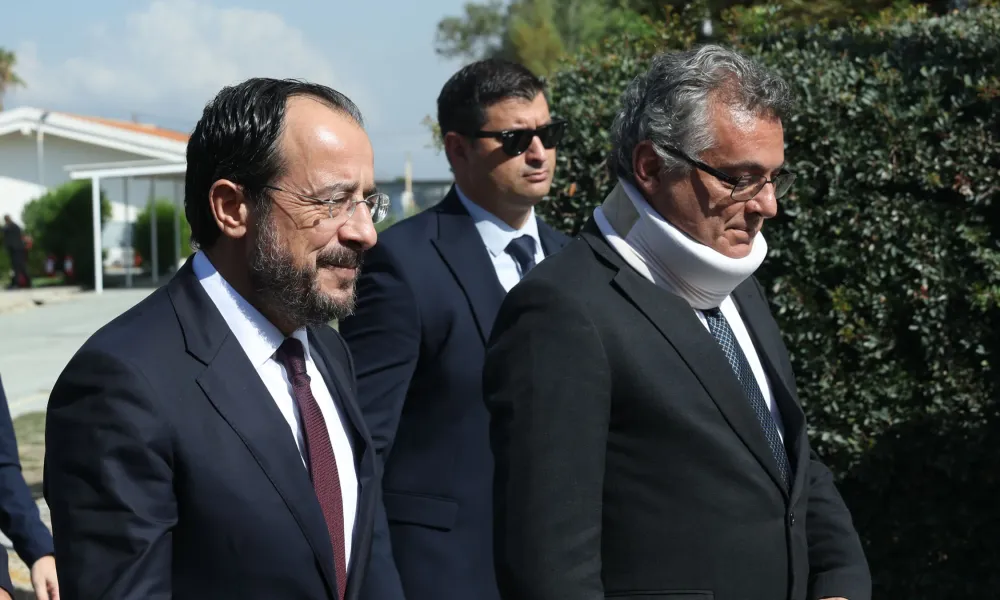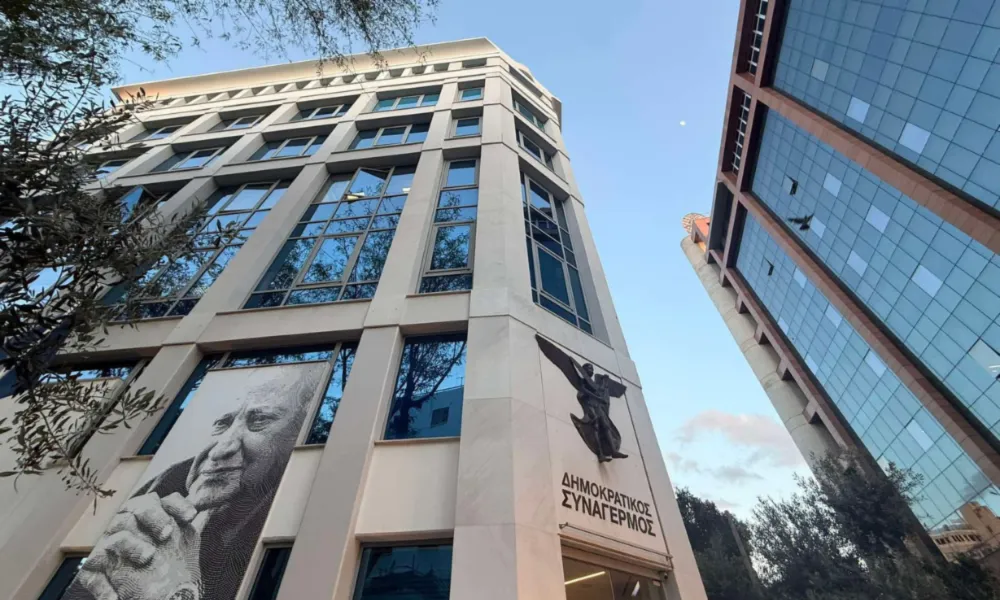

Haris Georgiades’ public declaration that he will not support Averof Neophytou, even if the former DISY leader secures the party’s presidential nomination, has emerged as one of the most serious challenges Neophytou has faced from within the party’s inner circle.
The dispute goes beyond an ordinary internal disagreement. Georgiades, a former finance minister and former deputy president of the Democratic Rally (DISY), has questioned both the methods through which Neophytou has returned to the contest for the party’s nomination and his political credentials to represent it.
His criticism raises two fundamental issues: the political ethics of Neophytou’s approach and whether his positions remain consistent with DISY’s traditional identity.
Georgiades alleges political blackmail
The sharpest criticism in Georgiades’ letter concerns what he describes as “blatant political blackmail”.
Although he does not explicitly name Neophytou as a blackmailer, the implication is clear. Georgiades argues that Annita Demetriou’s withdrawal from the race for the party’s nomination was linked to pressure arising from the prospect of Neophytou running as an independent candidate.
In effect, he accuses his former political ally of using the threat of a split to strengthen his negotiating position and reshape the internal contest.
However, this interpretation conflicts with Demetriou’s own public account. She has said that she withdrew without being subjected to pressure.
The significance of Georgiades’ intervention lies partly in his longstanding proximity to the party’s leadership and his familiarity with its internal dynamics. His relationship with Neophytou, meanwhile, stretches back years and has been shaped by both cooperation and rivalry.
From political allies to rivals
For much of their political careers, Georgiades and Neophytou operated within the same camp, particularly during Nicos Anastasiades’ presidency.
Neophytou, as DISY president, and Georgiades, as finance minister from 2013 to 2019, were two influential figures in the governing establishment.
Their relationship, however, was not free of friction. Serious disagreements emerged as early as 2014 over the banking system, the co-operative banking sector and appointments to financial institutions.
The tensions reportedly became sufficiently pronounced to prompt a personal meeting between the two men in an effort to ease the situation, as reported at the time by Kathimerini.
These disputes exposed the existence of competing centres of political influence within the same governing camp.
The 2018 reshuffle and the Christodoulides factor
A pivotal episode came during the 2018 cabinet reshuffle.
Georgiades had hoped to move from the Finance Ministry to the Foreign Ministry. Instead, he remained in his existing post, while Nikos Christodoulides was appointed foreign minister.
According to an earlier report by Politis, Neophytou intervened in favour of Christodoulides’ appointment, leaving Georgiades to continue managing the politically difficult co-operative banking crisis.
Political interpretations at the time linked the decision to efforts to contain Georgiades’ growing influence. The then finance minister was widely regarded as having ambitions beyond his ministerial role and towards the party’s future leadership.
This does not establish that there was a coordinated plan to sideline him. It does, however, provide context for a relationship in which cooperation coexisted with competition.
On 7 October 2026, Georgiades publicly acknowledged in an interview with Phileleftheros that seeking a move to the Foreign Ministry had been a mistake.
The current confrontation therefore has a longer history, although it cannot be explained solely by past disagreements.
From backing Neophytou to rejecting him
Perhaps the most striking contradiction in the dispute is Georgiades’ previous support for Neophytou.
During the 2023 presidential election, Georgiades did not abandon his party leader. As DISY deputy president, he actively participated in the election campaign despite unfavourable opinion polls and internal tensions.
In November 2022, he had gone further, describing Neophytou’s candidacy in an interview with Politis as an “absolutely necessary choice”.
Four years later, his position has changed dramatically.
Georgiades has sought to explain the shift by arguing that the issue is not Neophytou’s electability, but his political positions and the way he is pursuing the party’s nomination.
That raises an obvious question: what has changed so substantially that a former close ally now considers support for Neophytou impossible?
Georgiades’ letter does not provide a detailed list of policy differences. His criticism appears, however, to be connected in part to Neophytou’s recent call for sanctions against Russia to be lifted.
In a podcast hosted by Phileleftheros, Georgiades also questioned what political common ground DISY could have with parties and movements such as Volt, Direct Democracy and Alma, given discussions about possible cooperation in the presidential election.
His objections suggest that the dispute is not simply about personalities, but also about the alliances and policy positions that should define the party’s future.
Who represents DISY’s political identity?
Georgiades’ intervention has opened a wider debate over the party’s ideological direction.
By arguing that Neophytou has departed from DISY’s traditional political line, Georgiades is effectively claiming the right to define the party’s enduring identity. It is a significant challenge to a politician who led DISY for approximately a decade.
Yet Georgiades’ own political position is not entirely straightforward.
His approach to the Cyprus problem does not fully align with the federalist tradition associated with former president Glafcos Clerides. He has also advocated rapprochement with DIKO, raising questions about how his own political strategy fits within the party’s historical framework.
Under both Anastasiades and Neophytou, DISY has frequently followed a pragmatic and personality-driven approach to politics, with alliances and tactical decisions shifting according to circumstances.
Georgiades is therefore attempting to move the confrontation away from personal ambitions and towards ideology. However, he has yet to establish conclusively that he himself represents a more authentic expression of DISY’s traditional identity.
Resignation adds to the political symbolism
Georgiades’ stated intention to resign as president of the Glafcos Clerides Institute has added another layer of symbolism to the dispute. His resignation was not accepted by DISY president Demetriou.
The institute is associated with the political legacy of the party’s founder. Georgiades’ attempted departure therefore reinforces his argument that the disagreement concerns principles rather than personal preferences.
Nevertheless, questions remain over whether the confrontation is driven entirely by political convictions or whether it also reflects longstanding grievances.
The two possibilities are not mutually exclusive. A genuine disagreement over principles can coexist with personal resentment, while previous clashes do not in themselves prove that the current dispute is an act of political revenge.
Georgiades previously bore the political cost of difficult government decisions, while Neophytou retained control of the party leadership. That imbalance may help explain the tensions, although it does not establish the motives behind the current intervention.
There has also been speculation that Georgiades’ position may have been discussed with Anastasiades, but no evidence has been presented to substantiate this.
Christodoulides could benefit from the dispute
Politically, Georgiades’ intervention could indirectly strengthen President Nikos Christodoulides’ position within DISY.
Anastasiades has argued that, if the party’s candidate fails to reach the second round of the presidential election, DISY should support the incumbent president.
Georgiades has gone further by ruling out support for Neophytou from the outset, regardless of whether he secures the party’s nomination. His declaration that he would not vote for Neophytou “even with a gun to his head” underlines the depth of his opposition.
The intervention could therefore complicate efforts to unite the party behind whichever candidate emerges from the internal process, while potentially benefiting those advocating support for Christodoulides.
However, the extent to which other party figures share Georgiades’ position remains unclear.
The double ultimatum facing DISY
The most consequential aspect of Georgiades’ intervention is that he is not merely declaring his personal opposition to Neophytou. He is challenging the former party leader’s political suitability in advance, even if party members ultimately endorse his candidacy.
If Neophytou wins the nomination on 28 November, he will have secured internal legitimacy through the party’s democratic process. That would not necessarily guarantee the unity needed for a presidential campaign.
Here lies the central contradiction.
Georgiades accuses Neophytou of exerting political pressure on Demetriou through the threat of an independent candidacy. At the same time, he is warning DISY members that he will refuse to support their choice if they select Neophytou.
In political terms, this risks creating a second ultimatum: while accusing Neophytou of undermining the internal process, Georgiades is signalling that the outcome may not command the support of all those who regard themselves as part of the party’s traditional core.
The question now is whether other party figures will follow his lead before the internal vote or wait until the result is known.
Ultimately, the issue extends beyond who secures DISY’s nomination. It concerns whether the party can emerge from the contest without allowing internal democracy to become a process whose outcome is accepted only by those who win.
The 28 November vote may determine the party’s candidate. Its greater test will be whether DISY can withstand mounting pressure from within, preserve its political identity and maintain enough unity to remain competitive in the next presidential election.