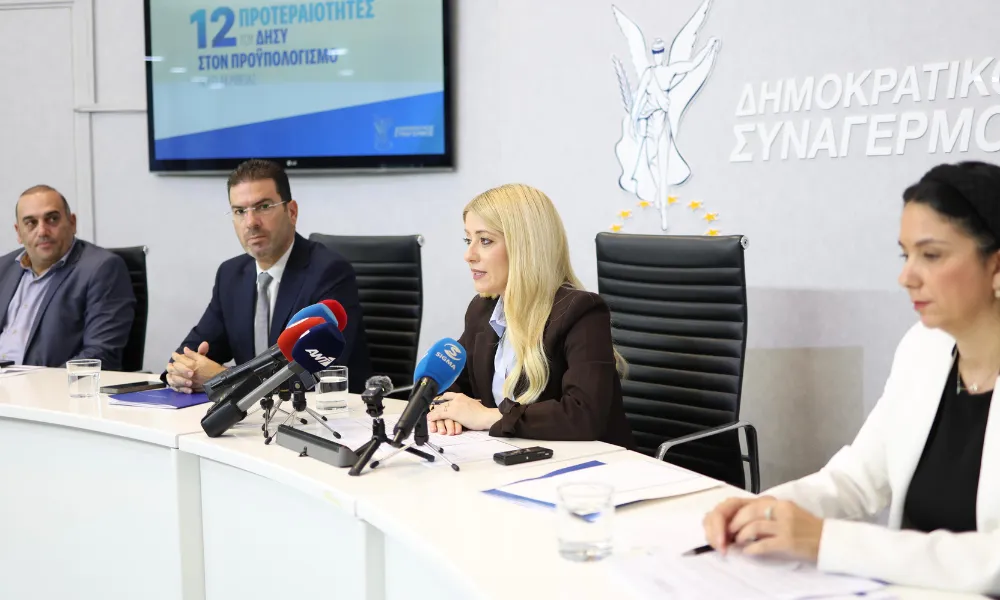

A moratorium on public statements regarding the internal DISY leadership contest came into effect on Thursday after the party's Executive Bureau decided that party officials would not participate in television discussions about internal affairs or post related content on social media.
Their television appearances will be limited to current affairs topics and discussions involving representatives of other parties, ensuring that DISY figures do not find themselves debating each other on the same programme.
According to information obtained by Politis, the decision followed intense behind-the-scenes discussions and disagreements during the meeting.
The immediate trigger was a letter sent by former finance minister Haris Georgiades to party leader Annita Demetriou, informing her that he would not participate in the election campaign if Averof Neophytou secured the party nomination and placing his resignation as chairman of the Glafcos Clerides Institute at her disposal.
Demetriou declined to accept the resignation, but reactions had already begun.
Deputy president Yiannis Karousos described Georgiades' remarks as inappropriate and divisive, while parliamentary spokesman Dimitris Demetriou opposed public endorsements by party officials.
Speaking on Wednesday after the student parade marking Oxi Day, Annita Demetriou acknowledged that party unity was under threat and called for full respect for the verdict of party members.
Similar appeals for restraint had also been made in mid-October following her withdrawal from the leadership race, but with little effect.
The barbs continue
The moratorium applies to party officials, not the two candidates themselves.
At his first press conference on Thursday morning, George Pamborides described Averof Neophytou's proposal to lift energy sanctions against Russia as "nonsense."
Neophytou first raised the issue on 16 October, calling on President Nikos Christodoulides to bring the matter before the European Union. DISY subsequently distanced itself from the proposal, describing it as Neophytou's personal opinion.
Pamborides left some room for interpretation by suggesting the remarks may have been influenced by campaign pressures.
At the same time, he argued that he is "the only one working for unity" and warned that a second defeat similar to that of 2023 would cause "the knitted jumper to unravel."
Earlier in the day, Neophytou announced in a written statement that he would spend the remaining month campaigning directly among party members rather than participating in public exchanges, which he said undermine party unity.
He made no reference to Georgiades' letter.
Pamborides' policy platform
Thursday's press conference marked the first substantial presentation of policy proposals in the internal contest, which until now had largely been dominated by internal disputes and political manoeuvring.
Pamborides identified the Cyprus problem as his top priority, proposed modernising the constitution and introducing measures against corruption, and outlined proposals addressing housing, energy, education and traffic congestion as responses to the rising cost of living.
He described himself as an advocate of a "radical Centre Right" and framed the contest as a clash with what he called a transactional approach to politics.
Asked how his message of change aligned with his own political background, including his involvement with DISY since 1981 and his service as health minister under former president Nicos Anastasiades, Pamborides argued that he had never sought party office before his recent election to parliament and said his tenure at the Health Ministry reflected his political identity.
Two different strategies
Neophytou's statement, combined with the leadership's decision to impose a communication freeze, points to a strategy of limited public exposure until the party vote.
The former DISY leader appears to believe that his image among the party base is already established and that further public interventions would carry more risks than benefits.
Any open confrontation could revive discussion of the 2023 presidential election, when Neophytou finished third as DISY's candidate and the party failed to reach the second round for the first time in its history.
Silence limits the opportunities for such a debate to emerge, while the moratorium ensures that party officials who might fuel that discussion remain absent from television panels.
For Pamborides, the situation is reversed.
The creation of the General Healthcare System (GeSY) during his tenure as health minister provides him with a significant political credential, but not necessarily the momentum required to shift the balance within the party base.
As a result, he is placing greater emphasis on change and confrontation with the existing political model.
For now, a debate between the two candidates focusing on their policy positions has not been proposed.
Yet such a debate would have substance.
On day-to-day issues, the two candidates share common ground in several areas, with Neophytou having devoted his own 16 October press conference to the cost-of-living crisis.
However, differences on economic policy and foreign affairs appear more substantial.
Pamborides views Greece as Cyprus' only genuine strategic partner on the Cyprus issue and argues that the island's relationship with NATO, including the possibility of full membership, should be examined without ideological preconceptions and in conjunction with a settlement.
His rival, meanwhile, has called for a reassessment of energy sanctions against Russia.