
Reporting from Dublin: Filip Polo
President Nikos Christodoulides has set 2027 as the target for Cyprus to become a full member of the Schengen Area, saying the country has already fulfilled all the technical requirements for accession.
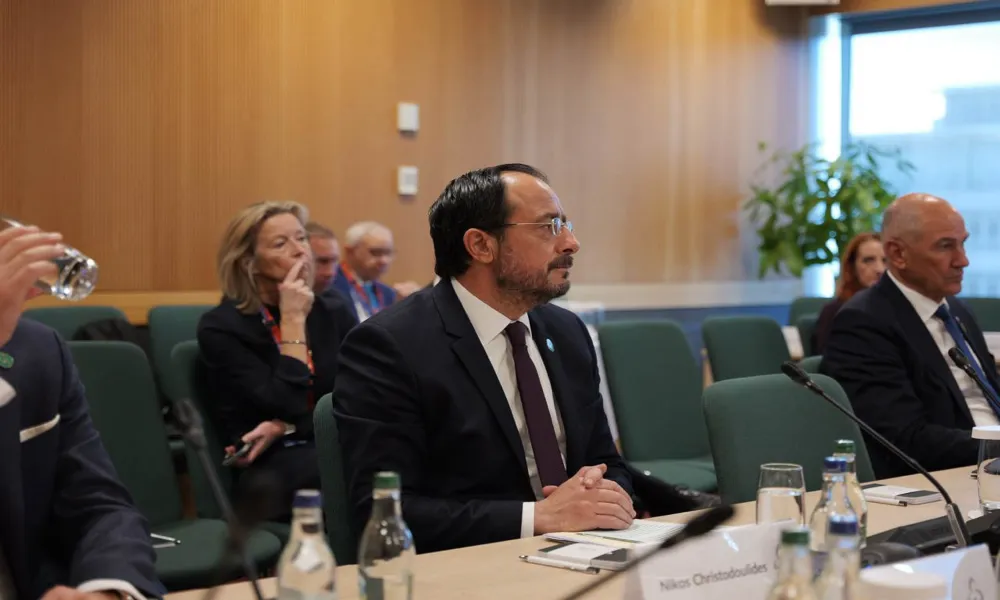
Speaking to Politis on the sidelines of the informal European Council summit in Dublin, Christodoulides also addressed artificial intelligence regulation, the Cyprus issue, EU-Turkey relations, the electricity interconnector project and European representation in discussions on Ukraine.
Cyprus awaits political-level decision on Schengen
Christodoulides said the Republic of Cyprus had completed all the technical requirements for full Schengen membership two years ago, adding that the country was not facing secondary migration flows.
"All the facts are there, and we want the Republic of Cyprus to become a Schengen member state as soon as possible," he said in response to a question from Politis.
Asked about the progress of the accession process, he said it was moving forward as planned, with a relevant working group meeting in Brussels on Friday. Cyprus is now waiting for the issue to be addressed at political level, which he hopes will happen as soon as possible.
He said Schengen membership would strengthen the country's security while confirming Cyprus's place at the heart of European integration.
"As a country that truly believes in European integration and European unification, we want to be at the core of the European Union. Just as we are in the euro, we also want to be in Schengen," he said.
AI must protect democracies and children
Artificial intelligence is among the main issues on the agenda of the informal European Council summit, marking the first time the subject has been discussed at the level of European leaders.
Christodoulides said the EU must make use of the technology's potential while establishing an institutional framework to protect democracies, societies and children.
He expressed particular concern about the malicious use of AI to influence electoral processes and results, referring to recent incidents involving schools and developments surrounding elections in Romania and other countries.
With several European countries due to hold elections in 2027, he said it was essential to ensure that malicious actors could not use artificial intelligence to influence voters' choices.
"We should not simply analyse these malicious actions after they happen. We need to have a framework in place to prevent such actions from taking place," he said.
He stressed that governments had a responsibility to inform citizens and introduce preventive measures.
Christodoulides also welcomed the participation in the summit's discussions of the head of an artificial intelligence company and a Nobel Prize-winning physicist, who could demonstrate the technology's practical potential in science, medicine and other fields.
Cyprus adopts first national AI strategy
The President also referred to the adoption of Cyprus's first national artificial intelligence strategy, covering the period 2026-2032, and the fourth intergovernmental summit between Cyprus and Greece.
The summit will bring together 11 ministers and deputy ministers from Cyprus and 13 from Greece, under the leadership of the two countries' prime ministers. Discussions will examine how artificial intelligence could affect all areas of governance.
He noted that technology was a growing sector of the Cypriot economy, currently accounting for approximately 15% of GDP.
Christodoulides also announced that he would travel to the United States at the end of November to attract more companies, particularly in the technology sector, and encourage Cypriot professionals and talent working abroad to return home.
Cyprus issue: Awaiting date for trilateral meeting
On the Cyprus issue, Christodoulides said a specific date for the trilateral meeting was expected to be set following the return of the United Nations Secretary-General from the Philippines.
He said the meeting was expected to focus on two main objectives: announcing further positive developments concerning confidence-building measures, methodology and working arrangements, and setting a specific date for an expanded conference.
The stated aim, he reiterated, was to resume negotiations from the point at which they were interrupted.
Asked whether he was optimistic about the upcoming contacts in Ankara, Christodoulides answered in the affirmative. He said he remained in regular contact with the UN Secretary-General's special envoy and expected to speak with him both before and after the envoy's visit to Turkey.
Progress in EU-Turkey relations depends on Cyprus issue
Referring to EU-Turkey relations, Christodoulides said he had held a telephone conversation with the European Commission's Executive Vice-President, following his earlier discussion with the President of the European Council.
He stressed that the Republic of Cyprus's position was clear: it wanted positive developments in relations between the European Union and Turkey, but these could only come about if there was substantive progress on the Cyprus issue.
"We want to see positive developments in EU-Turkey relations, but such developments can only take place if there is progress on the Cyprus issue," he said.
Electricity interconnector surveys continue
Christodoulides also addressed developments surrounding surveys for the electricity interconnector project, saying that, despite what he described as a verbal action by Turkey, seabed surveys were continuing as normal.
He said the situation was being monitored continuously in cooperation with France and Greece and had also been discussed with the President of the European Commission.
He underlined that the project was of common European interest and had received €657 million in EU funding, adding that further European funding had not been ruled out.
The President also said European leaders would be briefed during the summit on the latest developments in discussions taking place in Abu Dhabi.
EU representation in Ukraine discussions
Finally, Christodoulides referred to discussions at the informal summit about how the European Union should be represented in negotiations concerning Ukraine.
He said two approaches had emerged among member states.
The first holds that the EU should be represented exclusively by its institutions: the President of the European Council, the President of the European Commission or the High Representative.
The second proposes a mixed arrangement involving both EU institutions and selected member states.
Christodoulides said Cyprus had no objection to either approach, although he believed the participation of member states could add value to the process.
He clarified that no final decision was expected at the informal summit, noting that the matter was already being discussed by a relevant working group in Brussels.