


The recent poll on the 2028 presidential elections came exceptionally early in the political cycle to draw any conclusions about the range of potential or hypothetical candidates. In practice, it has society consuming poll findings with no real candidates, apart, of course, from Nikos Christodoulides himself. The current president has long insisted that it is too early for any discussion of the 2028 elections. His government, however, cannot treat political reality as though the countdown to the next contest had not already begun.
The president’s public statements, his moves on the party front, the whole pattern of appointments to key posts and the systematic promotion of government announcements combine into a picture that sits uneasily with the impression that 2028 will only concern the Presidential Palace once 2027 arrives. In practice, the election battle has already begun, and the first to make sure he is in it is the president himself, along with his circle. There is nothing paradoxical about preparing for a second term. The paradox lies in his attempt to appear as the last person interested in the elections, while his political moves, his government’s decisions and the relationships he is trying to build with the parties, or above all his efforts to find out what they are thinking and planning, point to a strategy with a clear electoral horizon.
Questions of ethics
The questions this first poll raises concern its ethics rather than its objectivity. It is no exaggeration to conclude that, in practice, it reinforces a sad reality of modern political life: the premature and almost obsessive transformation of governance into the instrument of a permanent, never-ending election campaign. At a time when the Cyprus problem is faltering with no real prospect and major social challenges call for bold reforms, the political scene is trapped in a cycle of showmanship and tactical manoeuvring.
The fact that names and scenarios for 2028 have been discussed for so long exposes the absence of a long-term vision, and not only in the government camp. For now, Christodoulides is trying to project strength, and he is succeeding. Yet even on the findings of an early poll that features people still in the realm of the hypothetical, those who may or may not end up as candidates, the gaps between the likely main contenders are far from wide or reliable. Every move the president makes is frequently read as aimed at the domestic front and at accumulating political capital ahead of the run-off in 2028. When the ultimate goal is simply to stay in power for another five years “at any cost”, the price is paid by the country itself, which remains stagnant and stuck in dead ends.
The Cyprus problem and introspection
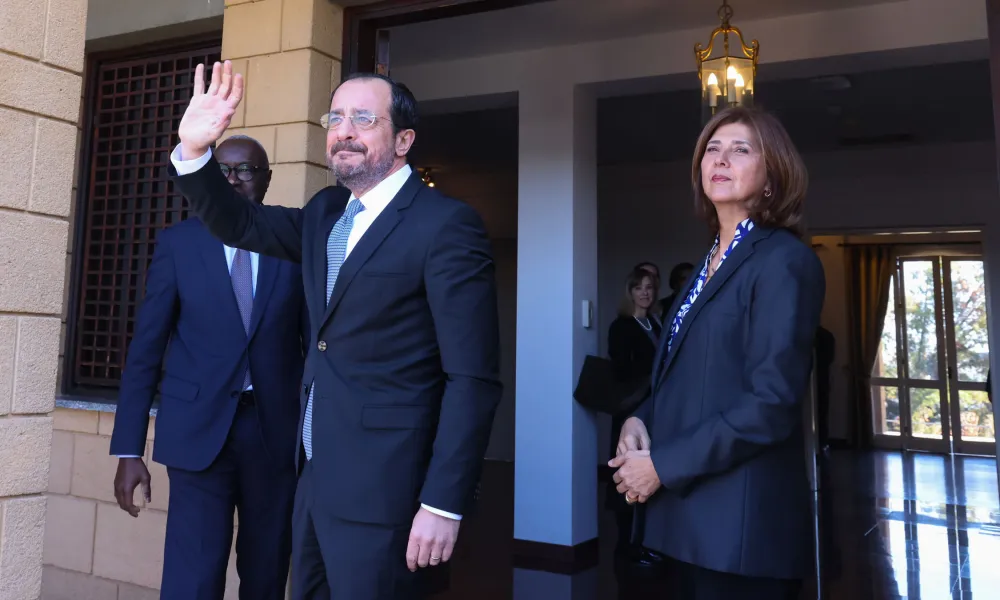
The clearest evidence of this introspection lies in the handling of the Cyprus problem. At a time when the UN secretary-general’s envoy, María Ángela Holguín, is sounding the alarm with a final warning that if nothing happens on the Cyprus problem, the secretary-general’s report will record exactly that “nothing”, Nicosia’s response often revolves around a communications microcosm. Last Monday’s agreement to open two crossing points, Louroujina–Lymbia and Kambos–Xeros, along with a few other very low-impact moves, is being presented as a historic breakthrough. After years of inaction, however, these are elementary steps that should have been taken a decade ago, had the political will existed.
The lack of boldness on substantive confidence-building measures that could genuinely change the climate, such as making use of the Green Line, island-wide mobile telephony or large-scale environmental projects, reveals an agenda that avoids political risk. A telling example is the handling of invitations and contacts at European level, such as the president’s recent references to the EU’s contacts through Raffaele Fitto and Turkey’s customs union. The circulation of information that often confuses the competences of the European Commission with the intergovernmental decisions of member states is aimed at creating an artificial image of diplomatic momentum.
While the international community clearly indicates that the only path to resuming talks is the unambiguous acceptance of the six points of the Guterres Framework from Crans-Montana, Nicosia often tries to sidestep the substance. In her interview with Politis last Sunday, Holguín put the question plainly: “What is your port of destination?” The public awkwardness and ambiguous positions on the fundamental outstanding issues show that the priority is managing the image rather than making real progress towards a viable settlement. From being five minutes away from a solution at Crans-Montana, nine years later we now find ourselves half an hour away from partition.
A fragile lead
On the domestic front, the president’s strategy currently rests on the weakness of the opposition parties, or their efforts to regroup, though he knows well that the landscape is extremely fluid and fragile. As the latest polls show, the gaps in voting intention between the incumbent and his potential challengers, above all Disy’s frontrunner Averof Neophytou, are far from wide. The lead looks fragile, as the wear and tear of government begins to show in the numbers, suggesting that the president lacks the comfort and momentum he enjoyed in 2023.
In the crucial second round, the equation becomes even more demanding. The confirmation of Disy’s candidate after the party’s internal process at the end of the month, and the candidate Akel chooses, will determine how voters shift. A united or more cohesive Disy party machine facing a president who relies on temporary and fragile alliances changes the terms of the game dramatically. Precisely because the balance is so delicate and the numbers so uncertain, resorting to communication tricks and demagoguery becomes the last refuge of a president who may still be able to manage impressions but cannot offer real solutions to the country’s real problems. Dependence on circumstantial balances and the lack of a solid reform agenda leave the current government highly vulnerable to future shocks, turning the prospect of re-election into a genuine political test.
Boldness or games
Political responsibility towards the future of a country that remains divided, and of a society that is anxious, is anything but a communications trick. For a president to devote himself from the start of his first term exclusively to planning his next election victory, deploying communication and demagogic tactics that touch on the country’s future, amounts in essence to political poverty.
Christodoulides needs to understand that history will judge him on whether he dared to break down the walls, look the Cyprus problem in the eye and deliver solutions to citizens’ real problems, and that his handling of early poll findings or communications surprises will count for little. Without that leap, power for power’s sake becomes an empty letter.