


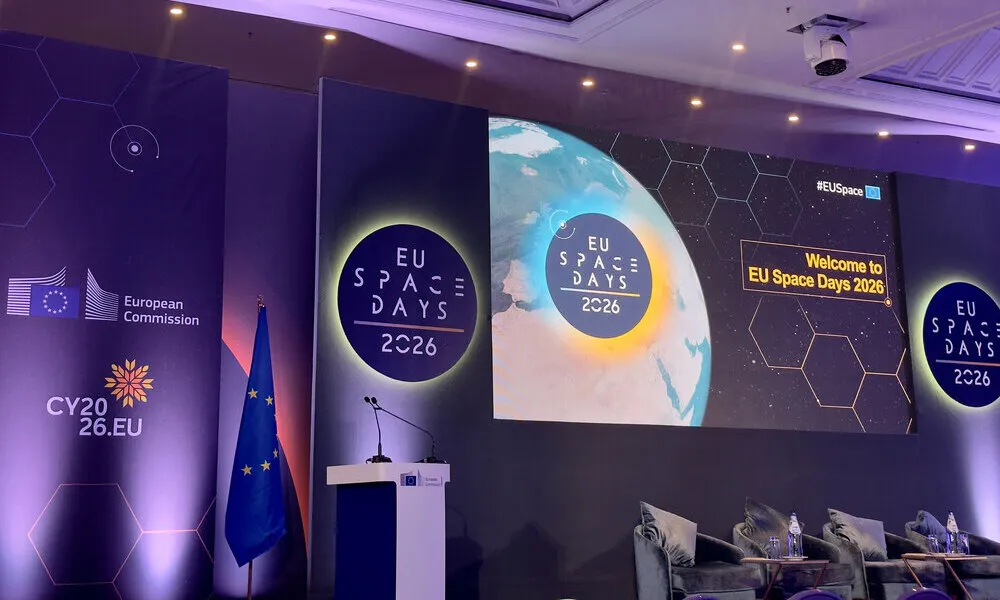

Europe must move faster to secure its strategic autonomy in space as geopolitical competition, security threats and funding pressures intensify, senior EU and space agency officials warned on Tuesday at a high‑level conference in Cyprus.
“What once was a frontier of exploration has become also a critical arena of competition, opportunities, and vulnerabilities,” said Javier Benedicto Ruiz, Director of Navigation at the European Space Agency (ESA), speaking at EU Space Days 2026 in Nicosia.
Ruiz said Europe’s security and resilience are now directly tied to space capabilities, warning that other global powers are investing heavily in defence and dual‑use technologies. “Without space, Europe cannot be autonomous,” he said, calling for a coherent European approach that links security needs with industrial development.
The two‑day conference is being held under the Cyprus Presidency of the Council of the European Union and brings together officials from the European Commission, ESA, the EU Agency for the Space Programme (EUSPA), industry representatives and researchers.
Space getting a bit crowded
During a panel titled “From Earth to Orbit: Flying the EU Flag Higher”, speakers outlined Europe’s priorities in an increasingly congested and contested space environment, where civil, commercial and military interests are increasingly intertwined.
From the European Commission, Christoph Kautz, Director for Space Policy, Satellite Navigation and Earth Observation at DG DEFIS, said Europe must ensure its space ecosystem is “future proof” and able to adapt to fast‑moving technological and geopolitical change.
As he noted, “we have to interconnect space with terrestrial systems”, pointing to the rapid evolution of ground‑based infrastructure and the need for space applications to keep pace. He stressed the importance of international cooperation, saying Europe must balance strategic autonomy with openness, working with partners including the United States, India, China and South Korea.
Funding emerged as a central concern. EUSPA Executive Director Rodrigo da Costa said discussions on the EU’s next Multiannual Financial Framework and the European Competitiveness Fund will be critical to ensuring continuity beyond 2028 for flagship programmes such as Galileo, Copernicus and GOVSATCOM, as well as new initiatives under development.
“We need a new programme that starts from 2028,” da Costa said, adding that Europe must secure “robust supply chains” and technological sovereignty in the space sector. While political support for Europe’s space ambitions exists, he said “the most important discussion will be the one on the budget”.
Space sovereignty
Opening the conference, Cyprus Deputy Minister of Research, Innovation and Digital Policy Nicodemos Damianou said Europe must accelerate efforts to strengthen space sovereignty through investment, regulatory clarity and closer coordination among member states.
“Space is at the centre of everything that matters for Europe: competitiveness, security, resilience, and strategic autonomy,” Damianou said, noting that space systems underpin navigation, telecommunications, disaster response, financial services and digital connectivity.
He pointed to the rapid growth of the global space economy, saying it has already surpassed €500 billion and is projected to exceed €1.5 trillion within a decade. Europe, he warned, risks falling behind unless it moves faster to turn innovation into industrial and strategic capacity.
Damianou highlighted work under the Cyprus Presidency on the proposed EU Space Act and future funding structures, saying a compromise text has already been tabled, while talks continue on long‑term financing and flexibility for future programmes.
Security concerns also featured prominently. Cypriot MEP Costas Mavrides warned that space has become “a critical arena of competition, opportunities and vulnerabilities”, citing advances by Russia and China in anti‑satellite and dual‑use capabilities.
The conference continues on Wednesday with sessions on defence‑related space applications, quantum communications, Earth observation and Europe’s broader push for strategic autonomy.
Source: CNA


