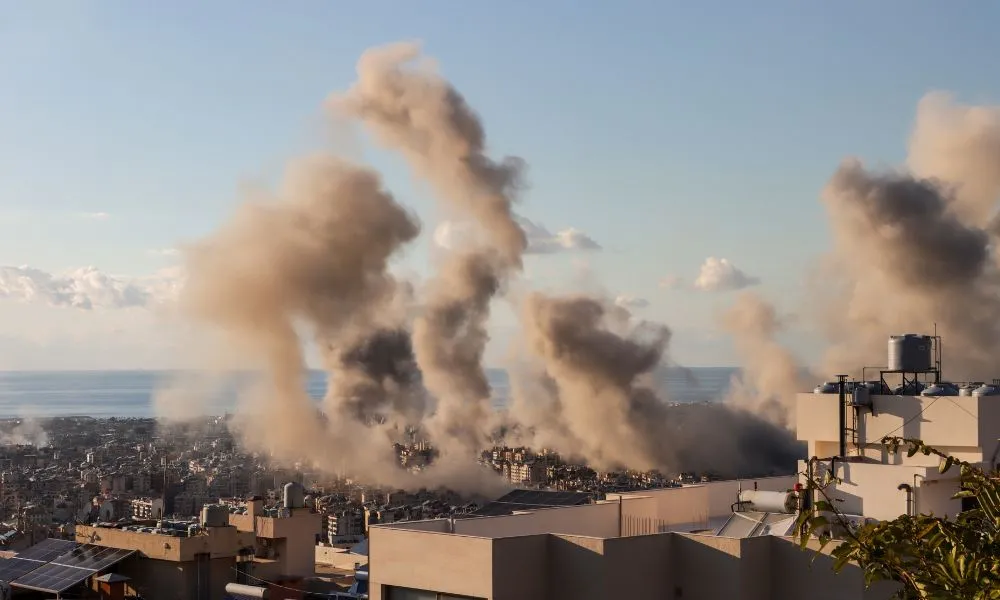


Israeli strikes hit a building in Beirut's southern suburbs on Sunday, with the Israeli military and Hezbollah continuing to exchange fire in Lebanon even as American and Iranian officials signalled they were close to a wider deal to end the conflict, of which Lebanon remains a key front, ABC News reported.
Israeli Prime Minister Benjamin Netanyahu said the Beirut strike was in response to Hezbollah fire into Israeli territory, adding that Israel would not tolerate such attacks. According to the report, Hezbollah said it had launched a drone attack early on Sunday against Israeli forces operating in the southern Lebanese town of Houla, while the Israeli military reported several incursions by "hostile aircraft" along the northern border overnight, with no damage or casualties. The Israeli military also issued new evacuation warnings for residents of 13 towns and villages in southern Lebanon ahead of further strikes.
The continued exchanges come as Washington and Tehran work towards signing a memorandum of understanding that Donald Trump has said could be finalised as early as Sunday, though Iranian officials have been more cautious about the timing. A senior Iranian official has set out the contents of the draft memorandum to Reuters, describing a text that covers Iran's nuclear programme, the reopening of the Strait of Hormuz and US sanctions relief, with a fuller agreement to be negotiated over the 60 days following any signature by the two sides.
According to the official, the draft text provides for Iran to immediately reopen the Strait of Hormuz to all commercial shipping, while the US would lift its naval blockade on Iranian ports, with that process beginning as soon as the memorandum is signed and completed within 30 days.
On the financial side, the draft reportedly commits Washington to imposing no new sanctions on Iran while a final deal is being negotiated. Once a final agreement is reached, all US and UN sanctions on Iran would be lifted according to an agreed timetable, and the US would waive oil sanctions for a specified period, allowing Tehran to sell oil and receive the proceeds. The draft also includes a US commitment to release $25 billion of Iran's frozen assets, through a combination of direct transfers, cooperation with regional states and financial credit lines, while Washington, working with regional allies, would prepare a reconstruction and development plan for Iran to be agreed with Tehran within 60 days.
On the nuclear file, the draft has Iran committing not to produce or acquire nuclear weapons. Pending a final agreement, Iran would maintain its nuclear programme at its current status, without further uranium enrichment or expansion of its facilities. The US, for its part, would agree to allow Iran to dilute its stockpile of highly enriched uranium on Iranian soil under a future comprehensive agreement. The substance of Iran's nuclear programme, including its enrichment activities and how its enriched uranium stockpile is handled, would be negotiated within 60 days of the memorandum and addressed in the final agreement.
Whether Sunday's strikes on Beirut affect that process is not yet clear. Israel has continued operations against Hezbollah in Lebanon even during previous ceasefire periods this year, including a major wave of strikes on Beirut in April that Netanyahu said at the time fell outside the terms of a ceasefire reached with Iran, on the grounds that the war with Hezbollah was separate from the war with Tehran. Reports on the draft US-Iran memorandum suggest a pause in Israel-Hezbollah fighting forms part of the terms under discussion, though Israeli officials have separately voiced concern, according to Israeli media, that the draft defers substantive discussion of Iran's nuclear programme to a second phase of talks.
Source: Reuters