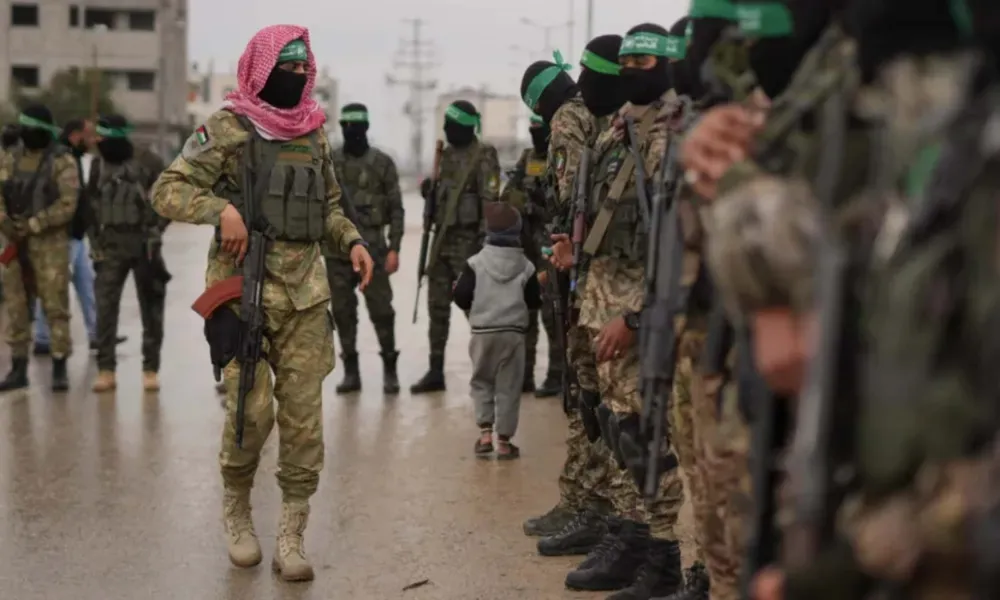

Hamas has announced the dissolution of the governing body that administered the Gaza Strip for nearly two decades, clearing the way for a technocratic committee to assume responsibility for civilian governance in the Palestinian territory.
The decision marks a significant political shift for Hamas, which has governed Gaza since 2007, when it took control of the territory from Fatah following its victory in the Palestinian legislative elections the previous year.
According to reports by Al Jazeera, Hamas has repeatedly signalled since the ceasefire brokered by the United States came into effect last October that it is willing to step back from the day-to-day administration of Gaza. However, the issue of the group's disarmament remains unresolved.
In a statement, Gaza's Government Media Office said that Mohammad al-Farra, head of the Government Emergency Committee, had submitted his resignation and formally dissolved the committee "as a demonstration of the seriousness of these measures, in implementation of the agreed arrangements and to facilitate the administrative transition process."
Path cleared for new governing authority
A Hamas official said the group wants the National Committee for the Administration of Gaza (NCAG) to be installed as soon as possible. The body is envisaged under a US-backed plan as the future administrative authority for Gaza.
"Hamas has taken a new step, as it will no longer lead the administration of the Gaza Strip, so that there are no pretexts for the occupying power, which continues its aggression and war of extermination," Hamas spokesperson Hazem Qassem told AFP.
He also expressed hope that the NCAG would soon be allowed to enter Gaza, adding that Hamas is prepared to transfer its governmental powers to the committee to ensure a successful transition.
Political, not military, withdrawal
Reporting from Gaza City, Al Jazeera correspondent Hani Mahmoud described the announcement as a significant political concession intended to advance negotiations and facilitate the arrival of the technocratic committee following months of deepening administrative uncertainty.
He stressed that the move does not mean Hamas is abandoning its political or military presence in Gaza, but rather that it is withdrawing from the direct management of civilian affairs.
Support for the transition
Ali Shaath, head of the NCAG, welcomed Hamas' decision, saying in a social media post that the committee is "fully prepared to assume its national responsibilities once the necessary resources and capabilities are made available."
Meanwhile, Nikolay Mladenov, head of the Board of Peace for Gaza, the US-backed body expected to oversee the NCAG's work, said the decision highlighted the importance of concluding ongoing discussions on a roadmap for implementation.
He described the move as "the bridge between declarations and implementation" and said that once agreement is reached on the remaining provisions, the NCAG will be ready to begin operating.
Israeli opposition remains a major obstacle
The NCAG has remained outside Gaza for months, with reports indicating that Israel opposes allowing the body to enter the enclave.
Israel has repeatedly ruled out any scenario under which Hamas would continue governing Gaza. At the same time, it has so far rejected the prospect of the Palestinian Authority, which exercises limited self-rule in parts of the West Bank, assuming direct control of the territory.
The future administration of Gaza therefore remains one of the central unresolved issues in ongoing diplomatic efforts aimed at securing a lasting post-war arrangement for the enclave.
Source: Al Jazeera