
Hamas has confirmed an agreement providing for its disarmament in the Gaza Strip under the second phase of the ceasefire with Israel. The move is a central element of US President Donald Trump’s peace plan and follows weeks of negotiations in Egypt.
What the agreement includes
The agreement marks the beginning of the second phase of the ceasefire signed by Israel and Hamas in October 2025, following two years of war.
Hamas made “concessions for the good of our people and the Gaza Strip, in order to save them from death and displacement”, Ghazi Hamad, a member of the group’s negotiating team, told AFP.
During the first phase, which was completed in January, the remaining Israeli hostages held in Gaza after being abducted during Hamas’s unprecedented attack on Israel on 7 October 2023 were released in exchange for Palestinian prisoners held in Israeli jails.
According to Hamas, the new agreement provides for the gradual withdrawal of Israeli forces from the Gaza Strip. The withdrawal is linked to the group’s disarmament, a process in which Israel will not be involved, and the deployment of an international force.
“This is a comprehensive framework whose elements must remain interconnected,” Hamad said, adding that other armed groups operating in Gaza would also have to be dissolved.
Trump said the agreement provides for the “complete disarmament of Hamas and any other armed group in Gaza”.
Who will oversee the process
The Peace Council, a body established by Trump, will play a central role in implementing the agreement.
According to Hamas, the National Committee for the Governance of Gaza, a group of Palestinian technocrats appointed by the Peace Council to oversee the territory’s reconstruction, will be solely responsible for registering and storing weapons.
“Israel will not intervene in the issue of disarmament. The National Committee is the only body that will undertake this task,” Hamad said.
A Hamas official said the group was relying on the mediators and the Peace Council to ensure that Israel fulfilled its commitments.
An Israeli political source, however, told AFP on Thursday that there would be no Israeli withdrawal from the “yellow line” until Hamas had been fully disarmed and Gaza completely demilitarised.
The “yellow line” is Israel’s term for the boundary separating the area controlled by Hamas from the part of Gaza under Israeli military control.
Following the withdrawal of Israeli forces, the newly established International Stabilisation Force will bring together multinational troops operating under the Peace Council. Trump said the force would work with a new Palestinian police service to maintain security in Gaza.
What happens next
Hamas said it would discuss the details of implementation with mediators from Egypt, the United States, Qatar and Turkey. The sides are expected to agree on a timetable, a process Hamas believes will take at least two weeks.
A meeting of the mediators is expected to take place in Cairo shortly.
“We must agree on every detail: how the agreement will be implemented, when it will be implemented and the mechanisms that will allow its implementation. All this will happen in the coming days,” Hamad said.
He warned that the process remained conditional on Israel meeting its obligations.
“The agreement contains a clear provision stating that Israel must commit to respecting and implementing its obligations. If Israel does not implement the agreement, neither will we,” he said.
Peace Council head Nikolay Mladenov said the implementation and verification process must be effective, adding that the Israeli withdrawal must proceed alongside disarmament.
The current situation in Gaza
Despite the ceasefire taking effect in October 2025, Israel has continued to carry out almost daily strikes on Gaza and retains control of around 60% of the territory.
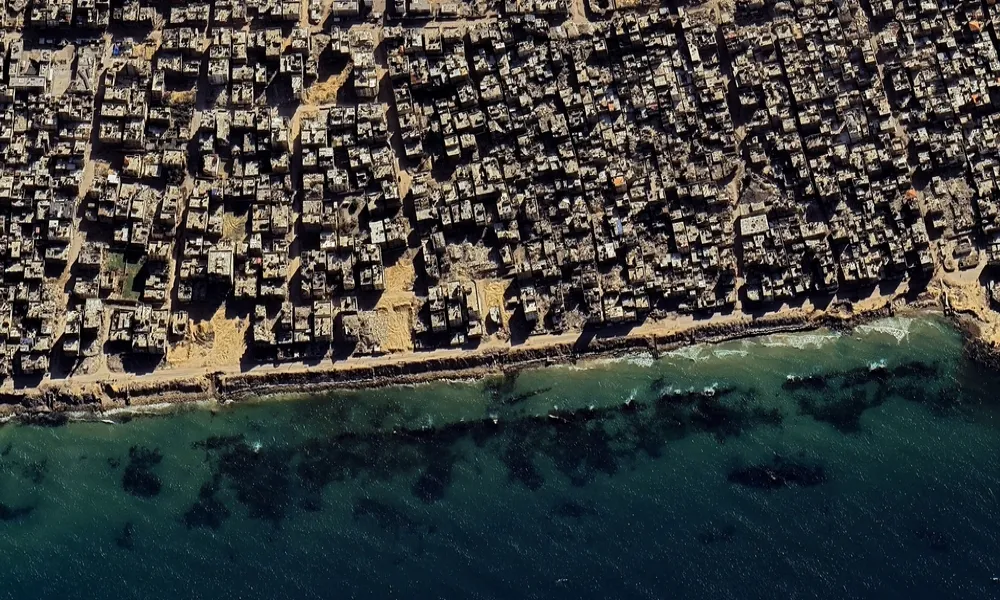
Tens of thousands of people remain in tents after two years of war left much of Gaza in ruins, while the population continues to face a severe humanitarian crisis.
At least 1,124 Palestinians have been killed since the ceasefire began, according to the Palestinian Health Ministry.
Over the same period, Israel has reported the deaths of five soldiers and one contractor.
Source: AMNA