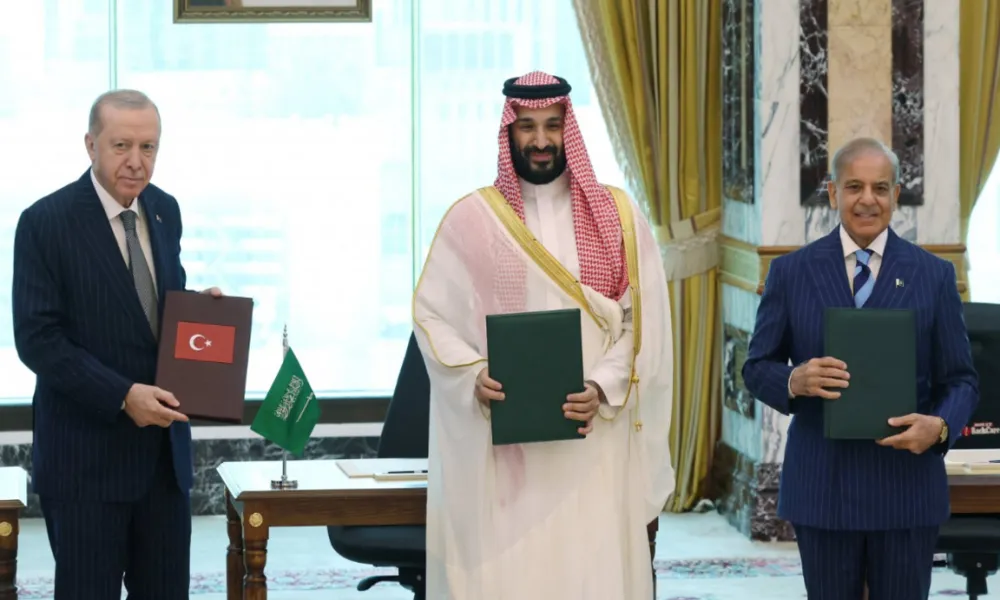

A mutual defence agreement involving Turkey, Pakistan and Saudi Arabia could strengthen Ankara’s strategic depth and contribute to a broader regional security architecture, according to international relations expert Charalambos Chrysostomou.
Speaking to the Cyprus News Agency, Chrysostomou said the development should not be underestimated by Greece and Cyprus, although he stressed that it does not yet amount to a NATO-style military alliance.
A political message on collective defence
The agreement’s full operational scope remains unclear, including whether it would require automatic military involvement during a crisis. However, Chrysostomou said the provision treating an attack on one of the three countries as an attack on all carries a clear political message.
“Turkey, Pakistan and Saudi Arabia want to be able to rely more on one another and less on a single external protector,” he said, adding that this could alter the regional balance.
He highlighted the combined capabilities of the three countries. Saudi Arabia brings economic and energy power, Turkey has strong armed forces and a growing defence industry, while Pakistan has a large military and a nuclear deterrent.
According to Chrysostomou, the agreement reflects a wider climate of strategic uncertainty across the Middle East, the Gulf and South Asia, where regional powers are seeking greater autonomy and more diverse security partnerships.
Saudi Arabia diversifies its partnerships
Chrysostomou said Saudi Arabia is not abandoning its relationship with the United States but is seeking a wider range of strategic partners.
Riyadh is simultaneously maintaining ties with China, India, Turkey, Pakistan and Europe. This means that US influence in the region remains significant, he said, but is no longer exclusive.
What the agreement means for Cyprus
For Cyprus, the development should be considered primarily in light of the country’s geographic position at the crossroads of Europe, the Middle East, North Africa and the Eastern Mediterranean.
Chrysostomou said the Republic of Cyprus could capitalise on its location through energy, shipping, infrastructure, telecommunications, data centres, maritime security and civil protection, strengthening its role as a European hub in the region.
“The response to the expansion of Turkish influence is not isolation. It is to increase Cyprus’ geopolitical value for as many partners as possible,” he said.
Greece urged to strengthen regional diplomacy
Chrysostomou stressed that the agreement is not directed against Greece, and that there is no indication Pakistan or Saudi Arabia would automatically intervene on Turkey’s behalf in a Greek-Turkish crisis.
However, Athens should not overlook Ankara’s growing strategic depth. Turkey already maintains close relations with Azerbaijan, Qatar and Pakistan, as well as countries across Africa and the Middle East, while retaining a presence in Libya, Syria and the Eastern Mediterranean.
He argued that Greece should respond by strengthening its diplomatic presence rather than attempting to create an “anti-Turkish axis”.
Chrysostomou described it as a “strategic mistake” for Athens to assume that Riyadh has automatically moved into the Turkish camp. Greece should instead seek a place within Saudi Arabia’s expanding network of partnerships while continuing to deepen its strategic relationship with India.
The agreement, he concluded, reflects a broader shift in regional relations, with countries increasingly building multiple and overlapping partnerships across security and economic policy.
Source: CNA.