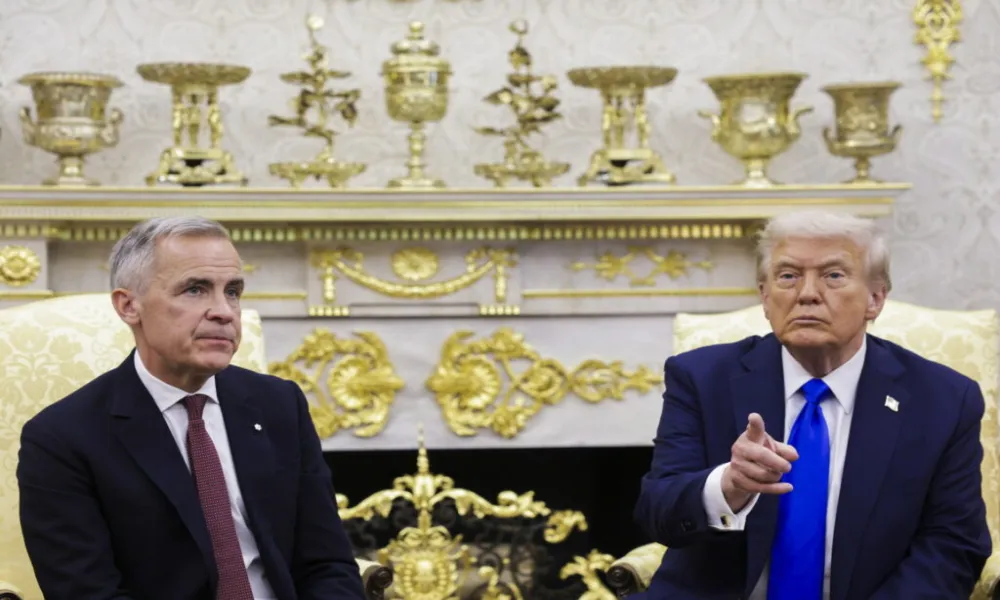

Canadian Prime Minister Mark Carney has announced retaliatory measures targeting American steel and dairy products, after rejecting what he called a bad trade deal proposed by Washington, with relations between the two countries now at their lowest point.
The measures, which will also affect the paper industry, agricultural machinery and the electronics sector, will take effect on 8 September, Carney said at a press conference.
Canada's new tariffs will be almost identical in scale to the American duties that came into force the same day, which apply to roughly 20 billion dollars worth of Canadian imports, including cement and hockey sticks.
After weeks of negotiations, Carney decided on Friday night to end the talks shortly before the White House's deadline expired, in order to avoid what he called a bad deal for Canada. "They were asking for too much and offering far too little," the former central banker said.
Since Donald Trump returned to the White House in January 2025, Canada has been at the forefront of the trade war launched by the American president, who has repeatedly said he wants to turn his northern neighbour into the "51st state" of the United States.
Tensions between the two countries have been building for a year and a half, and the latest round of American tariffs mainly affects products that would normally be protected under the free trade agreement between the United States, Canada and Mexico.
Speaking from Ottawa, Carney said it was clear that Canada was facing a fresh American assault and that the country was effectively under attack in a trade war. He added that America had changed and that Canada could not control the storm coming from Washington.
The Canadian government, which had sought a reduction in tariffs on the sectors hit hardest, including steel, had made goodwill gestures by asking provincial authorities to lift their boycott of American wine and spirits, a central US demand, but without success.
Across the political spectrum in Canada, the decision to break off talks won broad support. "Our courtesy must never be mistaken for weakness. We will always defend ourselves," said David Eby, premier of British Columbia.
The Canadian economy could nonetheless take a heavy hit from the new wave of tariffs, since the United States remains by far Canada's largest trading partner, with exports to the US currently accounting for around 70% of the country's total exports.
Carney sought to reassure businesses by announcing support measures that he said would remain in place for as long as necessary, with further details expected next week.
Since taking office in March 2025, the Canadian prime minister has been seeking to reduce his country's dependence on its southern neighbour by looking for new trading partners in Asia and Europe. He has also launched a series of major projects, chief among them a new pipeline linking Alberta's oil reserves to the Pacific coast, aimed at delivering Canadian crude to Asian markets.
"We are stronger now than we were when the United States started this trade war. More united, more determined, more ambitious," Carney said.
Source: CNA