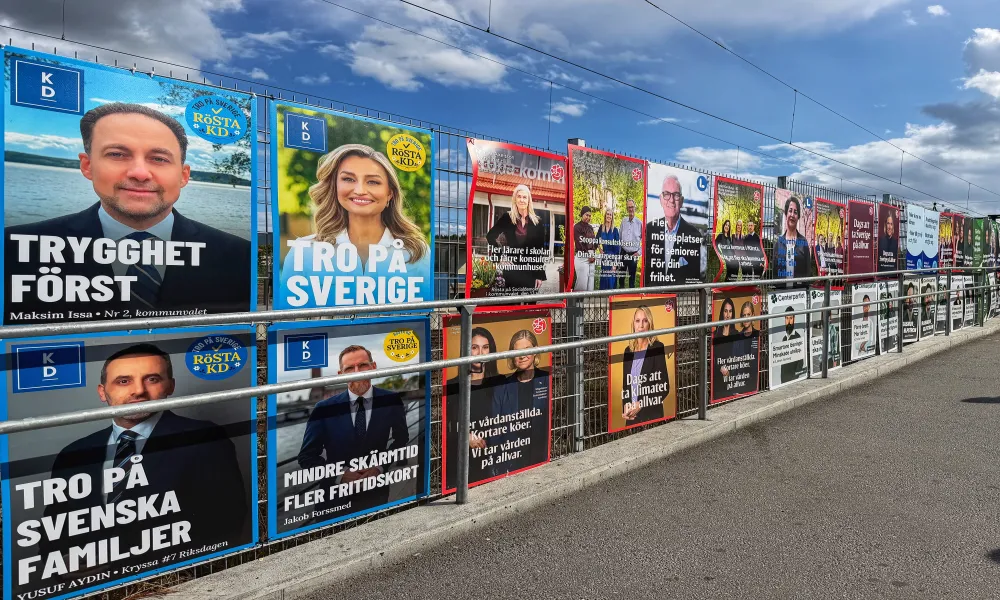

Swedish voters will head to the polls on Sunday in what is expected to be a highly competitive general election, with the centre-left opposition and the governing centre-right bloc separated by only a few percentage points.
For months, polls suggested that the centre-left opposition led by Social Democratic leader Magdalena Andersson was on course for a comfortable return to power.
More recently, however, Prime Minister Ulf Kristersson's centre-right alliance and its parliamentary partner, the anti-immigration Sweden Democrats (SD), have narrowed the gap, making the outcome increasingly uncertain.
"It's a bit of a suspenseful race," Stockholm University political scientist Jan Teorell told AFP.
The latest polls suggest the four parties of the left and centre command around 50% of voting intentions, compared with 47% for the four parties on the right.
Growing inequality takes centre stage
The governing right-wing alliance is campaigning on a platform focused on continuing efforts to combat crime and restrict migration.
Those issues helped bring Kristersson to power in 2022, but analysts say they no longer dominate public concerns to the same extent.
According to Teorell, crime and energy prices have fallen, reducing their prominence in the election campaign.
Instead, debate has increasingly centred on healthcare, purchasing power and growing social inequality.
The centre-left opposition is proposing higher taxes on banks and high-income earners to fund additional spending on healthcare and education while supporting households facing rising living costs.
"I think Sweden has changed. It is much more divided," Hanna Justine Hallborn, a 46-year-old fashion industry employee, told AFP.
"We need to improve the healthcare and welfare system. They have deteriorated in recent years and I think we need to rebuild them."
Andersson has framed the election as a choice about the future direction of Sweden.
She argues voters must choose between a Sweden focused on employment and strengthening its welfare model, or a government in which the Sweden Democrats play a dominant role.
The Sweden Democrats became the country's second-largest parliamentary party in 2022, securing around 20% of the vote.
Could the far right enter government?
If the right-wing bloc wins, the Sweden Democrats are expected to seek ministerial positions for the first time in their history rather than merely providing parliamentary support.
The party is demanding cabinet posts, with migration policy among the areas it hopes to influence directly.
Kristersson has indicated a willingness to allocate ministerial responsibilities to the party should the governing alliance retain power.
The prospect of the Sweden Democrats entering government has intensified debate in Sweden, particularly given the party's origins and its controversial positions on immigration and national identity.
Security concerns shape campaign
The final days of the campaign have also been influenced by security issues.
The anti-extremism foundation Expo, which monitors Sweden's far right, recently reported that a parliamentary employee linked to the Sweden Democrats had repeatedly shared pro-Russian propaganda on social media.
Kristersson responded strongly to the allegations.
"We are in the middle of a war in Europe," he told Aftonbladet. "It is not possible to have people in parliament spreading pro-Russian rhetoric."
Following Russia's annexation of Crimea in 2014 and its invasion of Ukraine in 2022, Sweden joined NATO and has significantly expanded its rearmament programme.
Authorities have also stepped up preparations against cyberattacks, disinformation campaigns and espionage operations frequently attributed to Russia.
Swedish officials have additionally reported repeated incursions involving drones and aircraft over the Baltic Sea region.
Source: CNA