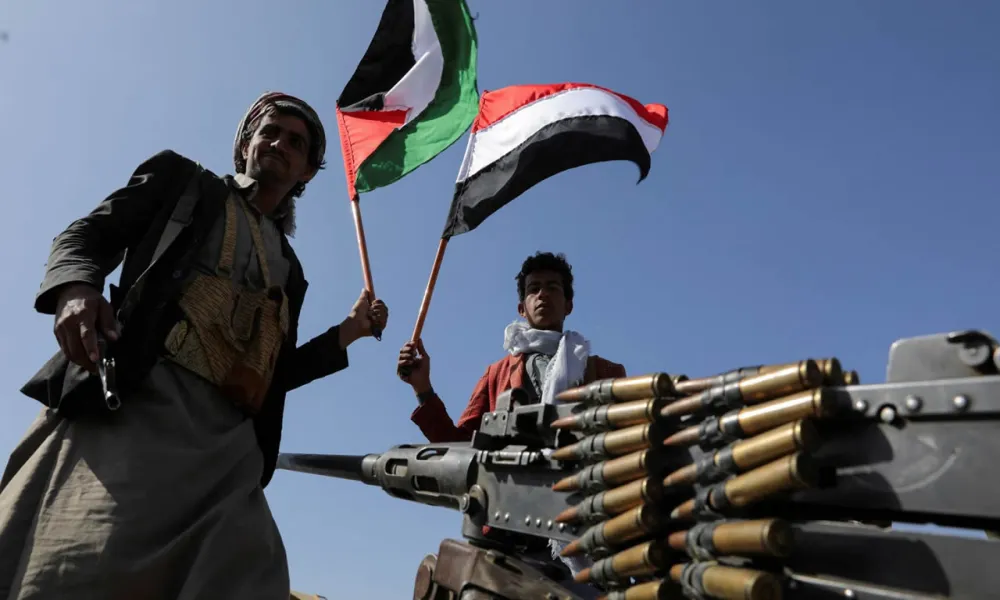

The United States has warned of the possibility of a “rapid escalation” in Middle East hostilities following attacks by Yemen’s Ansar Allah movement, also known as the Houthis, against Saudi Arabia, including an attack targeting Riyadh for the first time in months.
US President Donald Trump, who had been expected to spend the weekend at the presidential retreat at Camp David in Maryland, returned to Washington on Saturday evening. The White House, which has so far remained on the sidelines of the renewed war in Yemen, did not explain the reason for his return.
The move came as fighting between Saudi Arabia and the Iran-aligned Houthis crossed another threshold. The group controls large parts of neighbouring Yemen and is fighting forces aligned with the internationally recognised government, which are supported by a Saudi-led military coalition.
Trump reiterated on Sunday that he was in contact with the Houthis, according to Fox News. A network journalist who spoke with the US president said Trump stated that the group’s leaders had “agreed not to fight against the United States”.
Oil facilities in flames
Powerful explosions were heard twice in Riyadh on Saturday.
AFP journalists reported seeing a fuel tank bearing the Aramco logo burning near the airport.
“This military conflict has the potential to escalate quickly,” the US State Department warned on X.
Washington subsequently announced restrictions on the movement of US government personnel in two Saudi cities: Taif, home to an air base, and Yanbu, a Red Sea port that was targeted by Ansar Allah on Saturday.
Since the 2022 ceasefire collapsed in July, a rapid offensive by Houthi fighters in recent weeks has killed hundreds of people and forcibly displaced more than 110,000 civilians, according to the UN.
The Houthis now control the entire Yemeni coastline along the Red Sea, strengthening their position around the strategically important Bab al-Mandab Strait, which connects Asia and Europe through the Suez Canal.
The fighting and subsequent confrontation with Saudi Arabia have already caused serious disruption to shipping and to the kingdom’s oil exports.
As a result, crude oil remains above $100 a barrel, increasing fuel costs for consumers worldwide, including in the United States, where midterm elections are approaching in early November.
Missile launched at Riyadh
On Saturday evening, the Saudi-led military coalition confirmed on X that Ansar Allah had launched a missile towards Riyadh the previous day, although it said the projectile was “intercepted and destroyed”.
The coalition also accused the movement of attempting to target civilians in several Saudi cities, including Yanbu, a key point for the kingdom’s crude oil exports. It said the attacks had been thwarted.
Ansar Allah, meanwhile, said it had carried out two attacks using missiles and unmanned aerial vehicles.
According to the group, one operation targeted “vital installations in Riyadh”, while the other struck Aramco facilities in Yanbu.
The attack on the Saudi capital was absent from the front pages of the kingdom’s largest newspapers on Sunday.
‘Important psychological threshold crossed’
Andreas Krieg of King’s College London told AFP that the attack represented a “dangerous escalation”, as the Houthis were now striking close to significant civilian infrastructure in one of the kingdom’s most densely populated areas.
“An important psychological threshold has been crossed,” he said.
Until now, the Houthis had primarily targeted oil installations and military bases in southern Saudi Arabia or along the Red Sea coast.
Riyadh had not been threatened since hostilities resumed in July.
The Saudi capital had, however, come under repeated attack during the height of the broader regional war, which began with US-Israeli strikes against Iran on 28 February. Tehran retaliated by targeting Gulf countries allied with the United States and hosting American military bases.
“I heard the alarm, then my windows were shaking,” a 27-year-old resident of northern Riyadh, who asked not to be named, said.
Dispute over alleged Mecca attack
Earlier last week, Saudi Arabia accused Ansar Allah of targeting Mecca, Islam’s holiest city.
The Iran-aligned movement denied the allegation.
In response to continuing Houthi attacks, the Saudi air force has been carrying out daily strikes on areas controlled by the group in Yemen.
Those attacks have so far failed to force Houthi fighters to retreat. Ansar Allah said Saudi forces carried out 28 strikes within 24 hours.
Saudi Arabia, facing growing pressure, is attempting to contain the threat posed by the Yemeni group without being drawn into a full-scale war and has intensified its diplomatic contacts as the confrontation escalates.