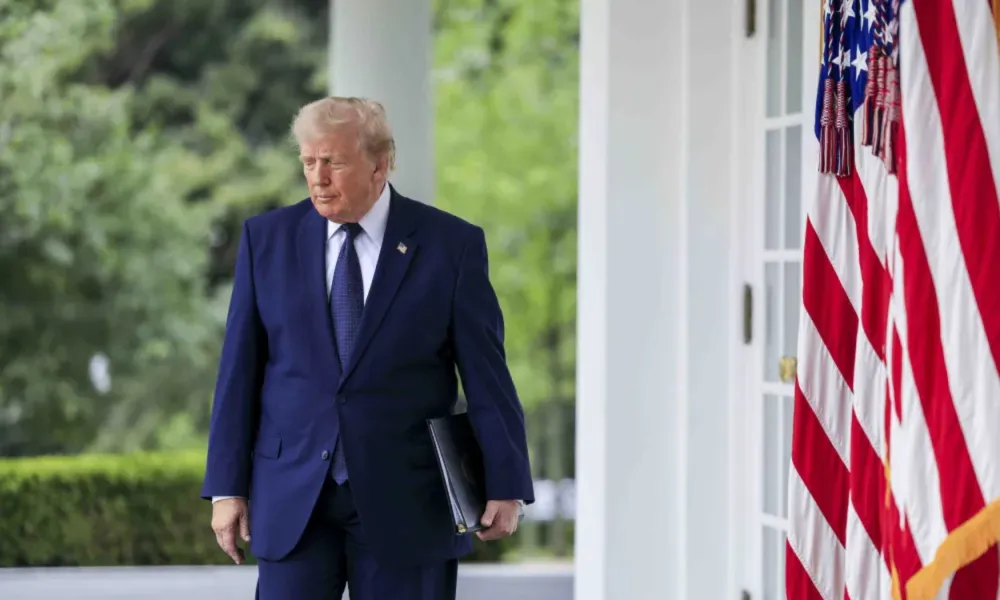

US President Donald Trump rejected an Iranian proposal on Friday to reopen the Strait of Hormuz within seven days, according to the Wall Street Journal, which also reported that he envisages renewed strikes on Iran after the US midterm elections in early November.
Late on Friday night, Trump also reposted on Truth Social a map renaming the strategic waterway the “Trump Strait”.
Citing sources within the administration, the Wall Street Journal reported that Trump remains sceptical over whether Tehran would comply with his demands.
Iran offered to reopen Hormuz within seven days
Iran had earlier submitted a proposal to the United States offering to reopen the strategically important Strait of Hormuz within seven days, saying that “the choice now rests” with Washington.
“The seven-day deadline will begin as soon as the US accepts this plan,” Iranian Foreign Minister Abbas Araghchi said at the UN headquarters in New York.
The reopening of Hormuz has become central to the conflict between Iran and the United States, which began following the US-Israeli attack on the Islamic Republic on 28 February.
Before the war, around one fifth of the hydrocarbons consumed globally passed through the strait without disruption.
Araghchi said the measures required from Washington were not new, arguing that they had already been included in a memorandum of understanding signed by the two countries’ presidents in June.
“If the US agrees to proceed in this way, everything will return to the situation that existed before,” Iranian President Masoud Pezeshkian told CBS News on Friday.
“The process will begin on the day they accept it,” he added.
June agreement collapsed
Trump and Pezeshkian signed the so-called Islamabad Memorandum of Understanding in June, which was intended to provide a path towards ending the war in the Middle East.
The agreement envisaged reopening the Strait of Hormuz and establishing the foundations for negotiations over the sensitive issue of Iran’s nuclear energy programme.
However, the two sides interpreted the agreement differently and it eventually collapsed.
Tehran sought end to hostilities
Among the conditions Iran raised in June was an end to hostilities and an immediate and complete halt to military operations on all fronts.
This included Lebanon, where the Israeli military has been engaged in conflict with the Shiite movement Hezbollah.
Tehran also demanded access to Iranian funds frozen overseas and the lifting of economic sanctions.
Iran’s economy has been under severe pressure from rapidly rising prices, which triggered widespread demonstrations in January before they were violently suppressed.
The country has faced US sanctions for decades, affecting its economy and particularly its international commercial transactions.
Iranian assets abroad have also been frozen since the 1979 Islamic Revolution.
In the absence of official figures, Iranian media estimated in the spring that the frozen funds were worth between $100 billion and $123 billion.
Yemen added to Iran’s conditions
In an exclusive interview with AFP on Tuesday, Revolutionary Guards spokesman Hossein Mohebi said Iran’s conditions now also include an end to hostilities in Yemen.
The expansion of Tehran’s demands reflects the increasingly regional nature of the conflict.
“It is up to America whether it wants this war to end or not,” Pezeshkian told Fox News earlier this week on the sidelines of the UN General Assembly.
Trump revealed on Tuesday that Iranian and American officials had held talks in New York during the annual diplomatic gathering.
Fuel prices add pressure ahead of US elections
Until recently, Trump had largely sidelined negotiations aimed at reopening Hormuz and reducing oil prices.
The political calculations are becoming increasingly significant as the US midterm elections approach.
The elections are crucial for Trump’s Republican Party, which risks losing its majority in both chambers of Congress.
Trump has also faced declining popularity amid the rising cost of living in the United States, particularly higher fuel prices.
Those increases have been partly driven by the war with Iran and the closure of the Strait of Hormuz, placing additional pressure on an administration now weighing diplomacy against the possibility of renewed military action.
Source: ANA-MPA