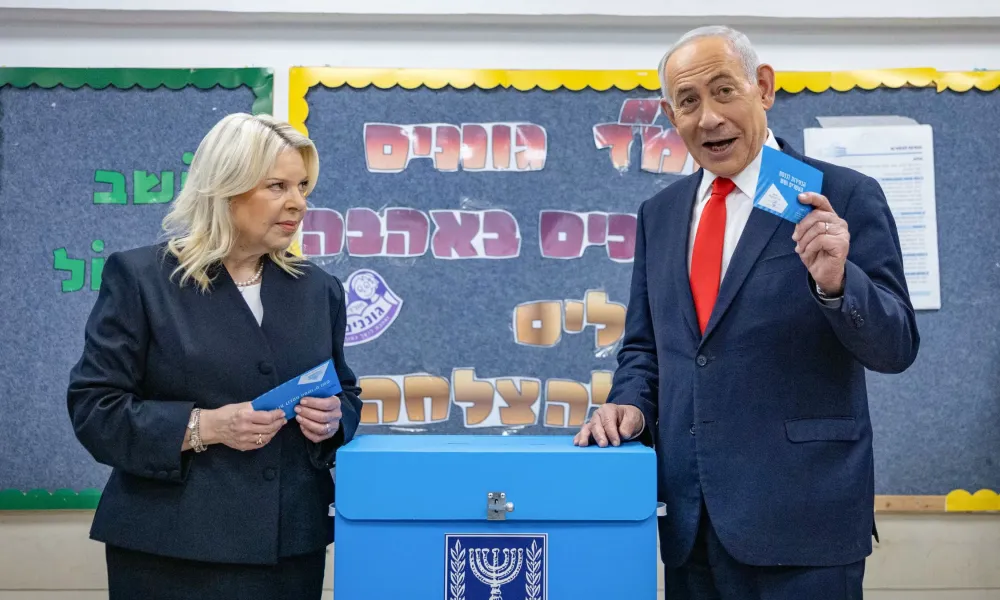

Israel's election ended without a governing majority, leaving Prime Minister Benjamin Netanyahu's bloc short of the numbers needed to form a government despite emerging as the largest political force in the Knesset.
According to the results, Netanyahu's coalition secured 54 seats in the 120-member parliament, while the bloc led by former military chief Gadi Eisenkot won 49 seats. The two Arab parties together captured 17 seats, placing them in a potentially pivotal position as coalition negotiations loom.
Neither camp reached the 61-seat threshold required to form a majority government.
Likud remained the largest single party with 27 seats, down from 32 in the outgoing parliament, followed by Eisenkot's Yashar!.
While exit polls initially suggested a narrow opposition advantage and later projected a 51-51 deadlock, the count gradually tilted towards Netanyahu's camp without delivering a viable governing majority.
Official results are expected to be announced on 4 November.
Voter turnout reached 77.7%, the highest level since 1999 and the first national election held since the 7 October 2023 Hamas attack.
Two leaders, two competing narratives
Eisenkot addressed supporters shortly after the exit polls were released.
"The people chose change," he told supporters in Tel Aviv, describing the result as a clear rejection of Netanyahu's leadership as crowds chanted "Bibi, go home."
The 66-year-old former military chief, whose son was killed during the Gaza war, vowed to do everything possible to form a government and ruled out another election.
Referring indirectly to tensions reported between Israel's political and military leadership, Eisenkot stressed that the security forces serve only the state.
Netanyahu appeared in Jerusalem at around 3am for a notably brief speech.
Without mentioning his rival by name, he highlighted Likud's position as the largest party and called on what he termed Israel's "Jewish and Zionist majority" to unite behind a strong right-wing government.
He also returned to the issue of Iran, describing the current moment as a historic opportunity to eliminate what he called the Iranian threat alongside Donald Trump.
Trump, who openly supported Netanyahu during the campaign, later shared social media posts crediting American backing for the prime minister's recovery in the polls.
Arab parties emerge as kingmakers
The night's most significant political development was the surge in support for the left-wing Joint List and the Islamist Ra'am party.
Together, they increased their representation from ten seats in the outgoing parliament to 17 seats, the strongest performance ever recorded by Arab parties in the Knesset and above the previous record of 15 seats achieved in 2020.
Netanyahu, whose campaign regularly targeted Arab parties under the slogan "either the right or Palestine", ruled out any government that relies on their support.
Eisenkot has also so far rejected cooperation with them, despite signals of openness from Arab leaders.
Ra'am leader Mansour Abbas said he was prepared to engage, while Yousef Jabareen, leader of the Joint List, indicated a willingness to help bring about a change of government.
Within the opposition camp, Yair Golan, leader of the Democrats, called for cooperation with the Arab parties, arguing that together they command a potential 65-seat majority.
Ra'am previously made history in 2021 when it became the first Arab party to join an Israeli governing coalition under the short-lived Bennett-Lapid administration.
Former Israeli ambassador Alon Pinkas told Al Jazeera that both major blocs face a dilemma, arguing that Arab citizens cannot remain politically excluded while being approached only when their votes are needed.
He also suggested that a grand coalition between Netanyahu and Eisenkot would be difficult, given opposition voters' expectations.
Once the final results are certified, Israeli President Isaac Herzog will consult political parties before assigning a mandate to the candidate viewed as most likely to form a government.
That candidate will have up to 42 days to assemble a coalition.
If negotiations fail, Israel could face yet another election, a familiar scenario in a country that held five national votes between 2019 and 2022.
Election held in shadow of Gaza conflict
The election took place against the backdrop of the ongoing Gaza conflict, despite a ceasefire reached through US mediation last October.
According to Gaza health authorities, 1,369 Palestinians had been killed since the start of the ceasefire by mid-September, while the total death toll since October 2023 exceeded 74,500.
Days before the election, a UN committee concluded that Israel continued to commit genocide in Gaza after the ceasefire, an allegation rejected by Israeli authorities as misinformation.
In the West Bank, restrictions remained tight following an attack near Hebron on 23 October in which two Palestinian gunmen killed two Israeli soldiers.
Netanyahu ordered the isolation of the city and extensive security operations in the area, while several communities in Masafer Yatta remained cut off for days.
On election day, the Israeli military imposed a general closure across the West Bank.
Meanwhile, Finance Minister Bezalel Smotrich pledged to continue expanding Israeli settlements, while Itamar Ben-Gvir, who has advocated Palestinian emigration from Gaza and the West Bank, said he would seek the defence portfolio in any future government.
Netanyahu, who is also facing an arrest warrant issued by the International Criminal Court over alleged war crimes in Gaza, fought the election campaign against the backdrop of the continuing Israel-US conflict with Iran that began in February.