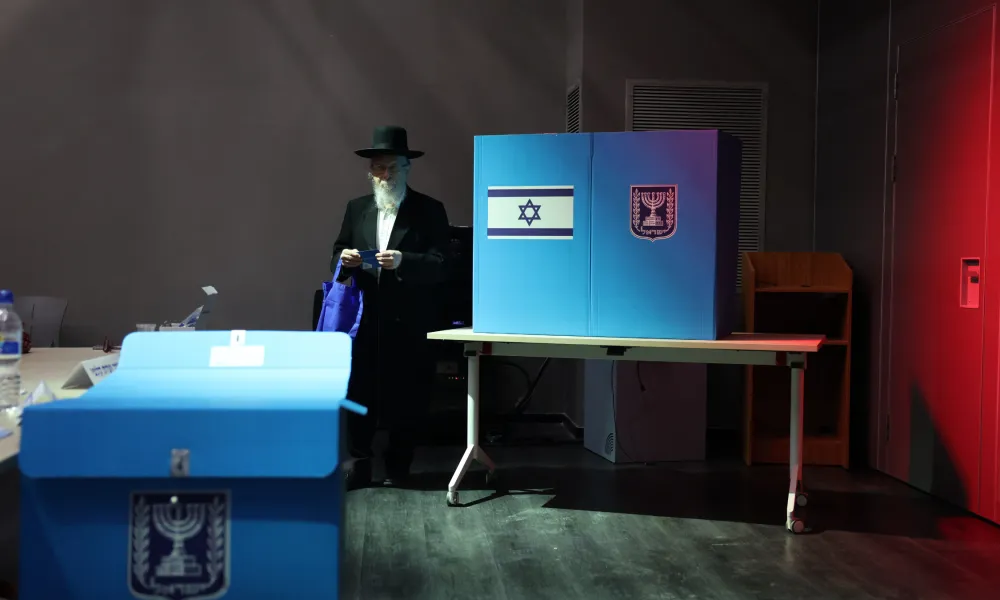

The alliance of the right, far right and ultra-Orthodox parties led by Benjamin Netanyahu has emerged as the largest force in Israel's elections but remains far from securing a majority in the Knesset, according to the final official results published on Friday.
The outgoing right-wing coalition won 53 of the Knesset's 120 seats, with Netanyahu's Likud retaining its position as the largest individual party with 27 seats.
On the other side of the political divide, the opposition alliance led by centrist former military chief Gadi Eisenkot secured 48 seats, according to figures released overnight by Israel's electoral committee.
Highest turnout since 1999
Tuesday's elections were the first held since the unprecedented 7 October 2023 Hamas attack on Israel and recorded the country's highest voter turnout since 1999, with participation reaching 77%.
One of the most notable outcomes was the strong performance of the two main Arab political groupings, Ra'am and the United Arab List, which together secured 19 seats in the new parliament.
Their gains have positioned them as potential kingmakers in the complex coalition negotiations ahead.
Fraud allegations rejected
The Arab parties became the target of allegations from figures within Netanyahu's political camp, who claimed they had received funding from Qatar to buy votes.
Qatar, which has frequently been a controversial issue in Israeli politics, was also criticised during the campaign by opposition parties, which accused Netanyahu and associates of maintaining close ties with Doha. The Gulf state has long been reported to have supported Hamas and hosted members of the movement's political leadership.
Both Doha and the Arab parties rejected the allegations.
Eisenkot accused Netanyahu of attempting to "delegitimise the election results".
Meanwhile, Israel's internal security service, Shin Bet, said it would investigate the allegations of irregularities while stressing that its aim was not to "criminalise an entire community that voted democratically and legally".
The tensions risk deepening political divisions at a time when Israel remains engaged in a broader regional conflict and amid continuing tensions with Iran.
Difficult coalition bargaining ahead
Without a parliamentary majority, coalition negotiations are expected to be lengthy and difficult.
Israel's electoral committee on Thursday dismissed some reports circulating about the vote as "completely unfounded".
The final official results will now be submitted to President Isaac Herzog, who is expected to begin consultations with party leaders before naming the politician tasked with trying to form a government.
Should those efforts fail, Israel could face yet another election, a scenario that has occurred several times in the country's recent political history.
The fragmented result underlines the divisions within Israeli society, which have deepened since October 2023 and throughout the war in Gaza.
The vote also took place against a backdrop of mounting international criticism over Israel's conduct of the war, settler violence and continued settlement expansion in the West Bank under what has been described as the most right-wing government in Israel's history.
Opposition explores options
Opposition figures have already begun discussions on possible coalition scenarios.
Yair Golan, leader of the centre-left Democrats, met Eisenkot on Thursday.
"The future of Israel is at stake," Golan said after the meeting.
He also held talks with Mansour Abbas, leader of Ra'am, widely viewed as a pragmatic actor, and with opposition leader Yair Lapid.
Meanwhile, according to Yedioth Ahronoth's online outlet ynet, the ultra-Orthodox United Torah Judaism party has reportedly indicated a willingness to support Eisenkot.
However, it is said to have conditioned any support on legislation exempting ultra-Orthodox Jews from compulsory military service.
That demand may prove problematic, as Eisenkot repeatedly stated during the campaign that ultra-Orthodox Jews should also serve in the military.
Source: ANA-MPA