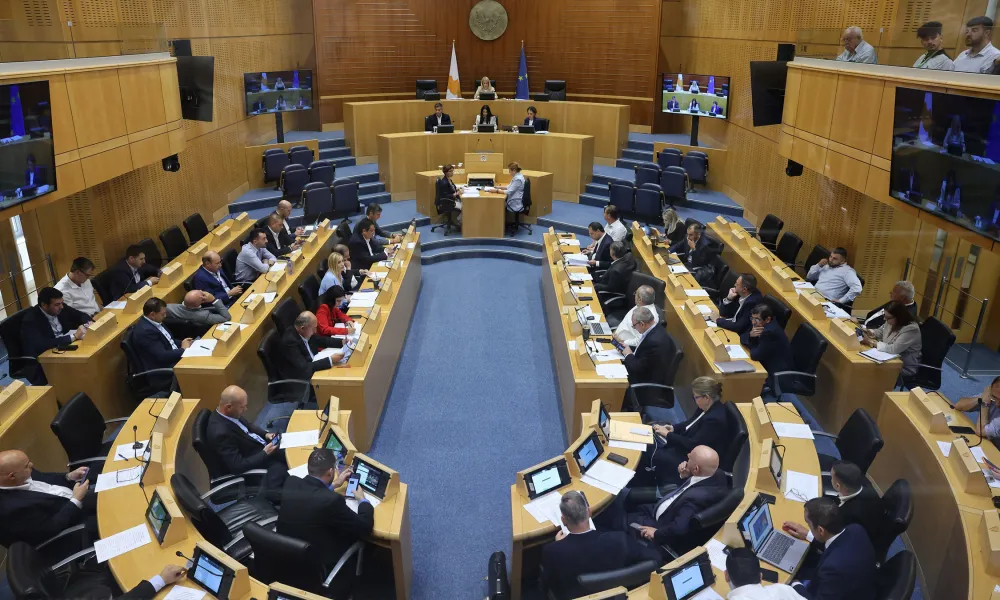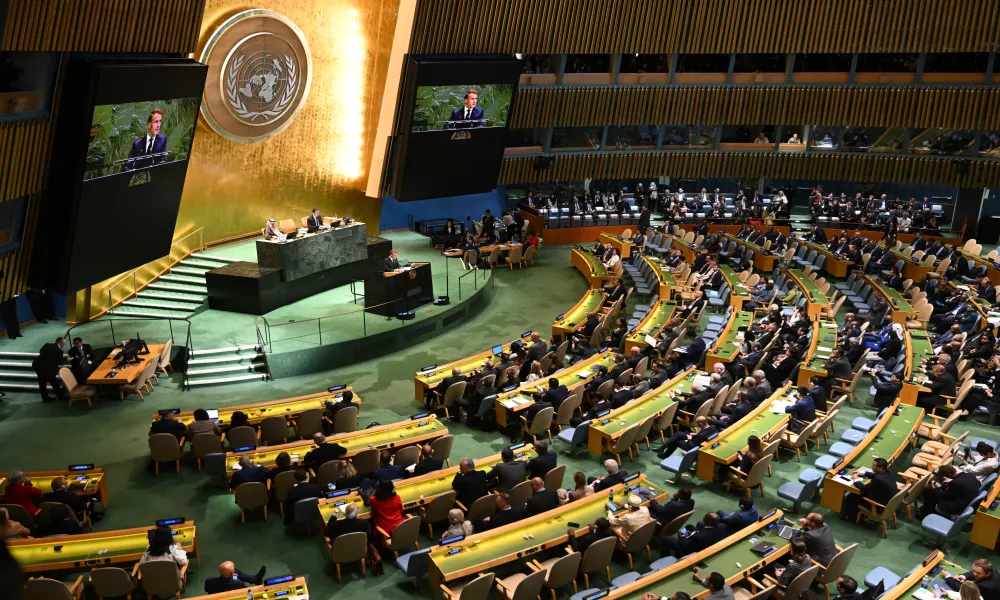

The UN Security Council is expected to hold its ninth informal round of voting today to select the next UN Secretary-General.
The vote is scheduled for noon in New York, or 7pm Cyprus time.
For the first time since October, different-coloured ballot papers will be used for the five permanent and 10 non-permanent members of the Security Council, allowing diplomats to identify which candidates face opposition from permanent members capable of exercising a veto.
Coloured ballots were last used during the sixth round of voting on October 16. At that stage, Rebeca Grynspan of Costa Rica, Rafael Mariano Grossi of Argentina and Carolyn Rodrigues-Birkett of Guyana each received two negative votes from permanent members.
The seventh and eighth rounds, held on October 30 and November 5 respectively, used ballots of a single colour.
For Lana Zaki Nusseibeh of the United Arab Emirates and Feridun Hadi Sinirlioglu of Turkey, this will be the first vote in which opposition from permanent members can be clearly identified.
Grynspan remains frontrunner
Eight candidates remain in the race.
According to leaked results from the eighth round, Grynspan strengthened her lead, receiving 12 positive votes and three negative votes, the strongest showing by any candidate so far.
Grossi received nine positive votes, four negative votes and two "no opinion" votes.
Rodrigues-Birkett secured eight positive votes, five negative votes and two "no opinion" votes, while Nusseibeh maintained seven positive votes, six negative votes and two "no opinion" votes.
Olara Otunnu of Uganda received four positive votes.
Maria Fernanda Espinosa Garces of Ecuador received three positive votes.
Yvonne A-Baki, also of Ecuador, received one positive vote.
Sinirlioglu, whose candidacy was submitted by Turkey on November 1, received three positive votes, eight negative votes and four "no opinion" votes in his first voting round.
Questions over Cyprus and human rights
Sinirlioglu later held dialogues with the UN General Assembly and the Security Council on November 6 and November 9 respectively.
During his appearance before the General Assembly, he faced questions about his independence, the Cyprus issue, human rights in Turkey and the law of the sea.
Meanwhile, leaders of the Community of Latin American and Caribbean States (CELAC) issued a statement on November 11 reiterating that "the time has come" for a national of the region to become Secretary-General and calling on both the Security Council and General Assembly to respect that position.
Uncertainty grows
Vote counting will be overseen by the Democratic Republic of the Congo and France.
The Security Council's president for November, Latvian ambassador Sanita Pavluta-Deslandes, is expected to inform journalists once voting has taken place.
Under Article 97 of the UN Charter, the General Assembly appoints the Secretary-General following a recommendation from the Security Council, which must first agree on a candidate in a closed session.
The process has already lasted longer than the equivalent contests in 2006 and 2016, when the Security Council recommended a candidate in early October.
The prolonged negotiations have increased uncertainty over whether agreement can be reached before Antonio Guterres' term expires on December 31.
Source: CNA