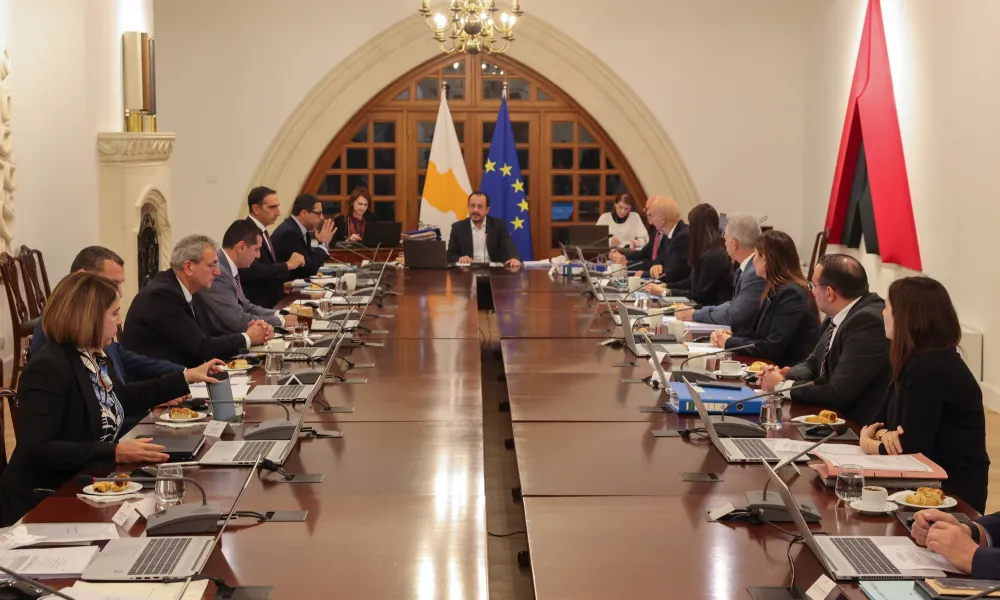
While Turkish Cypriot voters increasingly favor governance reform and cautious re-engagement under Tufan Erhürman, rising nationalism and political fragmentation among Greek Cypriots are steadily shrinking room for compromise. The paradox is growing clearer: diplomacy survives, but real negotiations remain distant as partition becomes increasingly normalized.
Last week’s meeting between Turkish Cypriot leader Tufan Erhürman and Greek Cypriot leader Nikos Christodoulides produced neither crisis nor breakthrough. Yet that may itself be the clearest indicator of where the Cyprus problem now stands.
For the first time in years, the island is entering a period in which the real political asymmetry is no longer primarily diplomatic, military or even ideological. It is electoral and societal.
While Turkish Cypriot politics is gradually reorganizing itself around governance reform, institutional normalization and cautious re-engagement with the outside world, the political mood in the Greek Cypriot-run Cyprus Republic is moving in the opposite direction: toward fragmentation, nationalist pressure, anti-system anger and growing public distrust toward traditional political structures.
This divergence is quietly reshaping the diplomatic environment surrounding the Cyprus problem far more profoundly than the technical outcomes of leader meetings themselves.
The paradox confronting diplomats in 2026 is therefore no longer simply the old disagreement between federation and two states. It is that the two electorates increasingly appear to be psychologically moving in opposite directions at the very moment the United Nations is preparing yet another attempt to revive a common political horizon.
Yet beneath the carefully managed diplomatic language of “positive climate,” “constructive dialogue” and “continued engagement” lies a deeper structural reality. Cyprus increasingly appears trapped in a phase not of active negotiation, but of managed ambiguity: A political environment where maintaining contact has become more achievable than resolving the conflict itself.
The danger for all sides is that temporary management of division may gradually evolve into permanent normalization of separation.
Meetings continue. Technical committees function. The United Nations maintains engagement. Both leaders avoid rupture. Yet the distance between maintaining contact and conducting meaningful negotiations remains substantial. What is emerging is not yet a settlement process in the traditional sense, but rather a low-intensity management framework designed to prevent collapse while avoiding the political costs of substantive compromise.
This political divergence comes at a particularly sensitive diplomatic moment. United Nations Secretary-General António Guterres is widely expected to attempt a new Cyprus initiative in July, after the Greek Cypriot-run Cyprus Republic concludes its European Union term presidency at the end of June and following the May 24 parliamentary elections in the south.
Diplomatic contacts intensified further during the Antalya Diplomacy Forum earlier this spring, while UN officials maintained quiet consultations with both sides ahead of a possible enlarged five-party meeting later in the summer involving the island’s two sides, Türkiye, Greece, the United Kingdom and the United Nations.
Yet despite last Friday’s meeting being described by both sides as productive and constructive, neither Erhürman nor Nikos Christodoulides publicly elaborated on the anticipated July initiative. Diplomats privately noted the silence was significant, particularly given mounting speculation over a possible new UN-led diplomatic framework later this summer.
Christodoulides nevertheless stated Friday that he expected the date of such an enlarged meeting to be announced “soon,” arguing that Guterres’ effort “is being strengthened even more.” Following contacts with UN envoy María Ángela Holguín Cuéllar, Christodoulides insisted that the objective remained the resumption of formal negotiations.
Erhürman, however, has repeatedly warned against reducing the process to a mere diplomatic format debate. Speaking during the Antalya Diplomacy Forum, he cautioned that the Greek Cypriot side has historically sought to “address Türkiye directly rather than the Turkish Cypriot side,” insisting instead that practical confidence-building measures between the two communities should precede any enlarged international gathering.
Managing division rather than resolving it
Friday’s meeting itself reflected that cautious and highly controlled approach. Hosted by UN Special Representative Khassim Diagne at the UN residence inside the buffer zone, the talks produced limited but symbolically important agreements in several areas directly affecting daily life on the island.
According to the United Nations, the leaders agreed on a framework for a consultative mechanism aimed at increasing civil society participation in the broader process, with designated representatives expected to begin work through existing bicommunal technical committees.
The leaders also agreed to prepare an initial six-month island-wide framework regulating religious services and worship across both sides of the island, following recent tensions over access to religious sites.
The issue became politically sensitive after Greek Cypriot authorities abruptly blocked the traditional Eid al-Fitr pilgrimage to Hala Sultan Tekke in March, while Turkish Cypriot authorities later revoked permission for a pilgrimage to the Armenian Sourp Magar Monastery.
Erhürman stated that the framework would allow disputes to be addressed before religious ceremonies take place rather than during politically sensitive moments.
“Hristodulides accepted our proposal,” he said after the meeting.
The two leaders additionally agreed to continue coordination in combating foot-and-mouth disease, which has affected more than 100 farms across the island in recent months.
Another agreement concerned products carrying European Union protected designation of origin and protected geographical indication status, particularly Hellim. The two sides agreed to establish a subcommittee under the bicommunal Technical Committee on Economy and Commerce to address geographical indication products and certification procedures.
The move comes as Turkish Cypriot authorities seek to accelerate exports of Hellim produced in the north under the EU PDO framework. Last month, Erhürman announced that Bureau Veritas had been authorized to inspect Turkish Cypriot producers, potentially paving the way for exports across the Green Line and into wider EU markets.
Yet the agreements ultimately reflected functional coexistence rather than political convergence.
Civil society coordination, religious service arrangements, veterinary cooperation and trade certification mechanisms help sustain communication channels and reduce friction in daily life. However, none directly address sovereignty, political equality, governance-sharing or security arrangements, the core disputes that have historically blocked comprehensive settlement efforts.
In this sense, the process increasingly resembles structured management of division rather than preparation for reunification.
Zero momentum on crossings
Perhaps the most politically significant outcome of Friday’s meeting was what did not happen.
Despite repeated UN encouragement, the two sides failed once again to reach agreement on opening new crossing points.
“We could not reach the point we desired regarding new crossing points, but on other issues we are at a stage where certain steps can be taken,” Erhürman said after the talks.
The failure matters because the United Nations increasingly views additional crossings not merely as technical arrangements but as symbolic indicators that political momentum still exists.
Holguín has repeatedly emphasized that practical improvements in mobility and intercommunal interaction are essential for rebuilding confidence ahead of any enlarged diplomatic initiative. The inability to secure progress even at this relatively modest level illustrates how deeply the two sides remain locked into different political logics.
The repeated references by both sides to a “positive atmosphere” increasingly function less as indicators of substantive progress than as mechanisms for managing expectations and avoiding blame.
Neither side currently appears willing to absorb the domestic political costs associated with openly collapsing the process. As a result, maintaining dialogue itself has become a political objective independent of whether negotiations genuinely advance.
Northern Cyprus: A political reset centered on governance
The political atmosphere in northern Cyprus changed fundamentally after the October 2025 presidential election, when Erhürman defeated incumbent Ersin Tatar by nearly 27 percentage points, securing one of the most decisive victories in Turkish Cypriot political history.
For many observers, the result represented more than a routine electoral turnover. It reflected a societal reaction against years of economic deterioration, diplomatic stagnation and growing unease over institutional and cultural debates inside the Turkish Cypriot community.
“The election reflected a societal demand for normalization,” former Turkish Cypriot negotiator and People’s Party leader Kudret Özersay recently observed in a television interview. “People were not simply voting for federation or against federation. They were voting for governance, predictability and international visibility.”
Speaking during recent meetings with journalists in Ankara, Republican Turkish Party leader Sıla Usar İncirli argued that the coming political period would be shaped primarily by demands for good governance, transparency, predictability, institutional credibility and the supremacy of law.
That distinction has become increasingly important.
While Erhürman adopts a cautious tone and the center-left CTP more openly advocates renewed negotiations for a bizonal, bicommunal federation, much of the party’s expanding support base appears motivated less by ideology than by economic anxiety, institutional fatigue and frustration with prolonged isolation.
The continuing volatility of the Turkish lira, soaring housing costs, inflation imported from Türkiye and mounting concerns over youth emigration have reshaped voting behavior in the north. Public debate increasingly focuses on governance quality, meritocracy, transparency and institutional credibility rather than solely on traditional security narratives.
Recent polling trends indicate that if parliamentary elections were held today, the CTP would likely emerge as the largest party in the Assembly, overtaking Prime Minister Ünal Üstel’s National Unity Party.
Although general elections are formally scheduled for 2027, political circles in northern Nicosia increasingly expect early elections sometime between September and November this year. Municipal elections are already scheduled for December, meaning northern Cyprus is effectively entering an extended electoral cycle that could further reinforce the current political momentum.
Political scientist Ahmet Sözen recently argued that the Turkish Cypriot electorate is undergoing what he described as “functional consolidation.”
“This is not a classic ideological leftward revolution,” he noted during a panel discussion in Lefkoşa. “It is a coalition built around pragmatism. Even conservative voters increasingly believe that isolation and diplomatic paralysis are economically unsustainable.”
That shift has also become visible in demonstrations throughout 2025 and early 2026 concerning education policies, secular identity debates and concerns over perceived external cultural intervention. Erhürman’s emphasis on preserving Turkish Cypriot communal identity while simultaneously maintaining constructive relations with Ankara resonated particularly strongly among urban and younger voters.
At the same time, Erhürman has carefully avoided direct confrontation with Türkiye. Following meetings with Turkish President Recep Tayyip Erdoğan during the Antalya Diplomacy Forum, Erhürman stressed that “every diplomatic step must proceed in coordination with Türkiye.” Turkish Foreign Minister Hakan Fidan has likewise maintained regular communication with both UN officials and Turkish Cypriot leaders ahead of any prospective renewed process.
The south moves in the opposite direction
If northern Cyprus is experiencing a center-left revival centered on governance reform and cautious diplomatic re-engagement, the political mood in the Greek Cypriot-run Cyprus Republic points in an altogether different direction: fragmentation, anti-system anger and growing nationalist pressure.
Recent polling ahead of the May 24 parliamentary elections suggests the traditional dominance of DISY and AKEL is steadily eroding. While both parties remain the two largest political forces, neither appears capable of restoring the political stability that once characterized the Greek Cypriot political system.
Surveys increasingly point toward what could become one of the most fragmented parliaments in modern Cypriot political history, with more than a dozen parties and independent formations competing for representation.
What is emerging is not simply electoral diversification but a profound weakening of the political center itself.
The ultranationalist ELAM party continues its steady ascent and now consistently polls in third place. Once regarded as a fringe protest movement, ELAM has increasingly normalized itself within mainstream political discourse, capitalizing on public anxieties over migration, regional insecurity, corruption and distrust toward traditional elites.
Analysts increasingly warn that nationalist rhetoric is no longer confined to the political margins but is beginning to shape the broader political agenda itself.
The erosion of the political center is equally visible in the rise of anti-establishment formations.
Former Auditor General Odysseas Michaelides’s reformist ALMA movement has rapidly emerged as a significant electoral force, capitalizing on anti-corruption sentiment and widespread distrust toward established parties. Michaelides built much of his public profile through investigations linked to the controversial “golden passports” scandal that severely damaged the international image of the Greek Cypriot administration before the scheme was dismantled under European Union pressure.
Simultaneously, social media-driven populist formations such as MEP Fidias Panayiotou’s “Direct Democracy” movement have further fragmented the electoral field, reflecting widening distrust toward conventional party politics.
Polls increasingly show voters dispersing across a bewildering array of ideological, protest and personality-driven formations rather than consolidating around traditional governing parties.
The political consequences extend well beyond parliamentary arithmetic.
For Christodoulides, the fragmentation poses a structural challenge. The centrist parties supporting his administration are all projected to lose ground. As their parliamentary weight weakens, Christodoulides may become increasingly dependent on a far more volatile and polarized political environment.
This has direct implications for the Cyprus problem.
Any future negotiation involving political equality, governance-sharing arrangements, rotating presidency formulas, territorial adjustments or expanded cooperation mechanisms risks triggering fierce domestic backlash from nationalist and anti-system forces increasingly empowered by electoral fragmentation.
Political analyst Hubert Faustmann recently warned that the “radicalization of political rhetoric” risks narrowing the room for compromise even before substantive negotiations begin.
“When nationalist parties become agenda setters rather than marginal actors, mainstream parties adapt accordingly,” he observed during a public discussion in southern Nicosia.
What makes the situation even more complex is that the electorate itself appears increasingly defensive rather than solution-oriented.
Migration pressures, economic insecurity, corruption scandals, institutional distrust and broader Middle Eastern instability now overshadow the Cyprus problem for many voters in the south.
One recent survey found that only around one quarter of respondents expressed meaningful trust in democratic institutions, while more than one-third declared they trusted no institution at all.
This atmosphere fundamentally complicates the diplomatic environment surrounding any prospective United Nations initiative.
Paradoxically, while Turkish Cypriot politics currently appears to be moving toward pragmatism, governance reform and cautious engagement, the south is entering a period of political fragmentation, ideological polarization and rising nationalist pressure.
The result is an increasingly asymmetric political landscape: one side cautiously exploring possibilities for managed reintegration, the other becoming progressively more fragmented, defensive and internally constrained.
Where is the framework?
Despite increasingly frequent references to a possible July initiative, there is still no discernible negotiating framework publicly visible.
Neither a common basis for discussion nor a clear indication that the sides have agreed, even minimally, on how a substantive process could be restarted has been presented.
Diplomatic sources increasingly indicate that Guterres remains cautious about launching another full-scale initiative without first identifying a minimum level of political convergence.
The failure of previous efforts, particularly Crans-Montana, has created considerable reluctance within the UN system to repeat an open-ended process lacking clear parameters or realistic expectations of compromise.
This explains why Holguín’s anticipated return to the island has not yet translated into a clearly defined negotiating framework.
An increasingly visible divergence also exists in how the two sides conceptualize the current phase of diplomacy itself.
The Greek Cypriot leadership continues emphasizing momentum, renewed initiatives and prospects for resumed negotiations, partly to sustain international engagement and diplomatic legitimacy.
The Turkish Cypriot side, by contrast, appears considerably more cautious, viewing contacts primarily as mechanisms for preserving communication and preventing deterioration rather than as immediate preludes to comprehensive negotiations.
This difference reflects not merely rhetorical variation but fundamentally different political calculations.
Behind the scenes, diplomats increasingly discuss whether a future process may require more flexible formulas than earlier negotiation rounds permitted.
While some officials still favor a structured framework agreement defining clear parameters before any new conference, others appear more open to gradualist approaches involving looser forms of federal cooperation, phased governance-sharing or functional integration mechanisms.
Such discussions remain preliminary, but they underline growing recognition that the traditional negotiation architecture may no longer correspond fully to political realities on either side of the island.
For now, Cyprus remains suspended between contact and negotiation, between coexistence and settlement, between diplomatic movement and political paralysis.
Meetings continue, technical cooperation expands incrementally and the United Nations preserves cautious engagement.
Yet beneath the language of momentum, adverse structural dynamics continue consolidating the partition status quo.
The longer substantive ambiguity persists, the greater the risk that political management of division gradually evolves into permanent normalization of separation.