
There are people in life who are loved with wreaths and flowers. Others with poems. Others with chocolates, cards, teddy bears, perhaps even an expensive watch for the more serious cases of emotional overflow.
Former President Nicos Anastasiades, however, as is well known, was never a man of small gestures. He was not for the trivial or the humble. A box of roses or a basket of Cypriot products – olive oil, soutzoukos, kiofterka and half a kilo of trahanas – would hardly move him.
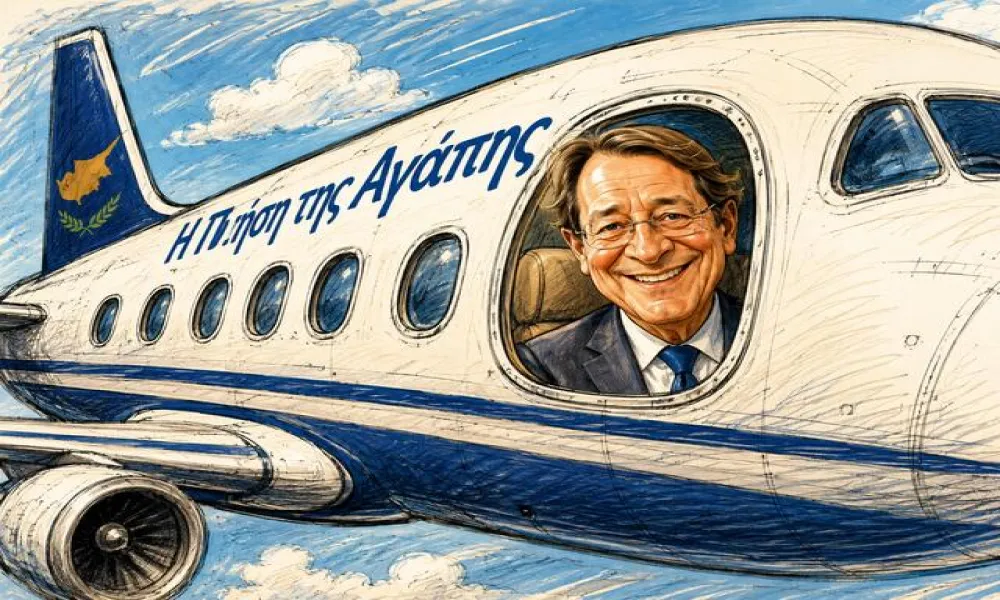
As follows from what he himself said at his press conference, in responding to accusations of corruption, he was loved at a different altitude – at 40,000 feet.
The oligarch’s love
It depends, of course, on who loves you. When ordinary people love each other deeply, they might lend you their car. Oligarchs operate on another level, so they lend you their jet.
While Giorgos Georgiou from Lefkara waits at the departure gate with hand luggage, boarding pass and anxiety about whether his suitcase will be weighed, the former President had the fortune – or misfortune, depending on who reads the report – of being surrounded by people who loved him so much that they told him: “Nicos, don’t trouble yourself with flights. Take my plane.”
What was he to do? Hurt them? We are talking about delicate human feelings here. About friendships. About relationships of care. About oligarchs with a heart. People who, seeing the president wearied in the discharge of his high duties abroad, could not bear the thought of him going through security like everyone else or even sitting in a first-class lounge.
“What sort of thing is that? Nicos taking off his belt at the airport? Removing his shoes because the scanner beeps? Being asked to open his laptop? Having his bottle of water taken away? No. Love does not allow that.”
And they gave him planes
Well-known princes and oligarchs, who inherited titles at birth or became overnight owners of factories and mines – figures like Lebesis, Riboules and the Saudi Abdul Hamid (who, incidentally, may have relatives in the occupied village of Hamit Mandres) – all admirers of Cypriot presidential virtue, felt obliged to help.
According to the version presented, they all shared something in common: they could not bear to see Nicos Anastasiades without a private aircraft. It was, one might say, a humanitarian issue. These people wanted nothing from Cyprus. Never. They did not ask the president for favours, passports or campaign funding. Not at all.
We are talking about noble individuals who simply wished to support another noble individual: the most honourable President Nicos Anastasiades.
At the same time, their gesture had an almost artistic purpose. They all knew the former president’s favourite song – ‘Aeroplano’ by Costas Hadjis. We have, after all, heard him sing it dozens of times in his wonderfully off-key major tone:
“When you look doooown from up hiiiiiigh, the earth looks like a painting…”
Then comes something resembling a bray, followed by a return:
“the houses look like matchboxes, the people look like ants…” – and another bray follows.
What is interesting, of course, is how little was said about these oligarch friends. They passed through the stage like aircraft without flight plans. They arrived, they loved, they took off.
No details, no unnecessary explanations, no names to spoil the romantic atmosphere. Because true love does not seek the spotlight – it seeks a runway.
If Lebesis’ plane had not required servicing, Anastasiades would never have boarded it. Since it was heading to Paris anyway for maintenance, he simply went along. What was the harm? The state even saved money.
As for the other oligarch, Riboules, he said he barely knew him. He flew on his plane once, by chance. The aircraft was returning to Cyprus, Anastasiades was stranded at an airport, and journalist Andreas Hadjikyriakos kindly brought him back. It remains unclear whether he was declared as a passenger or as cargo.
Lazaris
The only name Anastasiades publicly identified as a jet provider was that of Cypriot magnate Lazaris. It was said that he offered his jet so the president could travel abroad and carry out his duties – an act of patriotism, friendship and perhaps old school obligations.
According to information, however, Anastasiades never actually travelled on Lazaris’ jet. It is also said that Lazaris agreed to issue a covering statement because they were schoolmates.
And here, things become almost touching. According to school records, Anastasiades excelled in Greek and helped Lazaris with his studies. Seen calmly, this is not a political affair. It is perhaps the most delayed act of reciprocity in the history of Cypriot education. One wrote the essays; decades later, the other said he provided a jet – so that the former could travel on other people’s jets.
The question remains: why so much secrecy? Why so many discreet trips? Why the need for anonymity?
If everything was about love, why not issue official statements each time? Why, for instance, did a bird have to strike the windscreen of a Saudi aircraft for it to become known that the former president had been using it?
As it turns out, thanks to one unfortunate bird, even family trips to the Seychelles later came to light.
It could have been simple
Had there been no concealment – had the former president truly believed in transparency, and given that he insists he did nothing improper – things could have been much simpler. A brief statement each time would have sufficed:
“The President of the Republic departed today for abroad on a private aircraft belonging to a friend who holds him in deep affection. This affection is mutual but does not in any way affect the discharge of his duties.”
An official protocol could even have been established: the national anthem, an inspection of the guard of honour and then boarding the friend’s jet. With a sign reading: “Flight sponsored by selfless affection.”
The ordinary citizen, of course, may struggle to understand such situations. Perhaps unfairly suspicious. After all, when someone loves them, they usually bring halloumi from Pachna or halidjia from Pyrgos Tillyrias.
When told, “take my car”, they expect a 15-year-old saloon with the engine light on – not a Gulfstream G700 ready for international travel.
But presidents do not live like the rest of us. They carry different burdens, different responsibilities, different friends – and, above all, different take-offs.
A victim of love
Thus, in all of this, we come to understand how Nicos Anastasiades became a victim of excessive love. He was a man pursued by oligarchs eager to offer him their aircraft and, being courteous as ever, he did not wish to offend them.
How do you say no to someone who loves you and happens to own a jet? It would be impolite. It could even cause a diplomatic incident.
And so, Cyprus’s political history gains yet another chapter: “On love, power and private flights”.
In the end, we may never learn all the routes. We may never see all the flight plans. It may never be clarified who flew, when they flew, with whom they flew or why everything was done so discreetly.
One thing, however, we have certainly learned: in Cypriot politics, love has no limits. It only has destinations.