
For more than half a century, we have been writing, thinking and arguing about the Cyprus issue. Federation, two states, political equality, guarantees, territory, property, rotating presidency… None of these is unimportant; none can be ignored. Yet the real danger today is continuing to read all these headings solely through Cyprus’ own internal dynamics. The world has changed. Europe’s security understanding, the Eastern Mediterranean’s strategic balances, Türkiye’s geopolitical weight, the energy equation and trade routes are all being reshaped. Yet, although Cyprus stands at the very center of these transformations, much of the political debate on the island is still conducted through mental maps drawn fifty years ago.
Perhaps the greatest mental obstacle before the Cyprus problem is precisely this. Both the Turkish side and the Greek Cypriot side often try to read Cyprus only from within Cyprus. In the north, it is assumed that the political agenda of Sarayönü, Dikilitaş or Nicosia overlaps with the priorities of the rest of the world; in the south, that the historical memory and daily politics of Eleftheria Square correspond directly to the concerns of the international community. As if Washington, Brussels, London, Ankara and the United Nations all begin each day thinking about Cyprus; as if all roads of global diplomacy ultimately lead to Nicosia. This criticism applies to both communities. Indeed, this may be the common illusion that has made the island’s deadlock permanent for more than half a century.
Yet the international system has never looked at Cyprus from the viewpoint of Cypriots. Today, it does so even less. Europe is discussing how to fill the security vacuum created after Russia’s invasion of Ukraine. The United States is calculating the impact of its global competition with China on sea lanes, critical technologies and supply chains. Energy security, maritime jurisdiction areas and critical infrastructure in the Eastern Mediterranean are being reassessed. Transport corridors stretching from the Black Sea to Suez, from the Caucasus to the Gulf and the Indian Ocean, are being replanned. The Middle Corridor, the Development Road, the India-Middle East-Europe Economic Corridor, Eastern Mediterranean energy projects and Europe’s rebuilt defense architecture are not separate projects; they are different parts of the same major geopolitical transformation.
This is exactly what is changing Cyprus’ meaning. The island’s strategic value has never derived only from its size, population or natural resources. Cyprus has always mattered because of its geography. Yet even if geography remains fixed, the strategic meaning attached to it changes over time. The Cyprus of the Cold War was different. The Cyprus after 1974 was different. Cyprus during the European Union’s enlargement process carried an entirely different meaning. Today, the island is becoming one of the strategic centers where Europe’s security architecture, Türkiye’s rising regional role, the Eastern Mediterranean energy equation and new transport corridors linking Eurasia to Europe intersect. Therefore, Cyprus is no longer merely an unresolved political dispute; it is one of the important variables of a regional order being reshaped.
Türkiye’s rising geopolitical weight
The most important development changing Cyprus’ strategic meaning today is not the island itself, but the great geopolitical transformation taking place around it. Ankara has moved beyond being an actor that merely reacts to regional crises and has become a country seeking to shape the emerging regional order. Iraq’s Development Road Project, the Middle Corridor stretching from China to Europe, the Levant route that may be revived through Syria, initiatives to open transport links in the South Caucasus and networks connecting the Black Sea to the Eastern Mediterranean are not separate projects. Ankara sees them as parts of a long-term strategy that would make Türkiye Eurasia’s indispensable logistics hub.
This naturally changes Cyprus’ importance as well. The Eastern Mediterranean is no longer merely a sea where energy reserves are located. It is becoming a broad geostrategic basin where Europe’s efforts to reduce dependence on Russia, transport lines between Asia and Europe, maritime security arrangements and critical infrastructure investments intersect. In such an environment, Cyprus’ future cannot be explained only by the question of which governance model the two communities will agree upon. The real issue is where the island will stand within this new regional architecture.
The transformation in Europe’s security understanding after Russia’s invasion of Ukraine has accelerated this process. Circles that long believed Türkiye could be excluded from the European security equation have begun to accept that this is no longer realistic. A European security architecture excluding Türkiye, which has NATO’s second-largest army and possesses military and diplomatic capacity across a vast geography from the Black Sea to the Middle East, cannot be sustainable. This is one of the main reasons behind the European Union’s renewed diplomatic engagement with Ankara.
Therefore, reducing today’s debates on Cyprus’ future to federation, confederation or two states means missing the changing international reality. Of course, the constitutional model matters. But what will determine whether constitutional models can survive is the geopolitical environment in which they are implemented. When geopolitics changes, politics changes as well; when security architectures change, diplomatic priorities also change. Cyprus is today at precisely such a turning point.
Washington’s calculation, Brussels’ search
To read the diplomatic developments of recent weeks as isolated events would be to miss the larger picture. The Eastern Mediterranean Energy Center initiative raised in the U.S. Senate, the simultaneous visit of three senior European Commission members to Ankara, the joint support expressed by Türkiye and the European Union for the United Nations Secretary-General’s Cyprus initiative, and the fact that all this took place on the eve of the NATO Summit are complementary parts of the same strategic transformation.
At first glance, Washington’s Eastern Mediterranean Energy Center initiative may appear to be a technical arrangement in the field of energy. Yet it forms part of a far broader geostrategic vision. Alongside natural gas and electricity interconnections, it envisages regional cooperation on protecting critical infrastructure, cyber security, AI-supported energy management, port investments, maritime transport and new technologies. More importantly, the emphasis that the system may be open to new participants shows that the view that an Eastern Mediterranean architecture built by excluding Türkiye is unsustainable is also gaining ground in Washington.
A similar assessment applies to Brussels. The fact that Kaja Kallas, the High Representative for Foreign Affairs and Security Policy; Marta Kos, the Commissioner for Enlargement; and Magnus Brunner, the Commissioner for Internal Affairs and Migration, were in Ankara on the same day cannot be treated as routine diplomacy. For the first time in many years, the European Union is trying to redefine its relations with Türkiye by placing foreign policy, security, enlargement and migration files within the same strategic framework.
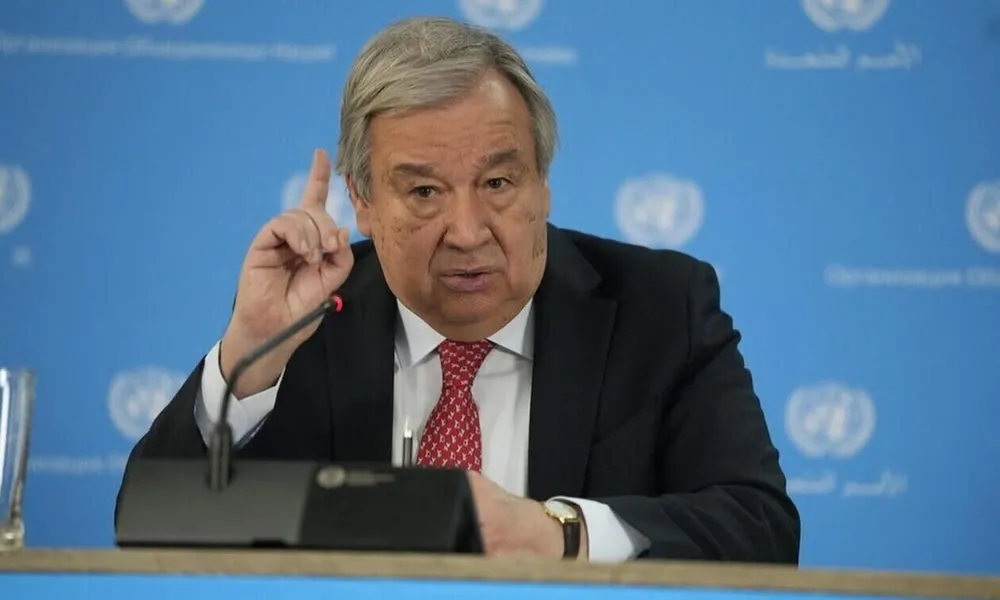
One of the most striking elements of the joint statement issued after these visits was Ankara and Brussels’ shared support for the United Nations Secretary-General’s Cyprus initiative. At first glance, this may look like diplomatic courtesy. In fact, it points to an important shift in mentality. Today, the only international political process continuing on Cyprus is the initiative carried out by María Ángela Holguín under the auspices of Secretary-General António Guterres. Türkiye and the European Union supporting this process in the same text indicates that the sides are at least moving toward a common assessment that the current status quo is not sustainable.
Holguín’s real message
The latest statement by Holguín drew public attention mostly because of its call for a “historic opportunity.” Yet in my view, the truly important part of the statement was elsewhere. After expressing respect for all previous settlement efforts, Holguín said that the realities on the island had changed significantly over the past decade. This single sentence summarizes the quiet change in the United Nations’ approach to Cyprus.
For decades, the basic logic of negotiations was built on preserving previously agreed parameters and completing the missing chapters. Holguín is indirectly saying that relying only on the parameters of the past is no longer sufficient. Neither the conditions of 2004 nor the political atmosphere of 2017 apply unchanged today. The world has changed; the region has changed; the priorities of the parties have changed. Therefore, the search for a solution must also take this change into account.
This approach is not entirely new. After the failure of the Crans-Montana Conference, Secretary-General Guterres’ phrase, “This time ought to be different,” was the first sign of the same understanding. He was saying that the same methods, the same diplomatic reflexes and the same political habits could not produce a different result. Today, no one expects a different outcome by simply placing the text left on the table in 2017 back before the parties.
Holguín’s use of security and prosperity together was also noteworthy. In past negotiation processes, security and economic integration were often treated as separate headings. Yet no solution that fails to take Turkish Cypriots’ security concerns into account will be sustainable. Likewise, an order in which international isolation continues, economic opportunities remain limited and young people cannot integrate with the world will not produce long-term stability. Security and prosperity are not alternatives to each other; they are two complementary pillars.
Common interests first, constitution later
Perhaps the greatest mistake we have made on Cyprus for half a century has been to discuss the solution only through constitutional models. The details of federation, the two-state formula, rotating presidency, power sharing, territorial adjustments, property and guarantees are all important. Yet none of them alone created lasting trust between the parties. In every new negotiation round the same headings were discussed again, the same red lines were repeated and the same deadlock was eventually reached.
Perhaps it is time to change the method. Developing areas of common interest first, and then building a lasting political structure upon those common interests, may be a far more realistic path. Constitutions do not produce peace by themselves. What sustains peace is the creation of common economic, social and strategic interests that make societies need one another. European integration itself was not built first on a constitution, but on common interests established through coal and steel. Political union followed economic interdependence.
Why should a similar approach not be possible in Cyprus? Joint projects can be developed in energy. Electricity grids can be connected. Mechanisms that increase interdependence can be created in water management, environmental protection, digital infrastructure, ports, air transport, logistics, tourism and trade. None of these replaces a final political settlement; but they strengthen the ground on which a settlement can survive.
At this point, it is possible to establish a direct link between the European Union’s agenda with Türkiye and the diplomatic process underway in Cyprus. Modernization of the Customs Union, revival of visa liberalization, Türkiye’s stronger inclusion in Europe’s defense and security initiatives can be considered together with creative arrangements that would facilitate the international contacts of the Turkish Cypriot community. Steps that would ease Northern Cyprus’ international isolation, increase direct contacts, support economic development and enable younger generations to build stronger ties with the world could become the natural complement of a new page in Türkiye-EU relations.
This approach does not mean abandoning federation, nor does it mean rejecting the two-state thesis in advance. Whatever the final model may be, it argues that the ground on which it can survive must be prepared beforehand. Perhaps in Cyprus we now need to reverse the logic of “constitution first, cooperation later.” First cooperation, first common interests, first jointly produced prosperity… A lasting political settlement should be the final link built upon these foundations.
The lessons not learned from the Annan Plan process
When discussing Cyprus’ future, we must remember the past not to search for culprits, but to avoid repeating the same strategic mistakes. Negotiation processes are shaped not only by what is said at the table, but also by timing, political will and the international conjuncture that is either correctly or incorrectly read. The most striking example is undoubtedly the 2002-2004 Annan Plan process.
The dominant public narrative is significantly incomplete. The Greek Cypriot side rejected the Annan Plan, the European Union failed to keep many of its promises, and Turkish Cypriots were treated unjustly. There is truth in all of this. Yet none of it justifies ignoring the strategic mistakes made during the process.
A very important fact has almost been forgotten. In the first three versions of the Annan Plan, the settlement referendum and the Republic of Cyprus’ European Union membership were linked. If the Greek Cypriot side voted “no” to the settlement, European Union membership would not take place either. This linkage was one of the most important strategic levers at the negotiating table. For the first time, the Greek Cypriot side would have had to bear a serious cost for rejecting a settlement.
Yet this critical linkage could not be preserved. The European Union’s enlargement timetable, international pressures and the Greek Cypriot side’s diplomatic efforts all played a role. But it is not possible to say that the Turkish Cypriot side embraced the process with the necessary determination. Support for the settlement process was often reluctant, and the political will needed for success was not fully demonstrated. The approach symbolized by the remark of Tahsin Ertuğruloğlu, “I will only sign my resignation letter,” became one of the defining features of that period. Others assumed that the Greek Cypriot side would reject the plan anyway and therefore did not feel the need to own every stage of the process with equal determination.
The result was the picture we all know. The link between the settlement referendum and European Union membership was broken. The Greek Cypriot side gained the freedom to vote “no” and nevertheless became a full member of the European Union. The Turkish Cypriot side, despite receiving praise from the international community, did not obtain the political and economic openings it expected. The lesson is clear: in international negotiations, being right is not enough. Strategy, timing, political will and ownership of the process are just as important.
Preserving the status quo is also a choice
In Cyprus debates, two extreme approaches often come to the fore. On one side are those who want a comprehensive settlement as soon as possible, whatever the circumstances. On the other are those who believe the current situation can be preserved indefinitely. Yet in international relations, the status quo is also an active choice, and like every active choice, it has political, economic and strategic costs. No status quo remains frozen forever. Even if you do not move, the world around you does.
That is precisely the transformation taking place today. Europe is rebuilding its security architecture. NATO is reshaping itself through new threat definitions. The United States no longer looks at the Eastern Mediterranean only through the energy lens; it is designing a new regional order through critical infrastructure, maritime security, artificial intelligence, cyber security and supply chains. The European Union is trying to redefine its relations with Türkiye around security, defense and economic resilience. Türkiye, in parallel, is pursuing a long-term strategy to become Eurasia’s indispensable logistics hub.
Cyprus stands at the very center of this transformation. The island’s future no longer depends solely on a constitutional compromise between the two communities. Cyprus is a strategic intersection between Europe’s security architecture and Türkiye’s place within Europe. It is also one of the important links in the new energy networks, transport corridors and economic connections to be established in the Eastern Mediterranean. Therefore, every decision taken or not taken on Cyprus will affect not only the island, but a much wider regional balance.
That is why the question we must discuss today is not only “federation or two states?” The real question is what role Cyprus will assume in the international order being reshaped. Will the island remain a fault line producing crises? Or will it become a strategic junction between Türkiye and Europe that produces security, energy, trade and shared prosperity? This is the real debate of the coming years.
Perhaps for the first time in many years, Cyprus’ future will not be determined only by negotiations in Nicosia. It will also be affected by strategic calculations made in Washington, security policies shaped in Brussels, Ankara’s regional vision, Athens’ choices and the new balances being formed in the Eastern Mediterranean. Therefore, both Turkish Cypriots and Greek Cypriots must first change their perspective. Instead of trying to read the world from their own squares, they must place their own squares within the changing world.
Because Cyprus is no longer only Cyprus. Cyprus is Europe’s security. Cyprus is Türkiye’s geopolitical future. Cyprus is one of the important links in the Eastern Mediterranean’s energy and transport equation. And perhaps most importantly, Cyprus is a small but indispensable node in the international order being reshaped.
Those who see this first will be the winners not only in today’s negotiations, but also in tomorrow’s Eastern Mediterranean. Because history is often written not in the square where you stand, but on the horizon you can see from that square.