
António Guterres left Cyprus without announcing the resumption of formal negotiations, fixing a date for another enlarged 5+1 meeting or unveiling confidence-building measures capable of immediately transforming daily life on the island. There was no joint declaration, no dramatic handshake and no carefully choreographed proclamation of a new beginning.
Yet judging the July 27-29 visit by the absence of diplomatic theatre would miss its significance. Guterres came to impose discipline on a process that has too often confused movement with progress, meetings with negotiations and declarations with results. Confidence-building measures, methodology and substance must now advance together, and another 5+1 will be convened only when there is a reasonable prospect it can produce movement. The likely destination: a two-state settlement under a deliberately loose federal framework, one international personality, narrowly defined common competences.
No meeting for the sake of a meeting
For decades, Cyprus diplomacy followed a sterile sequence: meetings convened, expectations inflated, hopeful communiqués issued, talks collapsed, blame exchanged, paralysis restored. The cost of failure was never equally distributed. Greek Cypriots returned to the internationally recognised Republic of Cyprus and its EU membership. Turkish Cypriots returned to isolation and legal uncertainty.
Guterres's most consequential decision may therefore have been his refusal to convene another conference simply to prove diplomacy remained alive. He secured agreement in principle from the two Cypriot leaders and the three guarantor powers that another 5+1 could be held only after adequate preparation on confidence-building measures, methodology and substance. This closely resembles the approach Turkish Cypriot leader Tufan Erhürman has advocated since taking office: no meeting simply for the sake of holding a meeting.
Ankara's objections shaped the formula
The cautious formula also reflected Ankara’s position before the visit. Diplomatic sources familiar with Foreign Minister Hakan Fidan’s July 24 meeting with Guterres’s personal envoy, María Ángela Holguín, described the Turkish minister as firmer than in previous exchanges.
Fidan reportedly argued that the Greek Cypriot side had made insufficient progress on confidence-building measures, negotiating methodology and substantive issues, and that Ankara did not consider another 5+1 appropriate under the prevailing conditions. He insisted that any settlement must recognise the sovereign equality and equal international status of the Turkish Cypriot people.
Subsequently Guterres wanted to talk with Fidan. During their exchange on the phone, Fidan repeated that Türkiye would not support another enlarged meeting without prior progress in the same three areas, but indicated that Ankara could accept a commitment by the Secretary-General to convene a 5+1 without fixing a date, provided its timing remained conditional on such progress.
The compromise announced by Guterres preserved the decision in principle to convene another 5+1 while leaving its timing dependent on progress in the three areas identified by Ankara and Erhürman. It also suggested that the UN process is beginning to acknowledge the political reality of two established sovereign administrations on the island, and that the task now is to organise that reality within an agreed framework rather than attempt to erase it.
A high-risk but purposeful mission
Diplomatic sources said Guterres’s decision to visit Cyprus appears to have rested on the calculation that his personal involvement could engage the two leaders and Ankara more directly, encourage movement on substantive issues and test whether sufficient space existed for a successful 5+1 meeting.
When it became clear that the two sides could not bridge their differences, however, he chose not to repeat the experience of the inconclusive July 2025 expanded meeting. Instead, he secured agreement in principle to convene another 5+1 while deliberately leaving its date contingent on tangible progress in confidence-building measures, foremost among them an agreement on new crossing points.
That approach shifted the emphasis from holding another conference to creating the conditions for one to produce meaningful results. It was welcomed by both Ankara and Turkish Cypriot leader Tufan Erhürman, as it reflected their long-standing view that another enlarged meeting should follow, rather than precede, measurable progress. Such a conference would also bring the three guarantor powers, Türkiye, Greece and the United Kingdom, directly into discussions on security, guarantees and the future constitutional relationship between the two sides.
The crossing-point issue was not a new initiative. The opening of four new crossings had been agreed in principle at the first expanded informal 5+1 meeting held in Geneva the previous year and was revisited at the subsequent meeting in New York on the basis of a proposal by the Secretary-General. That proposal envisaged crossings at Mia Milia (Haspolat), Louroujina (Akıncılar) to Lymbia (Limya), Athienou (Kiracıköy) to Pyroi (Gaziler) and Aglandjia (Eylence).
No agreement was reached in New York, however, largely because of continuing disagreement over the route of the connecting road. The Greek Cypriot side insisted that it should pass through the UN buffer zone, while the Turkish Cypriot side maintained that such an arrangement raised security, territorial and political difficulties. Over the following months, the Turkish Cypriot side presented a series of alternative formulas aimed at opening all four crossings while addressing the objections raised by the Greek Cypriot leadership.
When it was argued that no suitable road existed outside the buffer zone for vehicular traffic, the Turkish Cypriot side proposed the construction of a new road financed by Türkiye. When concerns were raised about compensation for privately owned property along the proposed route, it suggested that claims be addressed through the Immovable Property Commission. It also proposed that, should the Greek Cypriot side object to extending the road from the north as far as Aglandjia (Eylence), the crossing could instead be relocated to Yeri, with the European Union financing a connecting road between Yeri and Aglandjia (Eylence). According to the Turkish Cypriot account, each proposal was rejected and followed by new objections.
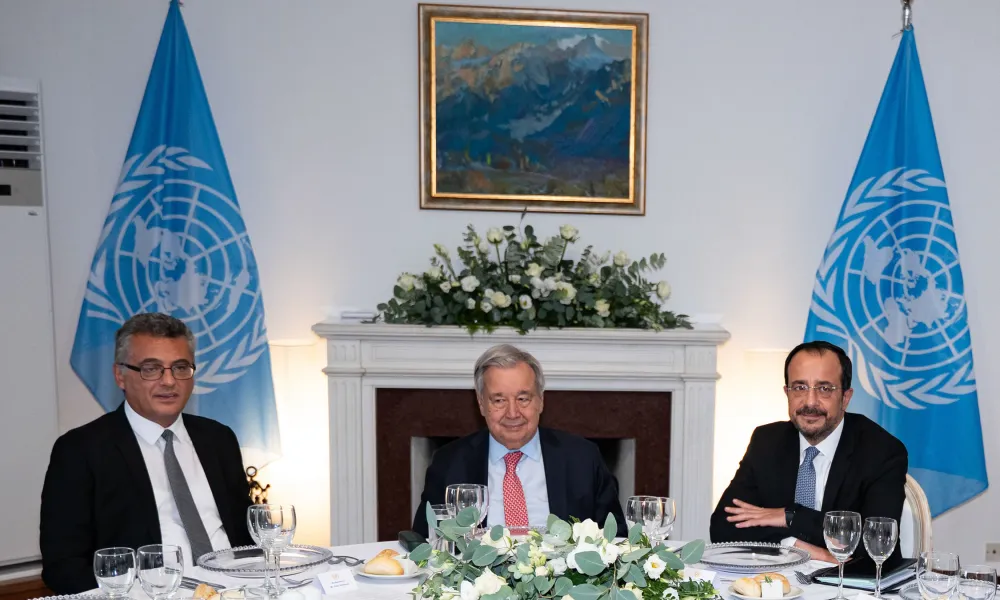
The issue resurfaced during the July 29 trilateral meeting hosted by Guterres. After the Secretary-General stressed the need to continue working on confidence-building measures, Christodoulides said he was prepared to accept the UN proposal on crossings. When Erhürman asked which parts of the proposal he was willing to accept, however, the Greek Cypriot leader reportedly limited his consent to the simultaneous opening of the Athienou-Pyroi-Aglandjia (Kiracıköy-Gaziler-Eylence) route, which in practical terms would involve two separate crossing points, together with Mia Milia (Haspolat).
That position excluded Louroujina (Akıncılar), even though it had formed part of the Secretary-General’s original four-crossing package from the outset. From the Turkish Cypriot perspective, the Greek Cypriot side was therefore not only maintaining its demand that the connecting road pass through the buffer zone, but also seeking the removal of a crossing considered essential to ensuring a reasonable balance of benefit between the two communities.
The disagreement was further complicated by Christodoulides’s renewed demand for a transit crossing through Kokkina (Erenköy). The Turkish Cypriot side regarded that proposal as knowingly unacceptable and objected in particular to its being presented as a condition for reconsidering the Louroujina (Akıncılar) crossing. In its view, the introduction of Kokkina (Erenköy) into the discussion created an additional obstacle and reinforced doubts about whether the Greek Cypriot leadership was genuinely prepared to agree on a balanced crossing-point package.
This broader context also changes the interpretation of the Athienou (Kiracıköy) proposal. UN technical work had reportedly shortened the section of the route passing through the buffer zone from approximately 13 kilometres to around 2.5 kilometres. Yet Turkish Cypriot leaders under both Ersin Tatar and Erhürman continued to consider the proposal politically and practically asymmetrical unless accompanied by Louroujina (Akıncılar) or another crossing providing a comparable benefit to the Turkish Cypriot side. Erhürman’s refusal was therefore not simply a rejection on narrow security grounds, but the result of a broader assessment involving reciprocity, territorial implications and equality of benefit.
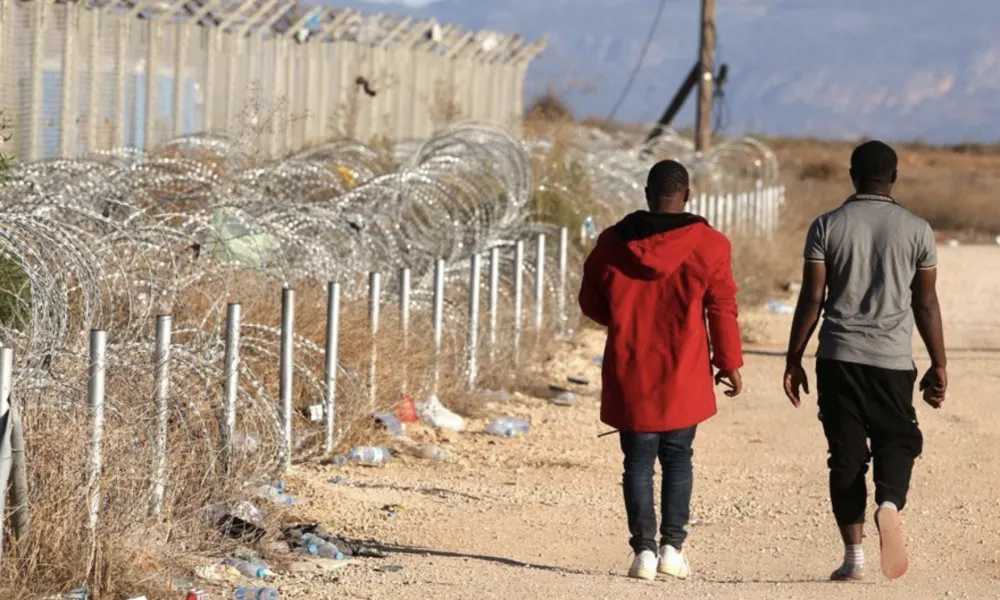
Crossing points were not the only area in which Guterres sought movement. During his visit, the Secretary-General proposed four additional confidence-building measures: progress on the problems affecting children and families arising from mixed marriages; island-wide demining beginning in the UN buffer zone; stronger cooperation against irregular migration; and the establishment of a joint mechanism to respond to natural and human-induced disasters.
The Turkish Cypriot side says it accepted all four proposals. The Greek Cypriot side rejected them, including the demining initiative, on the grounds that operations could not be conducted in areas where Turkish forces remained deployed. From the Turkish Cypriot perspective, this record weakens the argument that the failure to produce confidence-building measures resulted from its own inflexibility.
The episode reinforced a difficult lesson for Guterres. Almost nothing in Cyprus remains merely technical once it is converted into a concrete proposal. Roads become questions of territory and security. Demining becomes entangled with military presence. Migration cooperation touches on authority and recognition. Even disaster response can become trapped in arguments over institutional status. The Secretary-General’s result-oriented approach must therefore do more than identify practical measures. It must create a framework in which reciprocity is visible, benefits are balanced and neither side is expected to make concessions that reinforce the political advantages of the other.
The shape of a possible settlement
Nikos Christodoulides maintains that negotiations should resume where they ended at Crans-Montana in 2017. Erhürman remains committed to a settlement consistent with UN Security Council resolutions but argues that agreed parameters alone cannot produce an agreement without genuine political equality, effective participation and a results-oriented process.
That political equality cannot remain ceremonial. It must translate into effective participation, affirmative consent in designated areas, rotational arrangements and safeguards against domination by the numerical majority.
At the same time, the common state cannot be overloaded with powers the two sides cannot jointly exercise. The most realistic direction is a loose federal/confederal arrangement built on two politically equal constituent states, with the centre holding one international personality and a limited set of functions such as external representation, EU matters, macroeconomic coordination and agreed aspects of security, while most governing powers remain with the two states: federal in constitutional form but two-state in political substance, converting the island's existing duality into an agreed partnership rather than demanding either side abandon its position.
Confidence building as a test of capacity
Guterres has elevated confidence-building measures into a test of whether the two sides can cooperate, implement reciprocal decisions and deliver visible benefits. For Turkish Cypriots this matters practically: there has been no real improvement in mobility, Green Line trade, sporting participation, access to European opportunities or the status of children from mixed marriages, while property-related legal proceedings have increased uncertainty.
The next phase should concentrate on a measurable package covering crossings, trade, mixed-marriage children, youth and sport, environmental cooperation and energy.
Property illustrates why confidence building cannot substitute for negotiation: while the comprehensive property question stays unresolved, people cannot be encouraged to cross and cooperate while fearing unpredictable legal consequences.
Two diplomatic tracks, one objective
The Cyprus effort now proceeds along two tracks. The first, under the Secretary-General's good offices mission, will see Holguín return in the second half of September to continue engaging the two leaders and the guarantor powers, while Erhürman and Christodoulides work to narrow differences ahead of a possible 5+1 before the end of Guterres's term. Her task is not to resolve every issue beforehand but to establish shared purpose and a reasonable prospect that another conference can produce movement.
The second track belongs to the European Union. Commission Executive Vice-President Raffaele Fitto, the EU's special representative for Cyprus, arrived immediately after Guterres's departure for separate talks with Erhürman and Christodoulides. His role should not be to mediate governance, territory or guarantees, but to mobilise the EU's legal, financial and political instruments in support of a settlement.
The EU must become part of the solution
The European Union has long been part of the Cyprus problem as much as any prospective solution. Admitting the Greek Cypriot-controlled Republic of Cyprus in 2004, despite Greek Cypriot voters' rejection of the UN plan and Turkish Cypriot approval of it, removed incentives for compromise and deepened the imbalance between the two communities. Promised relief from Turkish Cypriot isolation was diluted or blocked, and direct trade never materialised. That approach has entrenched mistrust rather than bringing reconciliation closer.
The EU should now prepare a visible package improving Turkish Cypriot access to trade, education, youth programmes, finance and European institutions without waiting for a final settlement, address the status of children from mixed marriages, and demonstrate that its engagement is not channelled exclusively through the Republic of Cyprus.
The same track extends to Türkiye's expectations from Brussels, including Customs Union modernisation, visa liberalisation and participation in initiatives like the SAFE defence framework, which should form part of a wider architecture of reciprocal incentives rather than prizes granted in exchange for concessions.
No European package should be negotiated between Brussels, Nicosia and Ankara over the heads of Turkish Cypriots, who must be treated as a political actor and future constituent partner, not a minority awaiting accommodation.
Political equality and security remain the decisive tests
No methodology will succeed unless political equality becomes enforceable constitutional practice rather than a ceremonial acknowledgement. A partnership of two peoples cannot function as a conventional majoritarian state where one side can permanently outvote the other.
Security is equally difficult: Turkish Cypriots regard Türkiye's role as indispensable, while Greek Cypriots demand the end of intervention rights and withdrawal of Turkish forces. These questions cannot be settled by the two leaders alone, which is why a properly prepared 5+1 involving Türkiye, Greece and the UK remains necessary. A phased, reviewable and internationally supported arrangement may offer more promise than maximalist demands from either side.
A narrowing window
Guterres's term expires at the end of 2026, leaving only a few months to generate enough progress for a meaningful 5+1 before the Cyprus file passes to his successor. The goal is not a comprehensive settlement by December but enough common ground and substantive convergence to open a credible negotiating process. There is no reason for triumphalism: no comprehensive negotiations have begun, no conference date has been set, and no decisive agreement exists on governance, property, territory, political equality, security or guarantees.
It would nevertheless be wrong to call Guterres's mission a failure. He moved the process away from meeting-centred diplomacy and towards results-oriented preparation, steering the debate towards the only formula that may now reconcile principle with reality: two politically equal states, linked through a loose federal partnership, represented internationally through a common structure and supported by security arrangements acceptable to both communities and the guarantor powers.
The burden now rests on Erhürman, Christodoulides and their teams to narrow differences; on Holguín to turn the Secretary-General's formula into a workable roadmap; on Ankara, Athens and London to address the external dimensions; and on the European Union to decide whether it will keep protecting the imbalances of the past or finally use its power to help build a new partnership. Guterres did not leave Cyprus with a breakthrough, but he left behind a narrowing path towards a realistic settlement, one whose direction now depends on whether every actor, especially the EU, is prepared to become part of the solution.