

By Fiona Mullen*
On Thursday 27 August the 10 names of the newly constituted “Steering Committee of the Civil Society Consultative Body” were quietly released to the media.
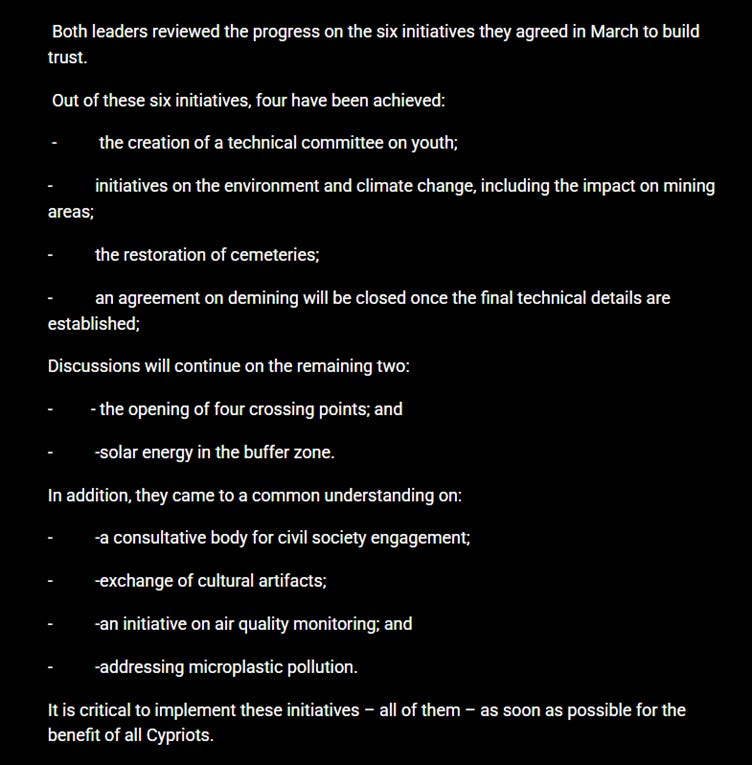
After many years in which the UN Security Council had called for greater engagement of citizens, the Consultative Body first started to come to life in July 2025, when the UN Secretary-General, Antonio Guterres, announced that the two leaders in the context of Cyprus problem negotiations, Nikos Christodoulides and at that time Ersin Tatar, had come “to a common understanding on … a consultative body for civil society engagement”.
It took another step forward in May 2026, when the leaders (this time Mr Christodoulides and Tufan Erhürman) “agreed on a framework for the establishment of a consultative body for civil society engagement”.
Finally, when the same two leaders met on 26 August this week, it was announced that the members of the Steering Committee would be released the following day.
The new Steering Committee has highly dedicated people with solid experience in citizen engagement and public opinion, who also have the nous to know what is politically achievable. In short, it is a really good team.
Drawing from remarks made on the Greek Cypriot side, the Steering Committee will essentially be the project manager for a broader 100-member body, with equal Greek Cypriot and Turkish Cypriot participation, “that will submit recommendations and views to both leaders”.
This two-tier approach, with a smaller expert group and then a larger group of citizens, is close to the proposals put forward by a group of us in February 2026. You can also find a more academic version of the paper here. For the larger body, we proposed not only that it should be randomly selected using internationally accepted standards but that it should also have rotating membership.
What resources will be needed?
Parallel to the official track, since May 2024 I have been working with Meltem Onurkan Samani of the Cyprus Peace and Dialogue Centre (CPDC) in promoting and testing pilot citizens’ assemblies, including a pilot funded by UNDP in December 2024 and the C-Up project currently funded the EU. This has supplied us with a number of lessons on how to make citizen deliberation as effective as possible. I am sharing my personal observations below.
To be really effective, the Consultative Body will need a range of resources.
- Professional selection. To ensure that the group of 50+50 is truly a random cross-section of citizens in each community, the Consultative Body will need to hire professionals to make the selection. This is really important because whenever I discuss assemblies, the first question out of everyone’s mouth, whatever their politics, is “who gets to decide participation?” The larger body needs not only to be a true cross-section but also needs to be seen as such.
- Simultaneous interpretation. Simultaneous interpreters will need to be hired to ensure that membership of the 100-member body is not confined to English-speaking elites and that members can speak in their own language and understand each other. (I have been nosing around the KUDO website for the latest in hybrid ai-live offerings.)
- Technical support on best practices. The Steering Group would benefit from hearing about best practices, for example, hearing from countries such as Ireland and France that have a long record of citizens’ assemblies on difficult topics.
- Compensation for participants. Best practice from the Netherlands-based DemocracyNext says that participants should be remunerated for their time.
- Employer support for participants. Unions and employers also need to be involved if sessions are to take place during working hours.
- Additional surveys. Even the larger group of 100 might benefit from additional surveys of opinion in the broader population to help support their decisions.
What topics should initially be discussed?
What topics should the 100 randomly selected citizens discuss? In some parts of the world, citizens themselves choose the topics for deliberation, or at least can be actively engaged in choosing them. However, the Cyprus problem is highly sensitive, and Cyprus is a young democracy, from a “broken home” so to speak. It has had little experience in truly deliberative citizen engagement. My hunch is that the leaders will at first mandate baby steps, rather than a full-scale launch into the Guterres Framework, for example.
Perhaps the 100-member body could start by making proposals for some of the less hot topics on the list read out by Mr Guterres in July 2025 (see the screenshot below). While the Technical Committee on Youth and now the Steering Committee for the Consultative Body have been constituted, my understanding is that there is still plenty to be done with the other items on the three lists.
Maturing into the Cyprus problem?
My hope is that, once the Consultative Body has been established as a viable and trusted way to support the leaders in making decisions about less hot but still controversial topics, they will be allowed to handle some more difficult issues. As I have argued here, one of the biggest obstacles to solving the Cyprus problem is that the leaders are pretty much alone when trying to make decisions. Knowing that a randomly selected group of citizens from both communities has supported a particular proposal should give them a great deal more courage to walk that final mile.
The latest technology is already helping to test different options. A group of researchers led by Charis Psaltis at the University of Cyprus has developed a tool that essentially invites you to pick your preferred solutions for security, political equality, property, territory etc, and then out pops a result showing how likely this package is to secure more than 50% support in both communities. (You can try out your own preferred Cyprus solution mix here). The technical term is “conjoint survey experiments”. They use large-participant surveys to identify possible “zones of agreement” between Greek Cypriots and Turkish Cypriots on different peace settlement packages.
Secondly, the DEMOS platform under development by Centre for Sustainable Peace and Democratic Development (SeeD) uses ai and doubtless great deal of background data to simulate UN-facilitated negotiations between Greek Cypriots and Turkish Cypriots. It can spot areas where there is likely to be disagreement, which can help train facilitators or potentially flag up issues that need more preparation before they head into full negotiations.
Either way, it is good for democracy
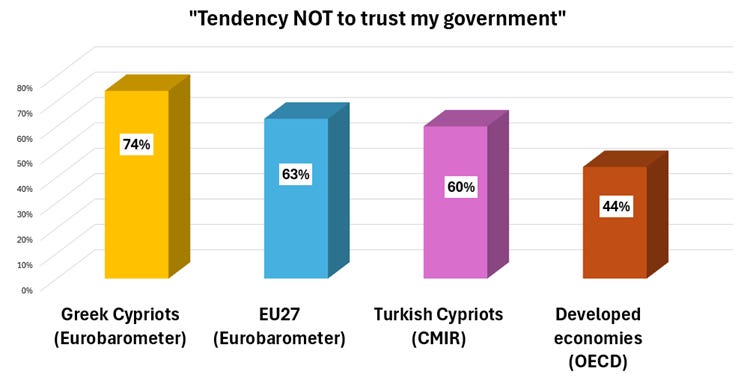
Even if we are still living with the Cyprus problem 10 years from now, the new Consultative Body will be good for democracy. You can see from the chart below that Cypriots have high levels of mistrust in their leaderships even by developed economy standards, which only encourages anti-democracy parties and the pursuit of damaging policies. Fully engaging citizens should go some way towards bringing down those mistrust levels.
*Fiona Mullen is Director of Sapienta Economics. This article first appeared on SapientaCyprus.substack.com.