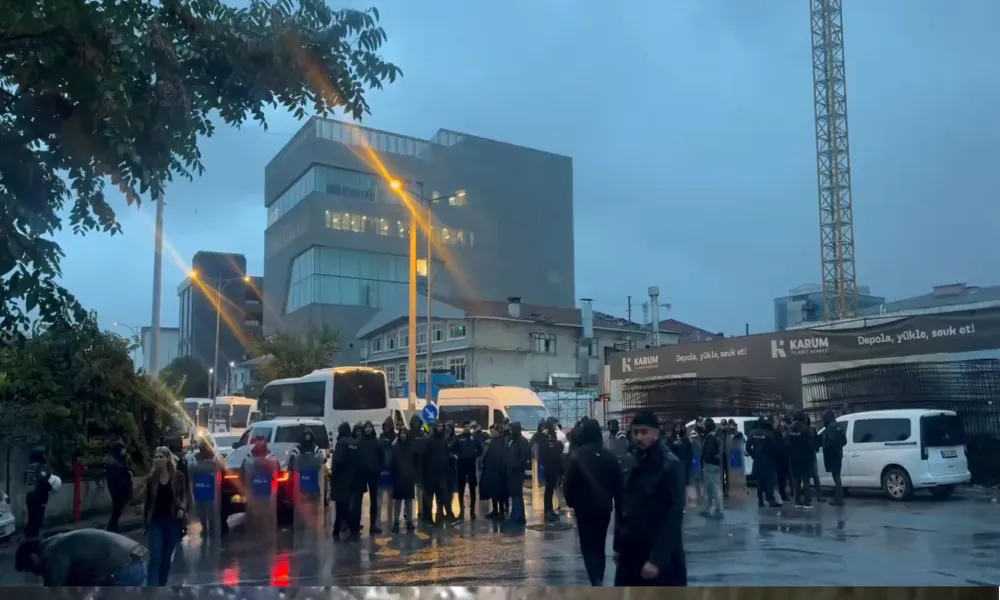

Police raided Halk TV’s Istanbul headquarters before dawn on 14 October. Reuters reported that the channel’s live feed was cut at 6:30 a.m. and replaced with prerecorded material. AFP described journalists and staff waiting outside in pouring rain as riot police stood behind shields. The live programme had been discussing the investment-fund scandal when it switched to a 1973 film. The images were striking, but the underlying fact was simple: a news broadcast stopped as police searched the premises and journalists were initially kept out.
The authorities said the operation stemmed from an investigation into Halk TV chairman Cafer Mahiroğlu. Prosecutors issued detention warrants for 17 people, and 11 were taken into custody. The allegations include bribery, bid-rigging and money laundering. Mahiroğlu denied wrongdoing, called the allegations baseless and accused the government of using the judiciary for political ends. He called the day “dark” and said, “We will get our channel back.” These are allegations and counterclaims in an ongoing investigation, not findings of guilt or motive.
The distinction matters. The investigation concerns alleged business conduct by the channel’s owner. The appointment of the Savings Deposit Insurance Fund (TMSF) as trustee and the suspension of live broadcasts affect the newsroom and its audience. The legal basis for investigating the owner and the consequences of suspending a broadcaster are related, but separate, questions.
Opposition leaders condemn the takeover
Opposition leader Özgür Özel condemned the dawn raid and trustee appointment, calling them “an act only dictators would commit.” He said that after trustees had been appointed to municipalities, the same approach was now being used against Halk TV, a broadcaster watched by millions. Özel also drew attention to the timing: the channel was taken over on the day jailed Istanbul Mayor Ekrem İmamoğlu was due to begin presenting his defence in court. That coincidence does not establish the operation’s motive, but it intensified opposition concerns about the channel’s ability to cover the trial.
İYİ Party leader Müsavat Dervişoğlu placed the raid within what he described as a widening use of trustees against institutions and groups outside the government’s control. “Dawn raids are less about establishing justice than extending a government’s tenure,” he said. He concluded: “Turkish democracy has seen coups, but it has never witnessed anything like this.” These were Dervişoğlu’s political judgments, delivered as he condemned the intervention.
DEM Party co-leader Tuncer Bakırhan also condemned the appointment, saying it was an intervention in press freedom and the public’s right to information. Together, the reactions show how opposition leaders connected the channel’s takeover to a broader concern over trusteeship and the shrinking space for dissent.
Journalists’ organisations warn of wider consequences
The International and European Federations of Journalists (IFJ and EFJ), together with the Journalists’ Union of Türkiye (TGS), DİSK Basın-İş, the Association of Journalists, the İzmir Journalists’ Association, the Contemporary Journalists’ Association and the Turkish Journalists’ Association, condemned the trustee appointment and broadcast suspension. IFJ and EFJ said viewers had lost access to an independent news source and stressed that the allegations concern the owner’s business activities, not the channel’s journalism. This is the federations’ assessment of the consequences, not a judicial finding about the operation’s purpose.
DİSK Basın-İş and the Contemporary Journalists’ Association explicitly compared the intervention with the previous year’s takeover of Tele1. The Contemporary Journalists’ Association called it a grave intervention in press freedom and freedom of expression. Other organisations stressed that press freedom protects both journalists’ ability to work and the public’s right to information. Their language was forceful, as advocacy statements often are. The events prompting their concern are concrete: police searched the newsroom, journalists were initially kept out, and the broadcast was interrupted.
What AFP, Reuters and AP said
AFP, Reuters and AP gave the raid substantial coverage. Reuters reported the time of the interruption and the appointment of TMSF. AP described Halk TV as one of the few broadcasters not aligned with the government and reported the objections of press groups and opposition parties. AFP covered the scene outside the headquarters, Mahiroğlu’s response and reactions from journalists and media-rights advocates.
A sentence circulating online that AFP said “independent journalism in Turkey may be on the path to disappearing” could not be verified in AFP’s published report on the raid. AFP did report that Tele1, taken over in 2025, remained on air but had lost its hard-news content. That distinction is important: a sweeping prediction should not be presented as a direct agency quotation when the published dispatch does not contain it.
The agencies reported the raid and interruption as events. Describing them as a grave threat to press freedom is an assessment made by journalists’ groups, rights organisations and political figures. The reports document the incident and place it in context; they do not establish that independent media have disappeared or prove the authorities’ intent.
International warnings, with context
European Parliament Türkiye Rapporteur Nacho Sánchez Amor wrote that the authorities were “not happy with controlling 90% of media” and were “aiming for 100%.” He warned that media and expression freedoms could soon be “just a memory.” Reuters reported his post. The 90% figure is part of Amor’s political criticism, not a fresh ownership study published with his statement. It should be read as a pointed characterization rather than a precise new measurement.
The European Democrats (PDE/EDP) described President Recep Tayyip Erdoğan’s “authoritarian drift” as systematic and argued that silencing media is a tactic of regimes, not democracies. That is a political organisation’s judgment, not a neutral finding. Its statement nevertheless shows how the takeover was being interpreted beyond Türkiye.
A quotation also circulating under Reporters Without Borders’ name needs a date check. Its phrase about “crushing the remaining vestiges of independence” came from an RSF statement in 2018 on sanctions against Halk TV and Fox TV. It was not a fresh comment on the October 2026 raid. The earlier warning is relevant to the history of concern over pressure on critical broadcasters, but should not be misattributed as a current response.
Ownership, money and digital restrictions
The Reuters Institute’s 2026 assessment describes Türkiye’s media landscape as highly concentrated. Major television and print outlets are controlled by conglomerates known for close ties to the government, while independent outlets have limited financial and regulatory support.
A 2025 mission to Türkiye by eight international press-freedom organisations, including the International Press Institute, ARTICLE 19 Europe, the Committee to Protect Journalists, Reporters Without Borders and Amnesty International, recorded 100 legal-harassment cases affecting 248 journalists. The mission also cited violence and impunity during protests, digital restrictions, 92 million Turkish lira in fines imposed on Halk TV and Tele1, and financial pressures that contributed to the closure of Gazete Duvar. It described the cumulative pressure as a “systemic siege” on independent journalism.
Online platforms are not a reliable escape from those pressures. In a 12 October statement, the Freedom of Expression Association (İFÖD) and 20 other human-rights and media-freedom organisations, including ARTICLE 19, Human Rights Watch and Amnesty International, said at least 1,270 X accounts had been targeted by blocking orders in Türkiye in September. The accounts had a combined following of 35 million, and X had made at least 90% unavailable inside the country.
That does not mean 35 million individual people were blocked. Follower counts are not unique-user counts, but they indicate the potential reach of the accounts affected. Reuters reported that İFÖD could identify court decisions for only 115 accounts; the grounds for restricting the other 1,155 were unclear. The organisations called on the government to end restrictions that violate freedom of expression and urged X and Meta to resist censorship demands and explain restrictions more transparently.
The T24 case shows how restrictions can affect an entire outlet. Reuters reported that a court blocked access to the website and its social-media accounts after authorities cited 118 items they considered “LGBT propaganda.” İFÖD’s EngelliWeb 2025 report, meanwhile, counted 1,505,484 websites and domain names blocked from access in Türkiye by the end of 2025. The total included 232,441 in 2025 and 314,843 in 2024. These figures do not mean that every blocked address was a news outlet or remains inaccessible today. They show the cumulative scale of internet blocking. EngelliWeb’s own X account was also reported blocked, an especially striking development for a project that monitors online censorship.
Has independent media disappeared?
No. Journalists, digital outlets, critical broadcasters and local media continue to report. But concentrated ownership, financial strain, legal pressure, fines, trustee appointments and online restrictions make it harder to sustain their work and reach audiences.
The responses to Halk TV came from different quarters. News agencies documented the raid and interruption. Journalists’ organisations focused on the newsroom and the public’s right to information. Rights groups highlighted digital restrictions. Opposition leaders warned of political consequences, while European representatives offered broader criticism. Their assessments do not prove every claim about motive. Their convergence around access, pluralism and accountability does show why the takeover is being treated as more than a dispute over one company.
The number of channels on the remote may not change. The real question is whether viewers can still hear a range of independent voices, and whether those voices can keep reporting when the screen goes dark.