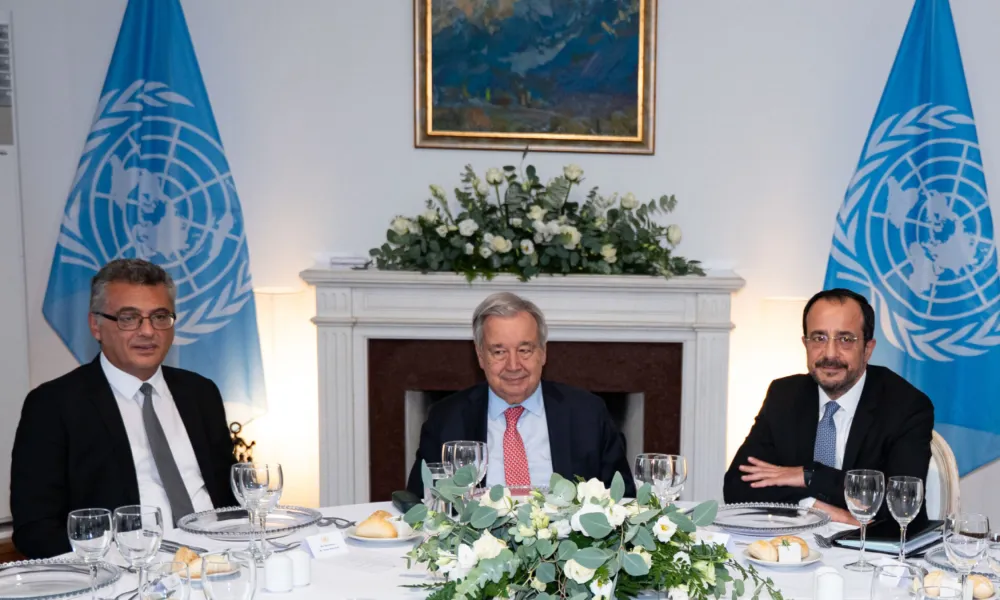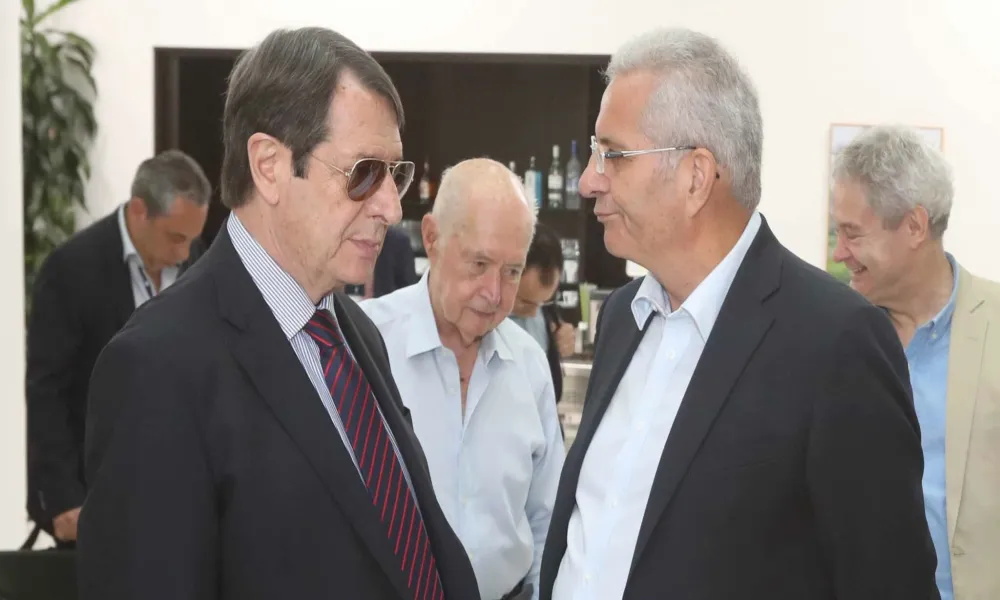

Former AKEL Secretary-General and MP Andros Kyprianou spoke to Politis about the final dinner at Crans-Montana and the stance of former President Nicos Anastasiades. He revealed that UN notes recorded the moment Anastasiades visibly changed colour when informed by the UN Secretary-General that the Turkish side was ready to discuss the abolition of guarantees and intervention rights. Kyprianou also assessed the latest developments in the Cyprus problem following the election of Tufan Erhürman as leader of the Turkish Cypriot community, as well as the position of President Christodoulides.
The discussion has resurfaced regarding the Crans-Montana dinner and the positions of the parties involved. What do you know about that evening, and who were you informed by?
First, I would like to express my regret that Nicos Anastasiades, instead of realising the extent of the damage he caused to the effort to resolve the Cyprus problem and put a stop to discussing these matters, continues to seek justification to this day for an issue where the overwhelming majority of the Cypriot people recognise that his actions caused enormous harm.
The day before the dinner, he spoke of two states to the Turkish Foreign Minister – a move which, in my view, was criminal against Cyprus. When you tell the party with whom you are negotiating that you are ready to discuss two states, that other party will not make the concessions you hope for to reach an agreed solution.
Secondly, I want to emphasise that I was informed about the dinner by the EU and from UN notes, which I obtained through contacts with the UN Secretariat. I also spoke with Federica Mogherini, who told me exactly what had happened. I had also spoken with the then Greek Prime Minister Alexis Tsipras during the dinner, who asked me to contact him, and subsequently updated me on what was happening at the dinner and requested that I intervene to change Nicos Anastasiades’ stance.
It should also be noted that before the dinner, the UN Secretary-General had informed Mr Anastasiades that Turkey was ready to discuss the abolition of the guarantees and the right of intervention, provided that we concluded discussions on the issues of rotating presidency and political equality. These were the issues of interest to the Turkish side. The Secretary-General reiterated this at the dinner. This is what the UN notes record. However, Mr Anastasiades requested that the Turkish side provide this in writing. I was informed by the UN before the dinner that there was no chance Turkey would provide such written assurances before being certain that an agreement would be reached. Mr Çavuşoğlu considered that if they did so and no agreement was reached, these positions would remain on the negotiating table for future discussions, and Turkey would face strong domestic criticism. They, too, needed to protect themselves. Therefore, the Turkish side asked the Secretary-General to present these positions at the dinner, as Mr Guterres did. The Secretary-General did not just say this once, but several times, and when Anastasiades asked Çavuşoğlu to confirm these issues, the Turkish Foreign Minister replied, “Listen to what the Secretary-General is telling you.” When the Turkish side realised that Anastasiades had no intention of negotiating seriously, it changed course and hardened its stance, leading to the dinner’s failure.
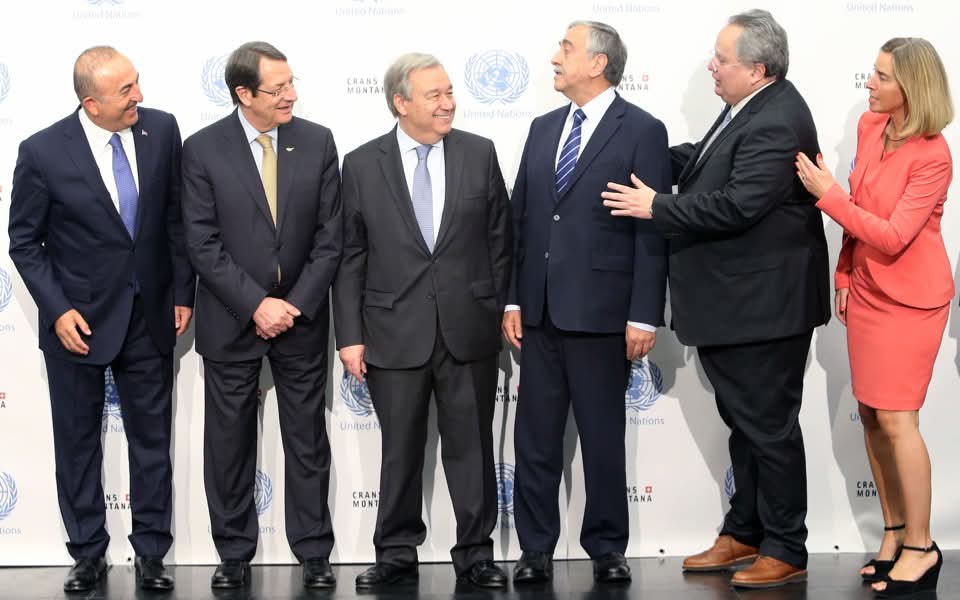
Meanwhile, in the UN notes I obtained and read, something quite interesting is recorded. They state that when the Secretary-General informed Mr Anastasiades of the Turkish side’s readiness to discuss the abolition of guarantees and the right of intervention, the former President changed colour and demanded the immediate withdrawal of all troops. This was a position repeatedly voiced in National Council meetings by the parties DIKO, EDEK, Citizens’ Alliance, and Solidarity, which Anastasiades had rejected as entirely unrealistic. However, upon hearing that the Turkish side was ready to discuss the other issues concerning guarantees and the right of intervention, he decided to shift and demand the immediate withdrawal of troops. All this shows that we went to Crans-Montana unprepared to work towards a solution. If the Turkish side had not cooperated, we would have been vindicated in the eyes of the international community as the side with genuine intent, while Turkey would have been exposed as representing unacceptable positions.
This did not happen. Instead, in the Secretary-General’s report, specifically paragraph 18, the last 2.5 lines clearly state that, regardless of the public rhetoric of the guarantor powers, in private, in-depth meetings, they were willing to cooperate to overcome differences and reach an agreement. In other words, according to the Secretary-General, Turkey went to Crans-Montana to cooperate and find a solution. When the draft report was circulated, Mr Anastasiades did not challenge this reference. With his acquiescence, it became an official UN document. I repeat: any researcher investigating what happened at Crans-Montana will see that Turkey cooperated to resolve the issue, and it was our side that bore responsibility for the failure. The question remains: why did Nicos Anastasiades not prevent the inclusion of this reference in the report if he believes his narrative is correct? Because I asked him many times and received no answer, my interpretation is simple: since the Secretary-General presided over the dinner and knew exactly what happened, Anastasiades did not dare tell him otherwise.
The narrative
Some say you were slow to speak about Nicos Anastasiades’ responsibility at Crans-Montana.
This is the narrative that Nicos Anastasiades is trying to cultivate. We returned from Crans-Montana on Friday 5 July 2017, and on Saturday morning, I appeared on ASTRA in an interview with Neophytos Neophytou, stating that Anastasiades’ narrative about the dinner did not convince me. I also said I would seek full information on what had really happened and then speak publicly. That same day, Anastasiades contacted me, saying he had heard what I stated on ASTRA: “Because I respect you and don’t want you to be exposed, don’t continue, or I will release the dinner minutes and you will be exposed.” I replied that he could maintain his narrative, but I would learn the truth and speak publicly. On Tuesday morning, I travelled to Athens, met the Greek Prime Minister Alexis Tsipras, and obtained further information. I then met with Ms Mogherini and UN representatives to discuss the matter. Once fully informed, I began speaking publicly, from early 2018. Therefore, the claim that I delayed speaking is, at the very least, laughable.
Did your support for Nicos Anastasiades on the Cyprus problem before Crans-Montana cost you the position of General Secretary?
Absolutely not. I want to clarify that it was my decision not to run again for AKEL General Secretary, as provided in the party’s statutes. The statute states that a member holds a professional post until the age of 65. I had turned 66 when I left office. This provision was introduced in 1990, and this is why Stefanos Stefanou stated after his re-election that he would not seek the post again, as he was turning 65. However, AKEL and I personally paid a political price for the support we extended to the process - not to Anastasiades. The abuse I endured online and offline was unprecedented. Images of me with a Turkish fez circulated, while Anastasiades and other political figures did not dare hint this directly to me, but publicly implied I adopted Turkish positions.
Erhürman
What is your reading of the developments likely to arise from Tufan Erhürman’s election as Turkish Cypriot leader?
I know Tufan Erhürman very well; we have met many times and have excellent personal relations. Politically, we are also close. Mr Erhürman is familiar with the Cyprus problem, having been in Mehmet Ali Talat’s negotiating team. He has repeatedly affirmed his agreement with the established framework and related UN resolutions, namely a bizonal, bicommunal federation with political equality. We have emphasised this in many joint statements when I was AKEL General Secretary and he was leader of the Republican Turkish Party. However, as leader of the Turkish Cypriot community, he faces constraints. Turkey controls the Turkish Cypriot community to a large extent, so Mr Erhürman will need to act politically vis-à-vis Turkey. He cannot confront Ankara and expect political survival and a Cyprus solution. If we do not understand these realities and assist him in helping us solve the Cyprus problem, I fear failure - just as Anastasiades failed with Mustafa Akıncı.
Nicos Christodoulides
How can the Greek Cypriot side help him?
I have observed that since Erhürman’s election, President Christodoulides seems completely awkward. This discomfort creates problems for Erhürman. The new Turkish Cypriot leader is preparing to visit Turkey. What message will he convey? He will essentially say, “I will start negotiations with Christodoulides, but I don’t know his intentions regarding the Cyprus solution.” Shouldn’t Christodoulides, from the moment of Erhürman’s election, publicly make clear statements to foster a climate that helps the new leader persuade Turkey to engage seriously, and indicate that this time we will go all the way? Shouldn’t he have stated, “If negotiations begin and Turkey cooperates within the agreed framework, I commit to achieving results swiftly, provided we collaborate on the right basis”?
Four points
Do you think the Greek Cypriot side should accept the four points set by Erhürman?
Three points can easily be accepted. The fourth point, which I raised with Özdil Nami, concerns recognising the pseudo-state if the process fails. No Greek Cypriot can accept this. I have said that while we do not want guarantees, the Turkish side insists on them, at least for now. If any process fails, who bears responsibility and who will be penalised? These are highly sensitive issues; one cannot predetermine punishment if no agreement is reached. There must be honesty, political will, commitment to put forward bridging positions, and readiness to see negotiations through to the end.
Is a change in negotiation methodology needed, as Erhürman suggests?
At Crans-Montana, we came very close to an agreement. Therefore, I believe that if there is political will and goodwill, the six points of the Guterres framework could be agreed. It would take just a few hours to reach agreement. Beyond that, many other details would need to be addressed. But if the six points are agreed, there will be no turning back, as they form the core of the substantive issues. That is where the focus must be.
Tufan Erhürman raises all these matters for a very simple reason: there is no trust between the two communities and their leaders. That is why I believe messages need to be sent from Nicos Christodoulides’ side. My view, however, is that Christodoulides started on the wrong foot from the outset. We had made proposals to Nicos Anastasiades in December 2020 on what needed to be done; the new AKEL leadership repeated these proposals to Nicos Christodoulides. What we are saying is very simple: we are ready to continue from where we left off at Crans-Montana, and if the Turkish side agrees to hold talks within the framework set out by the relevant UN resolutions, then we are ready to present bridging proposals and to move forward to a final solution in a short period of time, provided that the Turkish side is equally ready to submit similar bridging proposals.
We must also give Turkey an incentive. We need to make it clear that if Ankara helps us resolve the Cyprus problem, we are ready to discuss potential cooperation on gas and trade issues, and that we will not obstruct any possible upgrading of Turkey’s relations with the EU, provided it meets the criteria set by Europe. Christodoulides should have made these points from the beginning, but he did not. On the contrary, he handled the Cyprus problem in a very mistaken way, and I believe he bears responsibility, as 2.5 years after his election, negotiations have neither started nor has the Turkish side been effectively pressured.
Political equality
Mr Erhürman has stated that political equality is non-negotiable.
It is non-negotiable. Political equality is essential, but it does not mean numerical equality. I would remind you that at the first Mont Pèlerin meeting we reached conclusions on governance, that is, political equality. We retreated at the second Mont Pèlerin, and subsequently the Turkish side also backtracked, demanding a positive vote in all institutions.
Many believe that even if the two leaders reach an agreement, there would be huge difficulties in obtaining approval in referenda in the two communities and fear a repeat of the 2004 scenario.
I must say that in 2004 there was no agreement. If today’s leaders reach an agreement, I have no doubt that it will be approved by the Cypriot people. The problem is that these two particular leaders cannot reach an agreement, and that is my subjective view.
Why?
Time will tell. I hope it becomes clear that there is this possibility, and I have no doubt that AKEL would fully support such an outcome. I want to stress that DISY has spoken repeatedly about the need for compromise on national issues. AKEL has proven in practice that it made compromises without fanfare, whereas when Dimitris Christofias was President, DISY treated him harshly on the Cyprus problem from September 2009 onwards, using as a pretext that the rotating presidency should not be proposed. This was the argument of Nicos Anastasiades, who later adopted the rotating presidency.
Nevertheless, after many back-and-forths, when Anastasiades decided in 2015 to start negotiations, AKEL provided selfless support. AKEL supported the process without requesting any concessions. In fact, AKEL submitted comprehensive proposals on various aspects of the Cyprus problem in an effort to help achieve a solution. Even though AKEL had every right to criticise Anastasiades’ contradictory handling, it adopted a careful stance, allowing a chance for a potential agreement. Only when it became clear that Anastasiades had changed course did we begin to criticise strongly.
Therefore, I believe no formal cooperation is needed between AKEL and DISY, provided there is honesty and political will to work together for the good of the country and the people, as we did from 2015 until Crans-Montana. I am, however, waiting to see how Christodoulides will respond to Erhürman’s election. I have yet to see a concrete reaction signalling that he will seek to leverage Erhürman’s election. A new leader has been elected who supports the agreed framework for a solution; we do not agree on everything, and that must be understood, but at least discussions are possible, and where there is disagreement, solutions can be found that do not harm Cyprus or its people.
Recently, there has been a resurgence of American interest in our region, with concrete steps in energy and other initiatives. Do you believe this creates prospects for resolving the Cyprus problem through US mediation?
Various things are being written, and I do not know the reality regarding US intentions, specifically Mr Trump’s stance on the Cyprus problem. I do want to clarify something because much is said about the past, how AKEL supposedly acted against US initiatives. If there is an initiative or proposal from the US that primarily serves the interests of Cyprus and its people, I am convinced that AKEL will support it. But it must serve Cyprus and its people first, not primarily the US.
Can it serve both?
It depends. If, for example, we were asked to join NATO in order to solve the Cyprus problem, I declare now that personally I would not accept it.
Earlier you said we are on the brink of partition. So, if we simplified the dilemma to “partition or NATO membership,” would the Left…
There is no such dilemma. It exists only in the minds of some people. Turkey will never accept Cyprus joining NATO unless the Cyprus problem is solved. Which solution will lead to NATO membership is another matter. I repeat, NATO is an aggressive military organisation that has caused enormous damage in many countries, including Cyprus. I believe NATO has no reason to exist, as there is no opposing threat. The EU’s warnings of a potential Russian attack in 2030 are laughable. These arguments convince people who, in my view, have not studied history or contemporary politics. It is not Russia that is waging aggressive wars to shape the global order to its advantage - it is NATO. Russia, in my opinion, wrongly continues the war in Ukraine but understands it is encircled by an aggressive opponent like NATO. The Americans themselves acknowledge these issues.
Yes, but you did not answer my question. If a final solution were proposed, as you describe the situation, and it included reunified Cyprus joining NATO, would AKEL be right to choose partition to avoid NATO membership?
Your question reminds me of a story about a family: the husband asked his wife to fetch wine from the cellar, and she saw an axe hanging from the ceiling and began to cry. He asked why, and she said, “I thought, if we have a baby and it goes to get the wine and the axe falls on its head, what will we do?” I have learned in politics not to answer hypothetical questions. Let us wait to see what solution is proposed and what it contains, and then we can discuss.
His own book
Have you finished the book you are writing on the Cyprus problem? When will it be published?
The book is finished and has been sent to the publisher. I intend to release it after the parliamentary elections, as I do not want it lost amid pre-election debates.
What new insight does your book provide on the Cyprus problem?
Many new details. For example, I reveal the content of discussions I had with Turkish Prime Minister Ahmet Davutoğlu in Istanbul in January 2016. I also discuss my talks with Alexis Tsipras about Crans-Montana.
The book focuses entirely on the Cyprus problem, starting with a brief reference to Glafcos Clerides’ presidency, highlighting contradictions in his handling of the Cyprus problem. I then discuss Tassos Papadopoulos’ presidency and how he managed the Cyprus problem, followed by Dimitris Christofias, and in greatest detail Nicos Anastasiades, whose responsibilities, I believe, are enormous for where we stand today - not a step away from final partition.
I want to clarify something to avoid misunderstanding: Turkey is the occupying power. It invaded Cyprus illegally and continues to hold a large part of our territory unlawfully. It bears huge responsibility for its intransigence and unacceptable positions over the years. Yet we also bear our own responsibility, and if we do not confront it objectively, we will never resolve the Cyprus problem. That is why I decided to write this book - it is my duty to historical truth.
Does AKEL bear responsibility, such as for the “No” of 2004?
I would put the question differently: could AKEL have acted differently? Certainly. But I do not believe AKEL’s responsibilities can be compared to those of anyone else. That said, over the years AKEL has carried its share of responsibility.