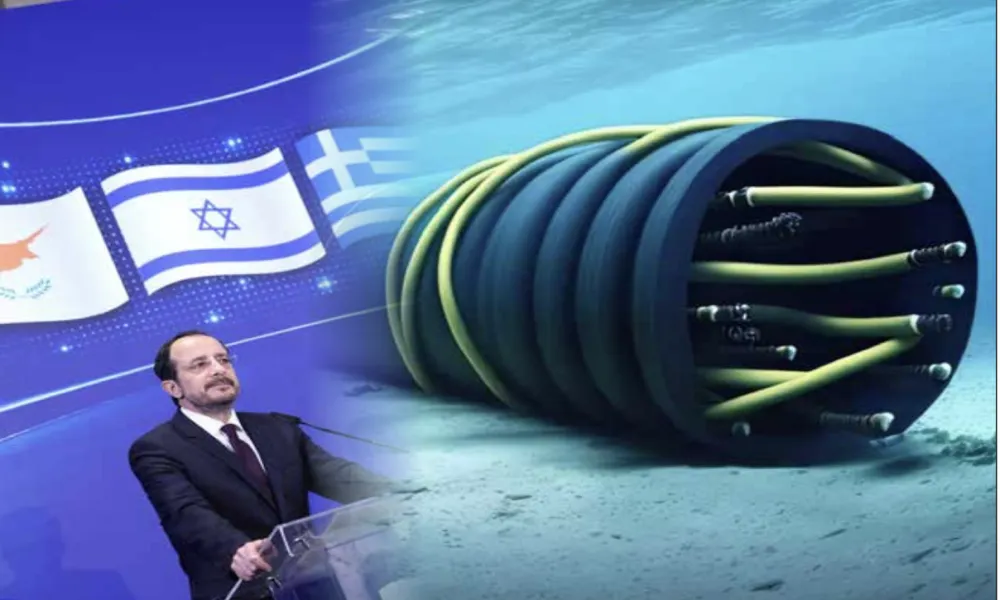

The IMEC, extensively mentioned by Israeli Prime Minister Benjamin Netanyahu during the Jerusalem trilateral summit, is the acronym for the India–Middle East–Europe Economic Corridor. Some investors are backing this corridor, while others say it could become yet another dream that never materialises. Supporters describe it as a geo-economic and geopolitical initiative aimed at creating a new corridor for transport, energy, digital networks, and trade, linking India, the Middle East (primarily Saudi Arabia, the UAE, Israel), and Europe via Greece and Italy. Where does Cyprus fit, and what role could it play?
What IMEC includes
IMEC plans include maritime and railway connections, energy infrastructure (electricity grids, green energy, hydrogen), digital cables, and data corridors. Announced in 2023 during the G20, with support from the EU, the United States, India, and Middle Eastern countries, it is seen as an alternative corridor to China’s One Belt, One Road Initiative, in which Greece already participates through the port of Piraeus.
Historical context
Both IMEC and One Belt are modern iterations of the Silk Road - a vast network of land and maritime trade routes connecting East Asia with the Mediterranean and Europe from around the 2nd century BCE to the 15th century CE. It was not a single road, but multiple branches passing through China, Central Asia, and the Middle East, reaching the Mediterranean. These routes transported silk, spices, precious stones, paper, and porcelain, as well as ideas, religions, and technologies (Buddhism, Islam, papermaking, gunpowder).
Corridors like these - then and now - are vital because they build economic and cultural links, facilitate knowledge and cultural exchange, influence the geopolitical balance of their era, and strengthen the role of the Eastern Mediterranean as a hub for energy and trade. Historically, Cyprus, as part of empires, had minimal influence over such corridors. From ancient times, the region was dominated by Phoenicians, Egyptians, Persians, Hellenistic kingdoms, Romans, Byzantines, Venetians, Genoese, and the British. Only from the late 20th century did Cypriots begin creating their own opportunities. Today, Cyprus is one of the largest maritime bases for ship management and services, with Limassol functioning as a full maritime ecosystem, supported by investment and modern infrastructure.
The trilateral summit
In his recent statements, Netanyahu linked IMEC to discussions with Greece and Cyprus, alluding to new regional balances and, implicitly, to countering Turkey. The Israeli Prime Minister’s message suggested that relations with Turkey are unlikely to return to normal, reinforcing scenarios for an Israel–Cyprus–Greece defence axis. Some Greek and Cypriot media interpreted this as Turkey being “encircled,” echoing Turkish propaganda that Cyprus has become a base for forces hostile to Ankara.
The contradiction
Both Cyprus and Greece seem to underestimate that Netanyahu will not remain Prime Minister forever. Israel is unlikely to support a Cyprus settlement that would enhance Turkey’s influence in the Eastern Mediterranean. By allowing the Israeli Prime Minister to speak on their behalf, both nations appear to endorse military rhetoric, enabling Turkish media to portray Ankara as threatened, reviving doctrines dating to the Treaty of Sèvres in 1918. This doctrine contributed historically to the destruction of Smyrna, the annexation of Alexandretta, the Cyprus invasion, and today shapes Turkey’s influence in Idlib, Syria.
Maintaining friendly relations with Israel is useful, but Cyprus aligning fully to counter Turkey contradicts its own president’s repeated statements about readiness for Cyprus settlement talks. Many diplomats and politicians worry that the Republic of Cyprus may once again be bluffing on the Cyprus issue.
IMEC and Cyprus
The significance of IMEC has been overshadowed by regional politics. Cyprus is not an official IMEC participant but is indirectly and potentially strategically involved at three levels:
-
Geographical and geopolitical hub: Cyprus lies on the natural maritime axis connecting the Middle East and Europe. If IMEC expands beyond its initial routes, Cyprus could serve as an intermediary hub (logistics, bunkering, data centres) supporting maritime and energy connections to the EU. Some Cypriot banks, like Eurobank, have already established offices in India to serve Greek and Cypriot investors.
-
Energy hub: IMEC includes electricity interconnections, green energy, and data cables. Cyprus could play a significant role if linked indirectly via Israel and Greece. Participation in energy/data connections aligned with EU priorities could position Cyprus strategically.
-
EU membership: Cyprus can indirectly influence European IMEC strategy, claim complementary roles through funding or confidence-building measures, and integrate IMEC into a broader narrative of stability and cooperation in the Eastern Mediterranean.
Limitations without a Cyprus settlement
Cyprus’ potential role depends heavily on political developments and regional stability.
-
With a settlement: Cyprus could transition from a peripheral actor to a strategic platform, integrated into a unified European energy and regulatory space, participating institutionally in IMEC expansions (energy, data, logistics) in Egypt, Syria, southern Turkey, and Lebanon. The island could facilitate electricity interconnections, green hydrogen, and subsea cables, becoming a bridge between the EU and the Eastern Mediterranean.
-
Without a settlement: The island remains divided, with disputed sovereignty in the north. Any large-scale intergovernmental project is legally fragile, and international financiers avoid politically or legally risky routes. Despite offshore gas reserves since 2011, no major investments have materialised from global energy companies like Chevron, Exxon, or Total. Major trade and energy corridors are planned not just geographically, but where stability, institutional cohesion, and implementation feasibility are guaranteed. Without a Cyprus settlement, IMEC will likely bypass the island in favour of politically safer routes.
Cyprus’ strategic potential is immense, but fully realising it requires a Cyprus settlement. Otherwise, the island risks remaining a marginal player while IMEC progresses along routes that are stable, feasible, and politically “clean.” The real stakes lie in transforming Cyprus from a geographic point into a strategic platform, a goal hindered by ongoing division and political uncertainty.
This article was originally published in the Politis Sunday Edition.