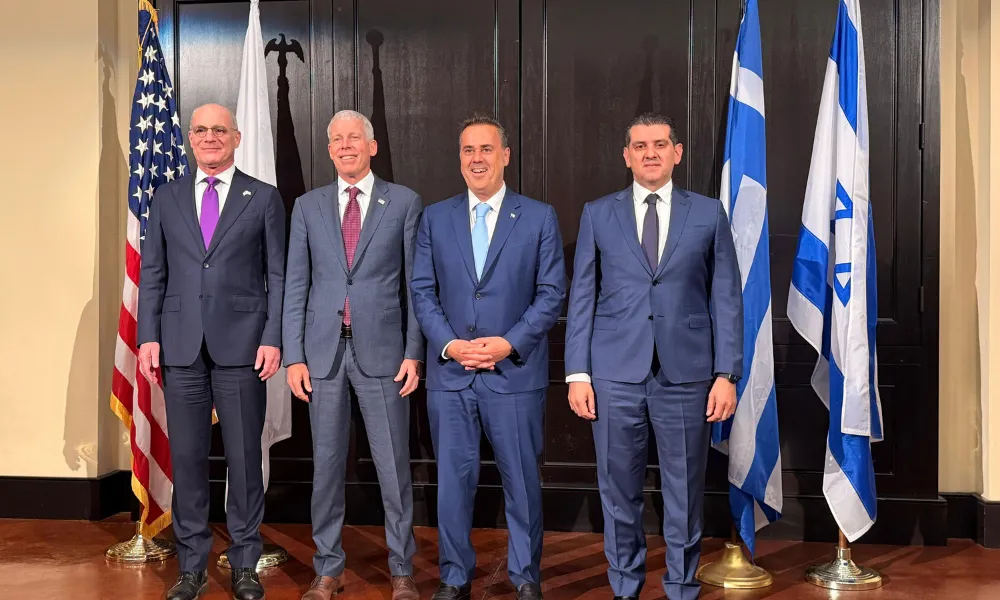

Energy ministers from Cyprus, Greece, Israel and the United States met in Houston on Thursday for a 3+1 ministerial dialogue that marked the launch of the Eastern Mediterranean Energy Center, a new platform designed to strengthen energy security, regional connectivity and cooperation in the Eastern Mediterranean.
Cyprus’ Minister of Energy Michael Damianos described the launch as a “historic” step, saying the centre had begun as an ambitious idea in 2019, when the Eastern Mediterranean Security and Energy Partnership Act was adopted by the US Congress, and had now taken concrete form.
The centre will be based in Houston, one of the world’s leading energy hubs, and is expected to bring together governments, universities, research institutions, energy companies and investors. Its work will focus on energy innovation, offshore development, technology transfer, technical standards, training and the analysis of emerging geopolitical energy challenges.
Damianos said the initiative comes at a time of “challenging geopolitical” conditions and sends an optimistic message about future cooperation. He argued that the Eastern Mediterranean can play a meaningful role in diversifying energy sources and supply routes, while strengthening the resilience of states and contributing to wider regional stability.
Cyprus’ role in the framework was linked directly to its natural gas prospects. According to Damianos, drilling activity in Cyprus’ Exclusive Economic Zone since 2011 has led to six confirmed discoveries, Aphrodite, Cronos, Zeus, Calypso, Glaucus and Pegasus, with total estimated capacity of around 20 trillion cubic feet.
He also pointed to the presence of international energy companies, including Chevron and ExxonMobil, as evidence of confidence in Cyprus’ energy potential. The development plan for Aphrodite provides for gas to be transported to Egypt through a subsea pipeline, while Cronos is being advanced through a fast-track process using Egypt’s existing infrastructure, with a view to exports to regional and European markets.
Connectivity was another central theme of the meeting. Damianos said ending Cyprus’ energy isolation remains a strategic priority, with electricity interconnections seen as essential for security of supply, greater use of renewables and the integration of the Eastern Mediterranean into European energy planning.
In that context, he referred to the Great Sea Interconnector, which is intended to connect Cyprus and Israel with the European Union’s internal electricity market through Greece. He also underlined the importance of US support for strategic connectivity projects.
US Energy Secretary Chris Wright said the centre brings together energy and the Eastern Mediterranean, describing the region as an emerging energy powerhouse. He said energy development and distribution infrastructure can bring countries and people closer together through commerce rather than conflict.
Greek Energy Minister Stavros Papastavrou called the launch a landmark moment for strategic cooperation and regional connectivity, while Yossi Dayan, Director General of Israel’s Ministry of Energy and Infrastructure, said Israel strongly supports the centre as a platform for energy security, technological innovation and regional resilience.
In Nicosia, Government Spokesperson Konstantinos Letymbiotis said on Friday that the 3+1 dialogue and the launch of the centre carry “particular political and geostrategic significance”. He said the centre gives the cooperation a more practical dimension and can become a point of reference for expertise-sharing and joint initiatives.
Letymbiotis also linked the development to the Eastern Mediterranean Gateway Act, saying it reflects a broader US strategy that treats the region as a strategic bridge between Europe, the Middle East and India, with explicit reference to Cyprus, the 3+1 framework and critical infrastructure.
With information from CNA