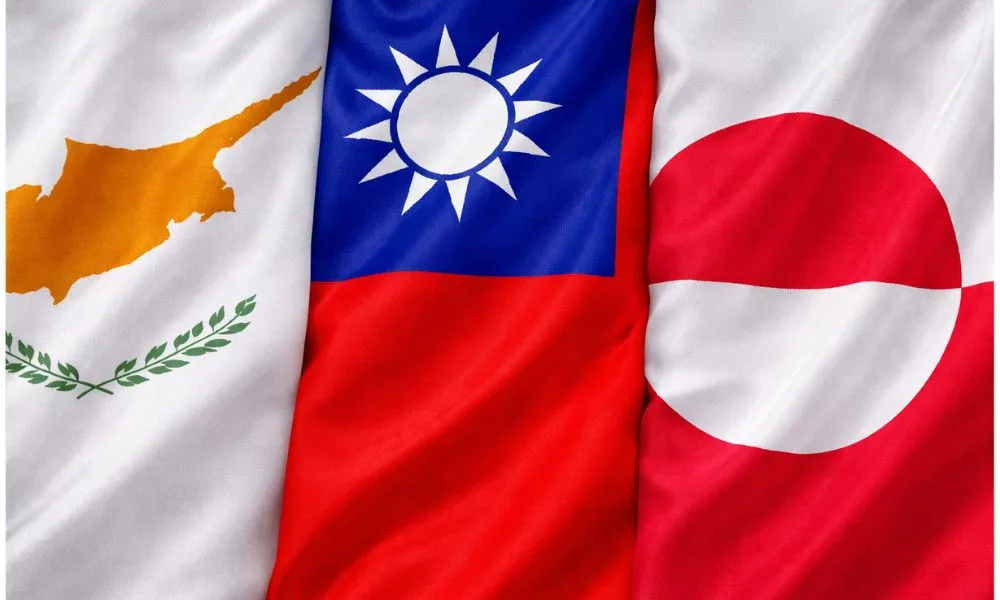
What do Cyprus, Taiwan, and Greenland have in common? Despite their different sizes, these three islands are linked by a shared geopolitical truth.
More than anything else, their fate is shaped by geography. As history has shown, geographic position is often more powerful than democratic will, international law, or the intentions of peoples. We are talking about three islands with small or medium-sized populations but enormous geopolitical significance. They do not set the global agenda, yet they inevitably find themselves at its centre.
Geography as destiny
Cyprus, with a population of one million, sits at the crossroads of three continents. Whoever controls its territory can influence maritime and air routes connecting Europe with the Middle East and North Africa. It is no coincidence that for centuries it was contested by empires, nor that today it hosts foreign military bases and remains divided.
Taiwan, on the other hand, is the cornerstone of Western security in East Asia. With a population of 23 million, it lies along the “first island chain” that restricts China’s naval access to the Pacific. If Taiwan slips from Western control, the balance of power in Asia — and possibly globally — would change radically, with Australia potentially the first major casualty.
Greenland, finally, dominates the Arctic. As climate change opens new sea routes, reveals mineral wealth, and revives great-power competition, control of Greenland becomes critical. With a population of around 56,000, Greenland offers vast land areas should climate change render other regions uninhabitable, and space for what could one day become the planet’s future tourist resorts.
Sovereignty without full control
In simple terms, these are three islands whose location makes them far more important than their population size would suggest.
-
Cyprus is an internationally recognised state and a member of the European Union, yet it does not exercise full sovereignty over its territory. Part of the island remains under military occupation, while sovereign foreign bases operate elsewhere, with the prospect of more to come. Its sovereignty is legally intact but politically and militarily constrained.
-
Taiwan has all the attributes of statehood: an elected government, armed forces, and a high-tech economy. Yet its status as a state remains contested. As the Republic of China under Chiang Kai-shek, Taiwan was expelled from the United Nations on 25 October 1971 under Resolution 2758, which recognised the People’s Republic of China, under Mao Zedong, as the sole legitimate representative of China. Since then, Beijing has claimed Taiwan as its territory.
-
Greenland enjoys extensive autonomy but is not a sovereign state. Key decisions on defence and foreign policy are taken elsewhere. Denmark retains political authority, while the United States maintains a military base in the region. Despite strong public sentiment for greater independence, geopolitical realities act as a brake. Greenland covers about 2,166,000 square kilometres and is 236 times larger than Cyprus.
In all three cases, sovereignty is a relative concept. It exists, but it is not absolute. It is defined by power dynamics that extend far beyond the islands themselves.
In Cyprus, the great powers did not ask permission when they established military bases or accepted decades of occupation as the status quo. In Taiwan, they do not ask when turning the island into a key pillar of their strategy against China. In Greenland, they do not ask because they regard it as a crucial link in Arctic defence.
Resources: blessing and curse
Cyprus discovered hydrocarbons in 2011 and found itself at the centre of new rivalries — yet has failed to exploit them. Taiwan controls the heart of the global semiconductor industry and withstands Chinese pressure largely due to US support. Greenland possesses rare earths and minerals critical to the green and digital transition, prompting US interest in either purchasing it from Denmark or even annexing it by force.
As a blessing, resources create opportunity. As a curse, they generate dependency, pressure, and interference. Every strategic resource turns its host into a battlefield of competing interests.
The lesson of the three islands
Comparing Cyprus, Taiwan, and Greenland reveals a harsh truth: in the 21st century, the international system is governed by realism — or what some would call cynicism. International law exists, but it operates within the limits imposed by power. Self-determination is recognised, but not fully implemented.
For Cyprus, the lesson is critical. It is not a unique case or a historical anomaly. It belongs to a category of regions at the centre of global competition. Its strategic survival cannot rest on wishful thinking, but on realism, alliances, and a clear understanding of its geopolitical position.
How can Cyprus survive?
Cyprus, Taiwan, and Greenland remind us that the world is not fair, but structured around power. In a world increasingly marked by cynicism — now no longer disguised after Trump’s election — how can Cyprus survive?
First, there is an urgent need to recognise that Cyprus faces an existential challenge. Judging by grandiose statements, catchy slogans, and noisy parades, many believe Cypriots alone could solve all their problems through sheer force of will. But if we accept the framework described above — that geography does not change and that great powers prioritise vital interests over justice — then Cyprus’ strategy cannot be emotional or ideological. It must be multi-layered, flexible, long-term, and above all realistic.
What might such a realistic approach look like — not ideal, but viable?
-
Strategic neutrality with a Western orientation. Cyprus cannot become a military power, but it can become indispensable. The Christodoulides government’s policy of anchoring Cyprus firmly in the EU, with a focus on common defence and energy security, is not misguided.
-
Credible functional neutrality. Where the government appears to falter is in convincing others that Cyprus maintains workable neutrality in regional conflicts — avoiding rhetoric that places it in “fronts”, whether anti-Turkish, anti-Russian, pro-Ukrainian, or pro-Israeli.
-
A clear message of stability. Cyprus must signal that it poses no threat to anyone, that it can serve as a hub of stability, and that it is more valuable as a peaceful actor than as an adversary. If this perception takes root, any attempt to destabilise Cyprus — as would be the case with Singapore — would impose a cost on whoever attempted it.
How indispensable can Cyprus become?
Cyprus could become essential to the Eastern Mediterranean on several levels:
-
By establishing a high-level university school, in cooperation with the Ministry of Foreign Affairs, as a centre for studies and diplomacy focused on the Eastern Mediterranean, the Middle East, and North Africa. Cyprus should promote dialogue, mediation, and humanitarian missions, supported by stronger civil protection, evacuation, and humanitarian assistance infrastructure.
-
By deepening expertise in international maritime, energy, and technology law. The more indispensable Cyprus becomes, the harder it is to bypass. This requires building an economy of resilience rather than opportunistic enrichment. Prosperity should not depend on vulnerable sectors, as was the case with the citizenship-by-investment scheme. The shift away from easy money has begun, but it must accelerate toward technology, education, green energy, and shipping — sectors of high added value.
-
By treating transparency and the rule of law as strategic assets, not moral luxuries. Democracy cannot survive without economic credibility, and it cannot function without swift justice.
-
By embracing realism on the Cyprus problem. The goal must be to reduce risks, not to achieve a perfect solution. No solution is acceptable if it preserves occupying troops or allows unilateral intervention. At the same time, the Cyprus problem will not be solved on moral grounds alone, but through risk balancing — recognising that an “unjust but workable” solution may be preferable to a “just but unviable” one.
Conclusion
The most realistic strategy for Cyprus is neither “heroic resistance” nor “unconditional adaptation”. It is smart survival. In a world where law follows power, Cyprus can survive with prosperity and democracy only if it transforms its geographic vulnerability into strategic usefulness.