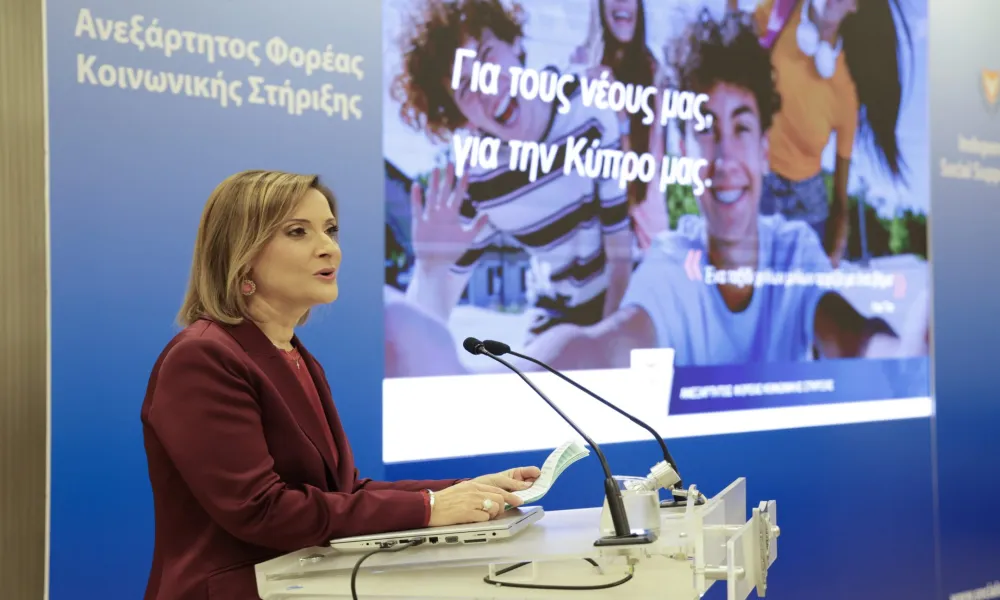
Cyprus’ political debate over transparency has reignited, with the Democratic Rally (DISY) preparing to submit a new bill to Parliament aimed at disclosing the names of donors to the Independent Social Support Agency. The fund accepts exclusively private donations and is chaired by the First Lady, Philippa Karsera.
The move comes in the wake of the controversial leaked video, which has fuelled allegations of suspect campaign-related funding and drawn the Presidential Palace into a broader political storm, despite the fund’s formally charitable mandate.
Renewed concerns after the video
Statements attributed in the video to former Energy Minister Giorgos Lakkotrypis and to Charalambos Charalambous, Director of the President’s Office and a close relative of President Nikos Christodoulides, have amplified concerns first voiced in 2024 by MPs from DISY and AKEL.
At the heart of the criticism are serious questions over whether the fund, which provides financial assistance to students from low-income families, may have been used for vote-seeking purposes or preferential treatment.
Donations, influence, and transparency
The fund receives hundreds of thousands of euros in donations from business figures and companies. According to the Audit Office, the lack of transparency in how the fund operates creates conditions that can undermine public trust.
The concern is structural: the chair of the fund is the President’s spouse, while the President himself takes decisions that directly or indirectly affect donors, including private companies. As a result, nearly all political parties are now calling for donor disclosure to determine whether any quid pro quo existed.
In a report published last November, the Audit Office identified specific cases of private donations that intensified concerns and raised reasonable suspicions of potential exchanges.
Why the disclosure law failed
A law passed by Parliament on 26 September 2024, following a proposal by DISY MP Nikos Georgiou, required the publication of donor names for contributions exceeding €5,000. The law was never implemented.
President Christodoulides refused to sign it and instead referred it to the Supreme Constitutional Court, arguing that Parliament had overstepped and violated the separation of powers. He maintained that mandatory disclosure interfered with the autonomy of the Independent Agency, which falls under the Executive’s responsibility.
On 11 April 2025, the Court unanimously ruled the law unconstitutional, citing insufficient justification for donor disclosure and noting potential interference with the right to privacy.
Sources say the new legislative proposal will be carefully aligned with the Court’s reasoning to avoid further legal challenges.
Poverty support or vote-seeking?
During parliamentary debate, AKEL MP Christos Christofides questioned why the state does not itself fully support students in need, so they are not forced to rely on private charity. He also pointed out that donations above €500 to political parties are publicly disclosed, asking why the First Lady’s fund should be exempt. “It is unacceptable for money to flow freely into the Presidential Palace without anyone knowing why or from whom,” he said.
The Audit Office steps in
A recent audit uncovered donations from companies that maintained – or continue to maintain – financial dealings with the state. Following these findings, Andreas Papaconstantinou, the Auditor General, publicly supported calls for transparency. In its report of 4 November 2025, the Audit Office recommended disclosure of donors contributing more than €20,000 per year.
Cases raising red flags
The Audit Office highlighted the fund’s unique governance structure: it was established by law, relies solely on private donations, and is run by a committee chaired by the President’s spouse, with the Accountant General as treasurer and three ministry permanent secretaries as members.
This structure, the report notes, creates a “special relationship” because the President ultimately makes decisions affecting donors. Among the cases identified:
-
Shipping companies that made no donations between 2018–2022 later contributed up to €500,000 annually, while participating in major state co-funded projects and benefiting from a tonnage tax decree issued by the current Cabinet.
-
Financial services firms under regulatory scrutiny donated between €10,000 and €50,000.
-
Individuals linked to the Citizenship by Investment Programme (“golden passports”) made significant donations.
-
A business owner who received a commercial development permit donated €400,000 over two years.
-
A wealthy foreign national who renounced Russian citizenship donated €250,000.
-
Three connected healthcare companies donated €90,000 while awaiting regulatory decisions.
-
A private individual donated €600,000, with only a name recorded and no further identifying details.
-
A company negotiating a high-value, long-term state contract donated nearly €700,000 over two years.
A defensive reaction
Rather than embracing the Audit Office’s transparency recommendations, the fund’s management committee, chaired by Karsera, attacked the Auditor General, accusing him of acting as a tool of political exploitation. The reaction followed his call to disclose donors contributing more than €20,000.
Critics note an additional factor: the First Lady qualifies as a Politically Exposed Person (PEP). International standards require enhanced scrutiny and full transparency when PEPs manage funds, precisely to prevent abuse of power or hidden exchanges.
For that reason, disclosure of donor identities is widely seen as essential to rule out any link between donations and political or economic benefits.
Yet, according to critics, even the mention of “disclosure” continues to provoke strong resistance from the fund’s leadership, despite the millions of euros it manages.