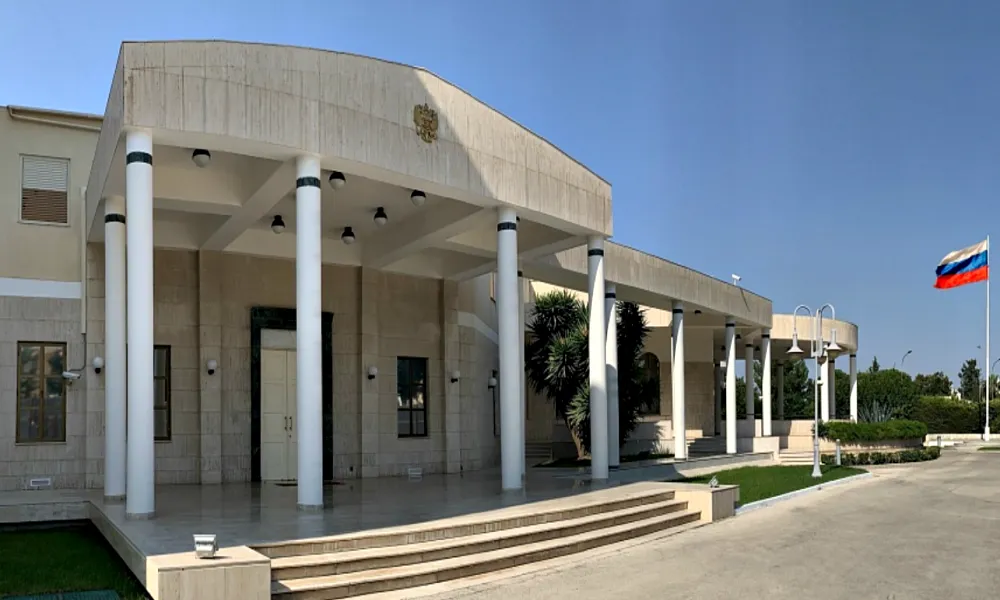
The Russian diplomat who was found dead in Cyprus, reportedly by suicide, was Alexei Panov, Third Secretary of the Russian Embassy, according to the diplomatic list of the Republic of Cyprus.
Researcher Dmitry Khmelnitsky, who studies Russian influence abroad, is the author of the book “Russian Agents of Influence in Germany” and has conducted related research into the activities of Russian intelligence services in Cyprus. Speaking to the journalistic platform Echo, Khmelnitsky said that, according to his sources, the 41-year-old Panov was a GRU officer holding the rank of captain.
Before being posted to Cyprus, Khmelnitsky said, Panov worked in Moscow at an institute linked to radiotechnology, where his wife may also have been employed. According to the researcher’s assessment, Panov’s duties at the embassy allegedly included “the maintenance and operation of espionage equipment within the embassy and possibly outside it as well.”
Kept secret for four days
Khmelnitsky noted that, according to a statement by the diplomatic mission, Panov died on 8 January, yet the embassy made the information public only on 12 January, did not allow Cypriot police officers to enter the embassy, and did not hand over the alleged suicide note to the Cypriot authorities.
“If the cause of the suicide were purely personal, it is unclear why the embassy concealed his death for so many days. This suggests that there was something that placed them in an extremely difficult position, and for four days consultations were taking place with Moscow. I do not rule out the possibility that he was preparing to defect, which was discovered and ‘prevented’ – something entirely typical of Soviet and Russian intelligence services,” Khmelnitsky assesses.
He added that, in his view, Russian embassies have always functioned more as intelligence centres than as classical diplomatic missions, while today, when diplomacy “has been reduced to the absolute minimum,” espionage is “almost their sole activity.”
“Just at the level of counsellors – positions equivalent to the rank of colonel – the Russian Embassy in Cyprus currently has eight, not counting first, second and third secretaries,” Khmelnitsky notes.
Serious institutional anomaly
The four-day delay in announcing the death, the lack of cooperation with Cypriot authorities, and the failure to hand over the suicide note constitute a serious deviation from standard diplomatic practice and, even under the Vienna Convention, amount to an institutional anomaly.
The description of the embassy’s staffing – an overabundance of high-ranking “counsellors” – reinforces the long-standing assessment of Western intelligence services that many Russian missions primarily operate as intelligence hubs rather than diplomatic entities. The incident fits into a broader framework of hybrid practices, where the distinction between diplomacy, espionage and political influence is deliberately blurred.
Claims regarding GRU affiliation and a possible attempted defection are explicitly attributed to the researcher and do not constitute official findings. Nevertheless, they raise reasonable questions that make institutional investigation imperative.
1. Obligations under the Vienna Convention (1961)
The Vienna Convention on Diplomatic Relations enshrines the inviolability of diplomatic premises (Article 22), but does not provide unlimited immunity from cooperation obligations in cases of serious incidents, particularly those involving a sudden death within a diplomatic mission.
The delay in announcing the death, the refusal of access to Cypriot authorities, and the failure to hand over critical evidence (e.g. a note) do not automatically constitute a breach of the Convention, but run counter to the principle of good faith that underpins it and undermine the functional balance between immunity and responsibility.
Diplomatic immunity does not legitimise the concealment of factual circumstances when issues of public order or host-state security arise.
2. Abuse of diplomatic status
If it is confirmed that the deceased diplomat was not in fact performing diplomatic duties, but was actively serving in a military intelligence service (GRU), then a serious issue of abuse of diplomatic status arises, in violation of Article 3 of the Vienna Convention (definition of diplomatic functions) and the principle of non-intervention in the internal affairs of the host state.
The systematic use of diplomatic missions as intelligence centres constitutes an abuse of rights (abus de droit) under international law.
3. Obligations of the Republic of Cyprus as an EU Member State
As a member state of the European Union, Cyprus bears an enhanced obligation to protect public order, security and the institutional integrity of the Union, particularly in light of its participation in the Common Foreign and Security Policy (CFSP), the fight against hybrid threats and foreign manipulation.
The existence of serious indications that a third-country diplomatic mission is engaging in espionage, interfering in the political or institutional environment, or concealing critical events triggers the right – and in some cases the obligation – of the host state to declare individuals persona non grata (Article 9 of the Vienna Convention), restrict the mission’s activities, and inform European and allied institutions.
4. Right to transparency and effective investigation
According to the case law of the European Court of Human Rights, the state has a positive obligation to conduct an effective investigation into sudden or suspicious deaths, even when third states or persons enjoying immunity are involved.
Complete inability to access key evidence restricts the exercise of sovereignty, creates reasonable suspicions of a cover-up, and undermines trust in the international legal order.
5. Hybrid threats and legal responsibility
The case falls within the framework of hybrid threats, as formally recognised by the EU and NATO – namely, a combination of diplomacy, intelligence, influence and institutional ambiguity.
Legally, the hybrid character does not remove responsibility; rather, it requires heightened vigilance, demands institutional transparency, and makes international cooperation imperative.
The case does not concern merely an individual death, but touches on the limits of diplomatic immunity, state sovereignty and European security. The legal response cannot be silence or diplomatic embarrassment, but institutional investigation, political vigilance and a clear delineation between diplomacy and espionage.