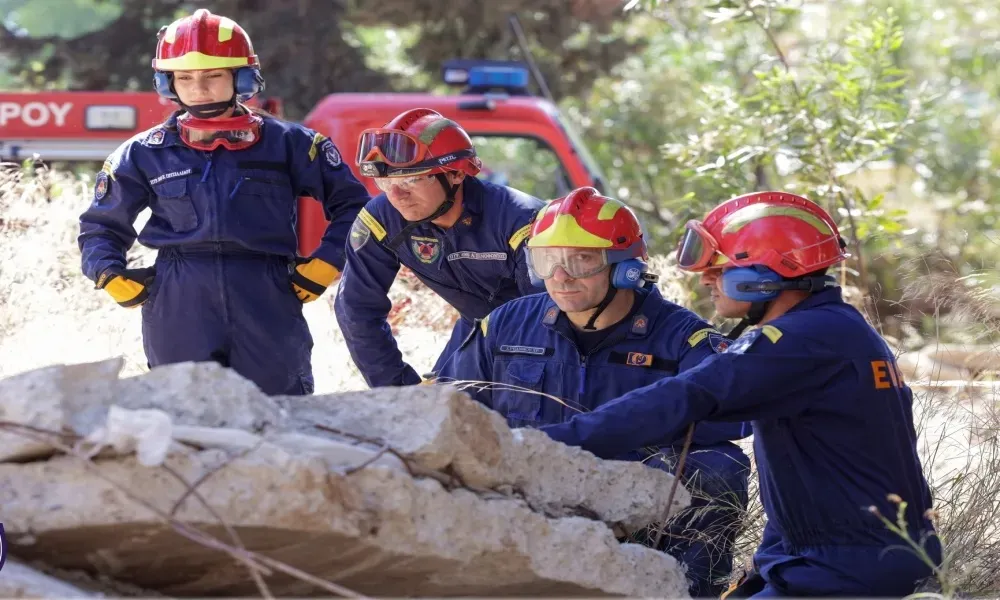
In cases of crisis, the National Coordinator, who may come from either the public or the private sector, will be able to declare a state of civil protection across the entire territory of the Republic or in a specific area.
With the aim of addressing natural and man-made disasters, ranging from extreme weather and earthquakes to fires and explosions, the Ministry of Interior has prepared a draft bill titled “The Civil Protection Law of 2026”, which has been placed under public consultation for all interested parties until Friday, January 23, 2026.
According to the Ministry, the purpose of the proposed bill is to establish the institutional framework for the creation of a National Civil Protection Mechanism, through which all departments, services and involved bodies will be coordinated in order to improve effectiveness in preparedness, response and crisis management.
The proposed framework
To implement these actions, a “Basic National Crisis Management Plan” will be applied in peacetime for natural and man-made disasters, as approved from time to time by the Council of Ministers. This plan will incorporate Special National Plans drawn up on its basis.
At the same time, a National Crisis Management Coordination Centre will operate, from which the coordination of all response forces during a crisis will be exercised. The Council of Ministers will retain overall supervision and guidance of the National Civil Protection Mechanism.
State of civil protection
In cases of hostile action or an imminent threat of hostile action endangering civilian life or property, or in cases of disaster or imminent disaster requiring mass mobilisation of personnel or resources not sufficiently available to the Republic at a given time and place, the National Coordinator may declare a state of civil protection.
Such a declaration may apply to the entire territory of the Republic or to a specific area, with the aim of taking immediate civil protection measures to safeguard people, property, natural resources and the environment. A state of civil protection may only be declared with the consent of the Minister.
The National Coordinator
The bill includes specific provisions governing the appointment and role of the National Coordinator.
The National Coordinator will be appointed by the Council of Ministers, following a recommendation by the President of the Republic of Cyprus and a proposal by the Minister.
During the response and management of crises, the National Coordinator will serve as head of the National Mechanism, acting on the basis of the Basic National Crisis Management Plan.
The position may be filled by an individual from either the public or private sector. The term of office will be defined in the act of appointment and will end no later than three months after the expiration of the President’s term. It may not exceed five years, with the possibility of renewal up to a total of ten years. The Council of Ministers may, following a recommendation by the President, dismiss the National Coordinator at any time if deemed appropriate.
The appointed person must be of proven integrity and professional ethics and must have experience in crisis or emergency management.
The National Coordinator may resign at any time by submitting a written resignation to the Council of Ministers, which will take effect upon acceptance.
Powers during a state of civil protection
During a declared state of civil protection, the National Coordinator will have the following powers:
– Exclusive responsibility for coordinating all departments and involved bodies participating in crisis response.
– Overall command regarding the deployment, movement and positioning of forces during crisis response, regardless of the service to which they belong.
– Authority to activate all necessary resources during a crisis, irrespective of the service controlling them.
– Responsibility to inform the President of the Republic and the Minister of the overall situation.
– Submission of recommendations to the President and the Minister on the most appropriate course of action, based on collected data, consultations with department heads and involved bodies, and professional expertise, and implementation of their decisions.
– Presence at the National Crisis Management Coordination Centre, coordinating intervention forces in direct communication and cooperation with department heads and involved bodies.
– Authority to decide on submitting a request for activation of the European rescEU mechanism or any other form of international assistance.
– Responsibility to indicate the need for traffic measures or evacuation of communities to the relevant departments or involved bodies.
– Responsibility for public communication, with the aim of reducing the risk of contradictory messages or inadequate information reaching the public.
Prevention and preparedness
With regard to prevention and preparedness, the National Coordinator will:
– Formulate recommendations and provide advice to the Minister to improve the functioning of the National Mechanism, based on risk analysis and identified weaknesses.
– Monitor the implementation of recommendations by departments and involved bodies through their annual action plans or other relevant documents and consultations.
– Advise on the revision and improvement of Special National Plans.
– Prepare a five-year Action Plan, with the contribution of departments and involved bodies, aimed at improving the existing crisis response system and creating a unified crisis management framework.