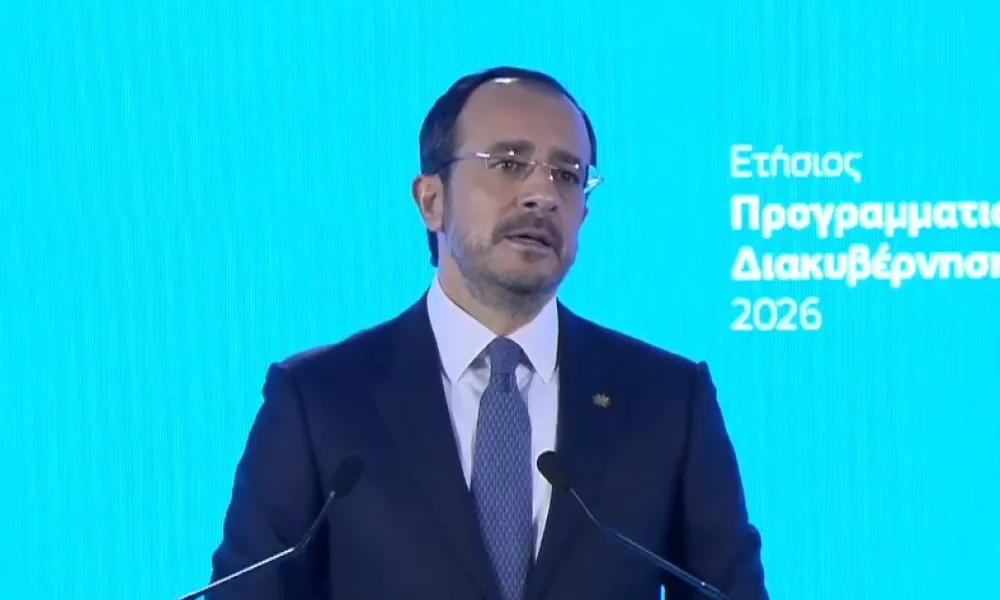

The 2026 State of the Union was delivered with confidence and ceremony, but once again without a realistic assessment of the country’s condition. As with previous government programming presentations, it amounted less to a genuine review of governance and more to an account of government performance as seen exclusively from the Presidential Palace.
Three years into this administration, it is now clear that this approach is no accident. It has evolved into a deliberate political choice. On the one hand, the presentation distilled a series of selectively framed achievements. On the other, it functioned as a carefully choreographed communication exercise, aimed at softening or omitting a number of serious problems confronting Cypriot society.
At its core, the event resembled a staged performance rather than a political reckoning. Stability was presented as progress, inertia as prudence, and the absence of strategic vision as technocratic competence. The President spoke at length about indicators, timelines and future reforms, while systematically avoiding the open and painful issues shaping everyday life.
Communication over politics
From the outset of this presidency, it was evident that communication strategy would dominate political decision-making. This is no longer a peripheral characteristic of the administration. It is a defining condition that shapes how power is exercised, how major issues are addressed, and how ambiguity is deployed when clarity is required.
This persistent focus on image management has created growing public unease. It has also contributed to declining public trust, despite efforts to reframe facts and manage narratives. The result is a leadership increasingly disconnected from lived reality, operating under constant psychological pressure to control perception rather than confront substance.
A staged presentation
Seen through this lens, the 2026 State of the Union was another performance designed for the world of communication rather than for the citizens affected by government policy.
Nikos Christodoulides, alongside the technocratic team assembled at the Presidential Palace, presented a speech that bore little resemblance to the realities faced by households across the country. Beyond broad policy directions typical of such addresses, the underlying assumption appeared to be that citizens are dealing mainly with routine inconveniences requiring minor adjustments.
In the government’s narrative, Cyprus is thriving, governed by a plan, and moving steadily forward. What remains glaringly absent, however, is any acknowledgement of the widening gap between rhetoric and reality, as structural problems accumulate without resolution.
A conspicuous silence
The omissions were particularly striking given the current climate. Cypriot society is grappling with a succession of scandals that have shaken public confidence, including resignations of close presidential associates and ongoing investigations. In this context, the President’s decision to remain silent on these matters was not neutral. It was politically revealing.
Corruption and institutional failure cannot be addressed through passing references or vague assurances. When issues of this magnitude reach the very heart of the Presidential Palace, avoiding a substantive political response becomes a conscious choice. In doing so, all other policy announcements are effectively sidelined.
If government planning is sound, it can proceed without theatrical displays. A presidential spectacle was neither necessary nor convincing.
An unacceptable absence of accountability
The handling of the Videogate affair stands out as particularly troubling. The complete avoidance of any reference to the case during a presentation covering the fourth year of governance underscored a lack of political accountability and empathy.
Subsequent attempts by the President’s deputy minister, Irene Piki, to justify the silence by pointing to ongoing investigations only reinforced this impression. The focus was shifted away from political responsibility and towards technical arguments about video manipulation, effectively reframing the issue to protect the Presidential Palace rather than address public concern.
Regardless of the criminal assessment, which is rightly a matter for the courts, the political issue remains unresolved. Yet in the 2026 State of the Union, the affair was treated as non-existent. Resignations were presented as a sufficient response, without any meaningful discussion of oversight, responsibility or institutional credibility.
The issues left unaddressed
At the same time, major challenges continue to unfold.
The Legal Service remains beyond scrutiny despite long delays in high-profile corruption cases. The rule of law is invoked rhetorically but rarely defended in practice. When transparency is praised while the most sensitive cases are avoided, silence itself becomes a political stance.
The same disconnect characterises the government’s 2026 policy announcements. Behind the list of 55 announced actions lies a striking absence of social substance. The cost of living has reached critical levels. Households are cutting back to essentials. The middle class, once described as a central policy focus, has quietly disappeared from the narrative.
The housing crisis has spiralled beyond control, with land, property and rental prices increasingly out of reach for most citizens. Yet the response remains confined to figures and declarations, without a credible relief strategy.
Energy policy follows a similar pattern. Natural gas remains untapped, electricity interconnections stalled, and consumers face some of the highest electricity bills in Europe. Future projects are promised while energy poverty is already a reality.
Even the water crisis is addressed through temporary measures and reactive decisions, while long-term solutions are delayed for political reasons.
Managing time instead of governing
Ultimately, the 2026 State of the Union reflects a government that manages time rather than uses it. A leadership that prioritises communication over accountability, avoids political cost, and governs through narrative rather than responsibility.
It is not merely a missed opportunity, but a conscious political choice.