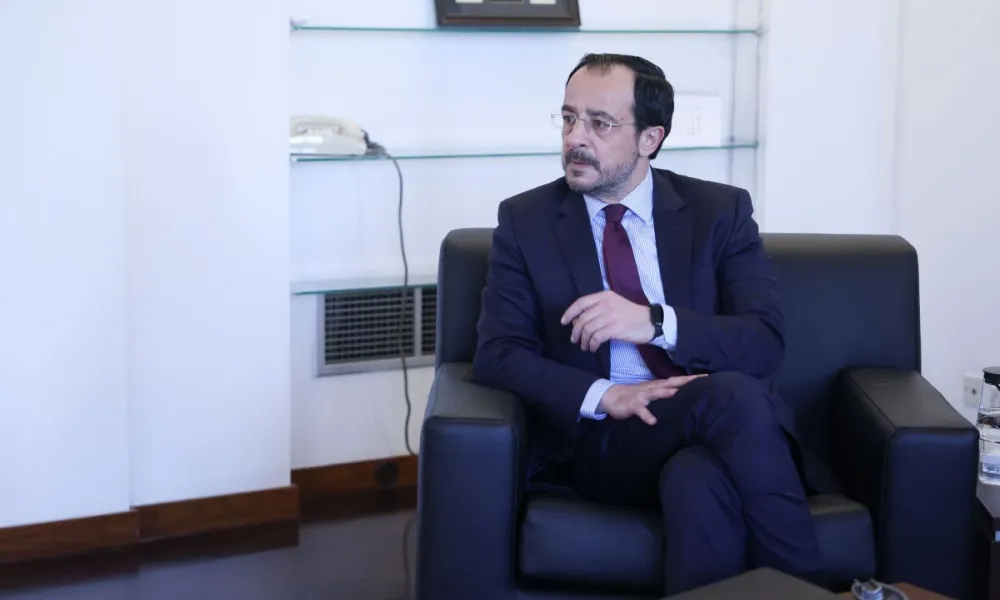
In a lengthy speech on Thursday (5/2), Cypriot President Nikos Christodoulides presented his government’s plans for 2026, once again emphasising what he describes as an “outward-looking foreign policy with a clear European–Western orientation, strong defence and security”, which he considers to be his key strength.
Having completed three years in office, Christodoulides has grown accustomed to delivering long speeches — monologues — without any genuine accounting of his record, as would normally take place, for example, in a press conference. In a fully controlled setting, he once again promoted foreign policy as a central pillar, describing it as “multidimensional” and “without wavering”: “our country is now recognised for what it truly deserves: a stable and secure hub of cooperation, a responsible and reliable partner in a region of particular geostrategic importance”.
Instability
Yet no leader of a small or large European country, in today’s fragile international environment, is guided by such dogmatism and certainties. Only the Cypriot president thinks and self-assesses in this way, while downplaying the most important existential issue for Cyprus: the unresolved Cyprus problem, now in its 52nd year. For this reason, he devoted only four lines to it.
In his speech, he avoided any reflection on the extremely fluid international situation, the ongoing erosion of international law, and the questioning of the UN’s collective security system (Ukraine, Gaza, Venezuela, Greenland, etc.). But if Germany’s Merz and France’s Macron are searching for answers on Europe’s security and defence architecture, and Canada’s Carney is speaking of a rupture in the Western order, how is Christodoulides managing so well?
Warning
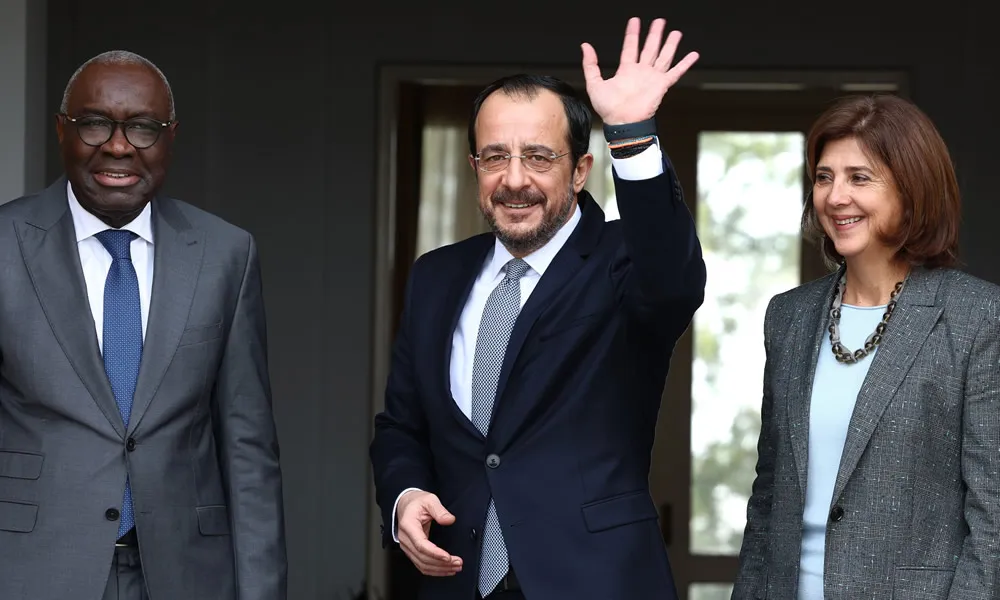
What Christodoulides describes is not supported by facts; it resembles a virtual world constructed around him. Last Thursday (28/1), at a meeting in Nicosia with the new Turkish Cypriot leader Tufan Erhürman — convened by María Ángela Holguín, the UN Secretary-General’s personal envoy — Christodoulides failed to find a way to restart negotiations on the Cyprus problem. Eight years have now passed since their collapse at Crans-Montana, marking the longest period of stagnation in half a century.
On Friday (30/1), the UN Security Council issued a resolution warning that “the status quo is unsustainable, that the situation on the ground is not static, and that the absence of an agreement intensifies political tensions and deepens the alienation between the two communities”. Christodoulides made no reference to this, nor did he comment on the Security Council’s warning about “the risk of irreversible changes on the ground that could reduce the prospects for reaching a compromise”.
Clearly, the Security Council does not consider Cyprus to be a safe and stable country. Furthermore, it decided to reassess the presence of the UN peacekeeping force (UNFICYP). It requested the Secretary-General to submit reports in July 2026 and January 2027 on progress towards substantive negotiations, along with a “well-documented analysis of the impact of the peacekeeping mission and its overall performance”. This adds serious uncertainty for Cypriots — uncertainty that Christodoulides has avoided explaining to citizens for days. What will happen if UNFICYP withdraws, or changes its mandate to a mere monitoring force, or further reduces its already understaffed personnel, which currently struggle to supervise a 180-kilometre line?
Credibility
Christodoulides presents his government as “a responsible and reliable partner in a region of particular geostrategic importance”. Yet on the Cyprus problem, the Cypriot president appears anything but reliable. At the trilateral meeting of 28 January, he presented proposals on the substance of the Cyprus issue and on confidence-building measures that are, so far, deemed insufficient by the UN. Moreover, his position on opening new crossing points runs counter to the UN’s minimum expectations. For this reason, the Secretary-General does not intend to convene another preparatory informal “5+1” conference involving the three guarantor powers.
The Cypriot president claims to be building bridges of cooperation with the Middle East (“a Union open to the world”), but he cannot do the same within his own country. He is unable to open a single new crossing point so that citizens of the island’s two communities can communicate more easily, rather than enduring endless queues and hours of waiting at existing checkpoints. The Security Council lists a series of obligations for both leaders in Cyprus, highlighting in particular the need to open new crossing points, strengthen interdependent economic relations, and develop interaction between Greek Cypriots and Turkish Cypriots. On all of this, the Cypriot president remains silent.
Abstraction
Why, then, does Christodoulides disconnect security and stability from the Cyprus problem? This “abstract” approach is not innocent. It is linked to the fact that the current president of Cyprus is, in practice, pursuing a policy that dismantles the prospect of reunification. This unspoken policy permeates his handling of the issue — a poor imitation of the approach adopted by his predecessor, Nicos Anastasiades, after Crans-Montana.
At the trilateral meeting of 28 January, under pressure from Guterres, Christodoulides presented an entirely vague proposal to record the negotiating material produced up to Crans-Montana — but requested that “only what is agreed” be included in a document (sic). This once again points to endless negotiations over what is written, what is informal, and what was agreed. He does not clearly propose a conclusive negotiation on the six remaining critical issues identified by the Secretary-General (Guterres Framework, 30 June 2017). This stance undermined the near-final strategic agreement and subsequently plunged Cyprus into multiple dead ends.
In his four-line reference, Christodoulides told Cypriots that “there is no alternative to the reunification of our homeland and our people” through a “functional and viable solution”. This formulaic language sidesteps the real stakes identified by the UN, while allowing the Cypriot president to evade responsibility and ignore Security Council criticism.
Deus ex machina
Christodoulides is completing three years in office and is permanently focused on his re-election bid in 2028. Naturally, he would like to avoid any visible fait accompli on the Cyprus problem. However, his support base consists of parties and actors who reject a federal solution or accept it only nominally, using vague formulations such as a “functional and viable solution”. He is not the first Cypriot leader to follow this tactic. He may, however, be the first to deeply entrench indifference and disengagement among Greek Cypriots, combined with renewed illusions about protectors and deus ex machina solutions.
In a poll presented by public broadcaster RIK (5/2), Israel emerges as Cyprus’s best ally for its defence. Israel records 41% (up from just 9.5% in 2024), while Greece falls to 27% (from 45% in 2024). Others follow: the US (16.5%), Russia (14%), France (12%).
This perception lies at the core of Christodoulides’ rhetoric and represents a rapid return to the pre-EU accession era. It coincides with systematic overtures towards Israel and arms procurement, without serious consideration of side effects such as fuelling tensions on the island. Behind-the-scenes moves towards Israel–Turkey rapprochement, mediated by the US, do not concern Christodoulides. Based on the RIK findings, it is enough for him that he is “shaping public opinion” with the uncritical support of aligned media outlets, transforming society into something more nationalist and reactionary — with only 13% viewing the EU as a space of security and protection.