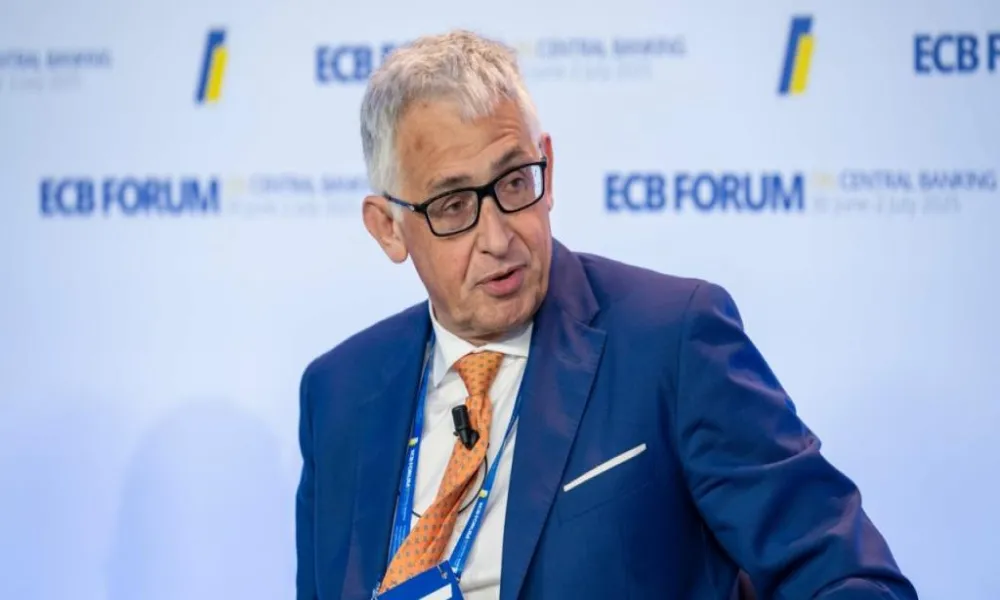
The digital euro would lower payment costs for small businesses hit by expensive international card schemes and reduce Europe's reliance on non-European providers that handle nearly 70% of card transactions, ECB Executive Board member Piero Cipollone told the Cyprus News Agency.
In an interview with CNA Cipollone described the digital euro as a "digital version of cash" that preserves the simplicity and freedom of physical money.
Warning of growing strategic vulnerability, he stressed that Europe must act now to build resilient, domestic payment infrastructure rather than deepen dependence on external companies.
He also said that the project remains conditional on EU legislation, but said that progress is accelerating, with the European Parliament expected to vote on its position in May, potentially paving the way for pilot projects in 2027 and issuance by mid-2029.
A digital version of cash
The digital euro, Cipollone explained, is intended to be a digital version of cash, preserving its simplicity and freedom while extending its use to areas where cash is no longer practical.
“Today cash cannot be used in many use cases, so through digital euro you will keep the simplicity of cash and yet to be able to pay also for those use cases that you cannot cover today, like for example when you want to pay for e-commerce, if you want to shop online, you cannot use cash. So, what we are doing is a digital version of cash”, he said.
For citizens, he said, the main advantages would be simplicity and choice. With a single solution, people would be able to pay “everywhere in Europe for all use cases,” maintaining “the freedom to pay as you wish to pay.”
Reduced cost for SMEs in Cyprus
For businesses, and especially small and medium-sized enterprises, Cipollone said the digital euro could significantly reduce the cost of accepting digital payments. He singled out Cyprus as a country where the benefits could be particularly pronounced, given its heavy reliance on international card schemes.
“Especially for small merchants accepting payments done through international card schemes is very expensive,” he said, noting that for small businesses the cost can be three to four times higher than for large merchants. Under the digital euro, he said, transaction costs would be “largely reduced” because the ECB would not charge scheme fees. In addition, he said that the existence of a public digital payment option would strengthen competition by giving small merchants greater negotiating power with private payment providers.
Offline payments and resilience
Explaining why a public digital currency is needed despite the widespread use of private mobile wallets, Cipollone pointed to the fragmentation of today’s payments market. The digital euro, he said, would offer a single instrument usable online, at the point of sale and also offline.
“The digital euro will bring one instrument and allow you to pay everywhere. There is an additional functionality that is not available today, such as the offline solution, which will allow you to pay even in cases where there is no electricity or connectivity”, he said.
Cipollone also framed the project as a matter of strategic autonomy.
“Today most of the transactions in Europe, I would say almost 70% of the card-initiated transactions are processed by companies that are not Europeans,” he said, warning that Europe depends heavily on non-European providers for a core part of its financial infrastructure. “As citizens we should be concerned about that,” he added, arguing that the digital euro would help address this vulnerability.
Asked why the ECB is moving ahead at a time when some other central banks have postponed or abandoned similar initiatives, Cipollone said Europe must focus on its own needs. The ECB, he noted, has a responsibility to provide resilient and smooth means of payment.
Given today’s fragmentation and growing dependence on non-European providers, “these conditions are not met,” he said. “We have these needs and we need to act now.” Delaying action, he warned, would only deepen Europe’s dependency and leave it “worse off.”
Legislation first, pilots from 2027
Cipollone outlined two parallel tracks towards a digital euro: technical preparedness within the ECB and the Eurosystem, and the legislative process at EU level.
On the legislative side, he said progress has accelerated. The European Commission presented its proposal in June 2023, and in December the Council working party reached an agreement on a position close to that original proposal. As he said, attention now turns to the European Parliament, which, according to the rapporteur’s schedule, is expected to vote on its position in May.
If all goes well, Cipollone said, negotiations between the EU institutions could follow, with legislation potentially in place by the end of the year. On that basis, the ECB aims to be ready to issue the digital euro by mid-2029. Before that, he said, pilot projects are expected to begin in 2027 to test payments on a limited basis.
Addressing banks’ liquidity concerns
Responding to concerns from banks that a digital euro could trigger deposit outflows and affect liquidity, Cipollone said safeguards have been built into the design from the outset, stressing that financial stability is a central concern for the ECB.
First, the digital euro would not be remunerated, removing incentives to shift funds out of bank deposits. Second, users would not need to pre-fund their digital euro wallet to make online payments, as a “waterfall” mechanism would automatically draw funds from a bank account at the moment of payment. Pre-funding would only be required for offline payments.
Third, Cipollone said, holding limits would cap the amount individuals can keep in digital euro form, and only natural persons – not merchants – would be allowed to hold digital euros. Cipollone said simulations show that even with relatively high holding limits, financial stability would not be endangered. He added that the ECB has published a report to the European Parliament supporting this assessment.
The exact holding limit has not yet been decided. Cipollone said it will be set through a “robust process” involving the ECB, the European Commission and the Council, ensuring that decisions cannot be taken abruptly and that financial stability remains at the centre of the process.
“It will be a long, articulated process, so that we are reassured that nobody can make a sudden decision and change the holding limit”, he said.
Privacy by design
Privacy and data protection, Cipollone said, have been built into the project from the beginning, reflecting citizens’ expectations.
“We tested what people were expecting,” he said, adding that the two main concerns were privacy and resilience.
He explained that for online payments, the ECB would not know who is paying whom, seeing only encrypted codes representing the payer and the payee, while personal data would remain with banks, much as they do today. For offline payments, privacy would be even stronger, as only the payer and the payee would know about the transaction, which would involve a direct transfer between devices.
“This is the highest level of privacy that you can get for the current technology today,” Cipollone said, stressing that it goes well beyond existing digital payment methods.
Exchange rate not a policy target for ECB
Asked on the recent strengthening of the euro against the US dollar, Cipollone said that is does not in itself determine the European Central Bank’s monetary policy decisions. He stressed that the exchange rate is not a policy target.
Cipollone explained that while the ECB does not have a specific exchange rate objective, movements in the euro are taken into account as part of the broader analytical framework. “Technically we do not have a specific target for the exchange rate,” he said, adding that the exchange rate is included “as an input in our projections”.
He noted that this is one of several factors used to assess inflation dynamics. “This is part of all the inputs that we will take into account to project the dynamic of inflation,” Cipollone said, stressing that policy decisions will depend on how updated projections evolve and what impact they may have on the inflation outlook.
He said that the euro strengthened earlier in the year but has largely remained within a familiar range, trading around 1.17–1.18 against the dollar for much of the past year.
The movement observed a few weeks ago, he said, has already brought the euro back to levels seen in previous months.
CNA