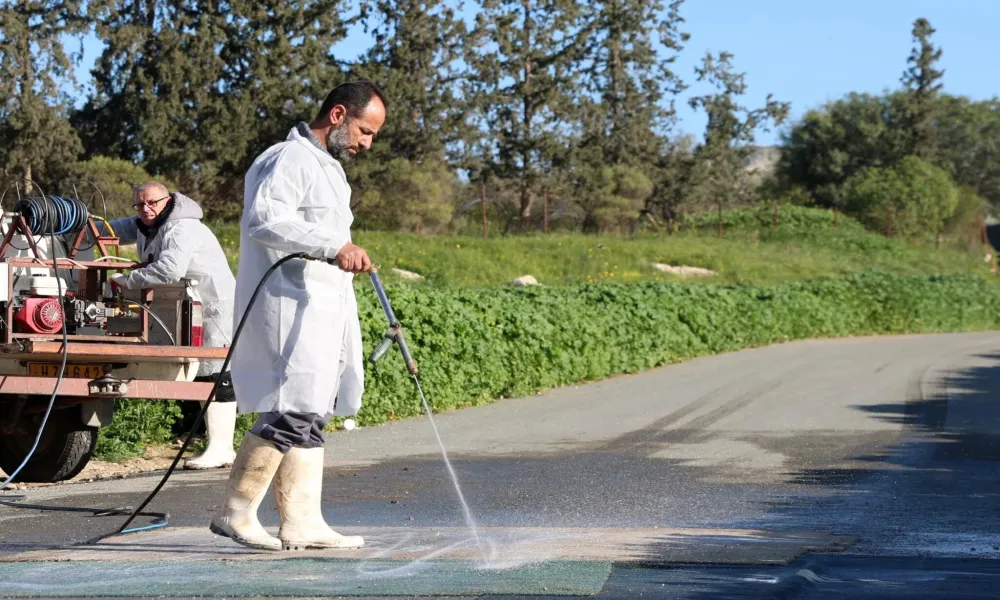

Uncertainty continues to surround the government’s strategy to contain the spread of foot-and-mouth disease, as the number of infected livestock units has risen to 38 and fears grow that the outbreak could spiral further out of control.
Around 13,500 animals have already been culled, with more than 10,000 additional cullings scheduled. As the crisis deepens, farmers and the wider agricultural economy are facing mounting pressure.
At the same time, the Ministry of Agriculture appears to be at a strategic crossroads, balancing between two different approaches. This became evident during a three-hour discussion held on Tuesday at the House agriculture committee.
Mass culling or vaccination
One approach involves continuing the mass culling of animals in infected farms, in line with strict European Union legislation and the recommendations issued on February 25 by European Commission experts.
The alternative would be to halt the cullings and shift towards widespread vaccination, similar to the policy followed in the north of Cyprus under Turkey’s approach to the disease.
Such a change would require approval from the European Commission and comes amid strong pressure from farming organisations and producers.
President Nikos Christodoulides met representatives of agricultural organisations on Sunday, raising expectations among farmers that the EU rules might be relaxed due to Cyprus’ specific circumstances.
Farmers argue that the island’s small size, the proximity of livestock farms and the different disease management policy followed in the north - where vaccination is used instead of culling - justify special treatment.
Following the meeting at the Presidential Palace, representatives of agricultural organisations spoke of a “positive meeting” and a possible “light at the end of the tunnel”, after the president reportedly pledged to personally raise the issue with European Commission President Ursula von der Leyen.
Risk of exclusion from the EU single market
However, Agriculture Minister Maria Panayiotou warned that ignoring EU legislation could carry serious consequences.
Speaking at the House committee, she said that if Cyprus chose not to follow European rules on culling after receiving a negative response from Brussels, the country could face major economic repercussions.
These could include exclusion from the EU single market and the imposition of restrictions affecting both products and people.
According to Panayiotou, the handling of the virus is governed by strict European regulations which leave little room for flexibility.
“Due to the highly contagious nature of the disease, the regulation unfortunately does not allow flexibility or take into account the particularities of member states,” she said, adding that efforts are nevertheless underway to seek possible derogations.
Limits of legal exemptions
During the discussion, the chairman of the House agriculture committee, Giannakis Gavriel, referred to a provision in European legislation suggesting that member states may suspend culling without prior approval from the European Commission.
However, a Veterinary Services official clarified that this provision only applies to rare animal species, such as Cyprus’ indigenous red cattle or the Machairas goat.
Selective culling continues
Senior veterinary officer Sotiria Georgiadou confirmed that culling operations resumed on Monday after being briefly suspended over the weekend due to resistance from some farmers.
She warned that deviating from EU legislation would place Cyprus outside the legal framework governing animal disease control.
“If we deviate from European legislation, we will all be acting illegally and we will exit the single market,” she said.
However, she also indicated that until the European Commission provides a response, Veterinary Services may partially adjust their approach by prioritising the euthanasia of animals showing severe symptoms and suffering.
Officials confirmed during the committee session that approximately 13,500 animals have been culled so far.
Farmers call for vaccination
Representatives of farming organisations and producer groups urged the government to immediately halt the culling programme and move to universal vaccination.
Panikkos Hambas, secretary general of the EKA farmers’ organisation, argued that Cyprus should emphasise the uniqueness of its livestock sector - particularly its role in producing halloumi PDO - when seeking exemptions from EU rules.
He warned that billions of euros could be at risk if the livestock sector collapses.
Hambas also argued that eradication of the virus may be unrealistic given the regional context.
“Turkey is next to us and follows a vaccination policy, while Turkish Cypriots import animal feed from Turkey. Therefore decisions about culling must take into account the realities in Cyprus and not those of other countries such as the Netherlands,” he said.
Nikos Papakyriakou, director general of the Cyprus Dairy Farmers Association, also urged the government to examine the situation regarding the disease in the north of Cyprus.
Criticism over crisis management
Several MPs criticised the government’s handling of the outbreak.
DISY MP Charalambos Pazaros said that preventive measures should have been taken earlier when the first cases were detected in the north.
“Today we see the anxiety of our farmers. The virus has hit the centre of the livestock sector, where large investments have been made and farmers who took loans now face an uncertain future,” he said.
AKEL MP Andreas Pasiourtides said recent decisions appeared reactive rather than strategic.
“In recent weeks it seems there has been no clear plan and the actions taken are fragmented,” he said, adding that it remained unclear whether authorities fully understood the situation in the north.
Committee chairman Giannakis Gavriel summed up the mood by saying: “Unfortunately we are running behind events.”
Government defends its response
Responding to the criticism, Agriculture Minister Maria Panayiotou said the government shares the same concerns as farmers and stressed that the strategy being followed is based on the recommendations of European Commission experts who visited Cyprus.
“Our aim is to limit the spread of the disease, protect the livestock population and ensure that affected farmers are not left alone to face the consequences,” she said.
She added that the government had already approved support measures for farmers who have lost income and is planning the next phase of recovery, including the rebuilding of livestock populations where necessary.
Authorities are also exploring the possibility of importing animals from countries free of the disease.
Panayiotou said crisis management involves the operational coordination of 16 government services and more than 500 officials working around the clock in cooperation with all relevant stakeholders.