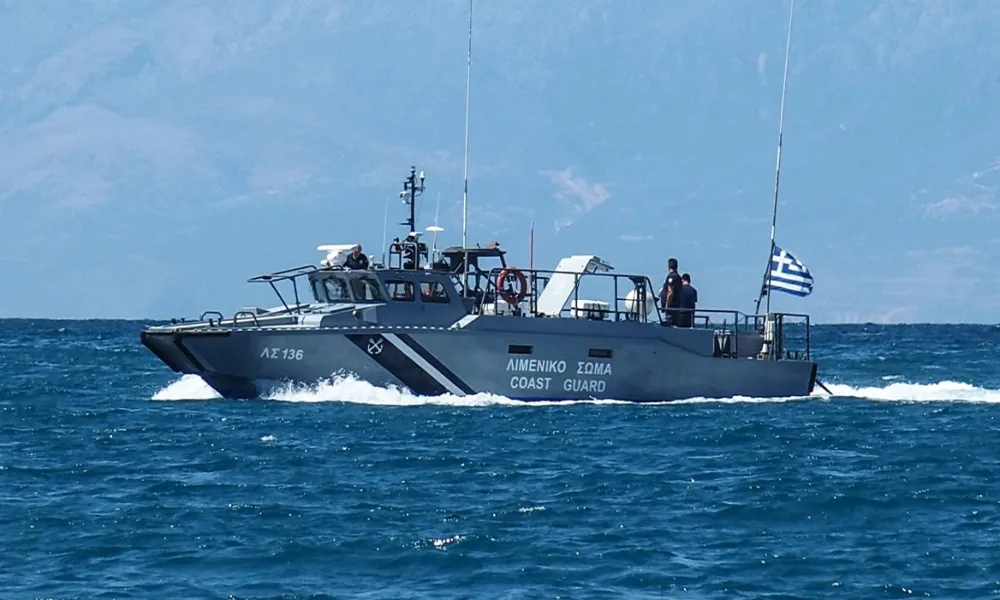
The Council of Ministers has approved the creation of a Cyprus Coastguard, paving the way for all state services with maritime responsibilities to be merged under a newly established authority.
The proposal, submitted by Minister of Justice and Public Order Costas Fytiris, was formally endorsed this week. Although the idea of a Cypriot Coastguard has been discussed for many years, it has never progressed to implementation. It gained renewed momentum after the discovery of hydrocarbons within Cyprus’s Exclusive Economic Zone (EEZ), highlighting the need for enhanced maritime monitoring capabilities. The surge in irregular migration by sea also pushed the issue back onto the political agenda, though again without result.
With the Cabinet’s latest decision, work now begins on drafting the legislative framework that will regulate the establishment and operation of the new Coastguard. Its core responsibilities will include monitoring and controlling all activities within Cyprus’s maritime zones, managing policing and navigational‑safety incidents, tackling criminal activity such as smuggling and human trafficking, protecting offshore installations and the marine environment, and participating in search‑and‑rescue operations. The Coastguard will have authority across all maritime zones under the Republic of Cyprus – territorial waters, the contiguous zone and the EEZ – with powers adjusted according to each zone’s legal regime.
The Coastguard will be based at the ‘Evangelos Florakis’ Naval Base in Mari. According to information obtained by Politis, plans to upgrade the naval base already include provision for administrative offices to house Coastguard personnel and command staff.
Bringing state services together
Several state services with fragmented maritime responsibilities will be transferred to the new authority, consolidating them under a single structure. These will include: the Port and Marine Police; the Police Aviation Unit; the Fisheries Control Branch of the Department of Fisheries and Marine Research, responsible for monitoring fishing activities at sea and in ports; the Department for the Prevention and Response to Marine Oil Pollution; the Vessel Traffic Monitoring and Information System (VTMIS) along with its equipment and personnel; and the Hydrography Division of the Department of Lands and Surveys.
Currently, maritime oversight and control are scattered across different ministries, often without coordination, real‑time information‑sharing or operational integration. This fragmented approach can lead to overlapping responsibilities, inefficient use of resources and reduced operational effectiveness. In some cases, services with legal responsibilities lack the necessary equipment or personnel to fulfil them.
The government notes that annual operational costs and the procurement of surveillance and control assets will be funded largely through EU financing, helping to minimise the burden on the state budget.
Following Cabinet approval, the Justice Ministry will form a legislative drafting committee to prepare the necessary laws and submit a comprehensive proposal for the Coastguard’s establishment.