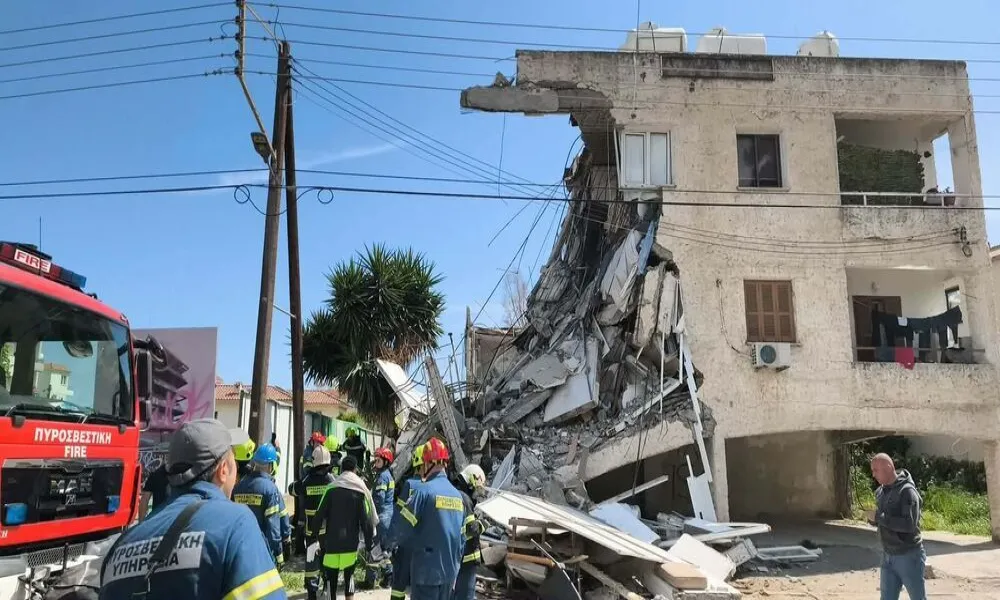
Serious shortcomings in the legal framework governing building management committees are emerging as a key factor behind the growing number of dangerous apartment blocks, following the deadly collapse of a building in Germasogeia that claimed the lives of two foreign nationals.
The apartment block that collapsed on Easter Saturday did, on paper, have a management committee. In practice, however, the committee existed in name only. As events showed, it failed to carry out even the most basic maintenance and oversight, leaving the building to deteriorate unchecked until it collapsed.
The case has drawn renewed attention to systemic weaknesses in the legislation regulating management committees of jointly owned buildings. As a result, hundreds of apartment blocks and housing complexes are gradually becoming unsafe and unfit for use. In many cases, no management committee exists at all, while residents refuse to pay communal charges without consequence. At the same time, numerous buildings remain uninsured, meaning damage to common areas goes unrepaired. Over time, entire blocks fall into visible neglect and decay.
These failures have created widespread practical problems, leaving thousands of residents trapped in disputes with no effective mechanism for resolution. Against this backdrop, legislative reform is widely regarded as both necessary and urgent.
The Interior Ministry sought to address the issue by submitting a bill to parliament aimed primarily at strengthening the powers and flexibility of management committees so they can carry out their duties effectively.
The bill
The draft legislation was prepared in 2023, before the establishment of the District Local Government Organisations (EOAs) and the transfer to them of licensing responsibilities. Despite concerns raised by the EOAs, the ministry proceeded with consultations before submitting the bill to parliament.
The proposed reforms include granting management committees the authority to incur reasonable and necessary expenses for the maintenance and proper functioning of common areas when owners fail to meet their obligations. Committees would be able to recover outstanding amounts through legal action and register a charge on the negligent owner’s property.
The bill also introduces a revised method for apportioning shared expenses, calculating contributions for services based on the floor area of each unit. It provides for suitability, structural, mechanical and electrical inspections of jointly owned buildings by professionals registered with the Cyprus Scientific and Technical Chamber, where deemed necessary by the management committee.
A central element of the proposal is the creation of a Service for the Registration of Jointly Owned Buildings and Supervision of Management Committees. This body would maintain a registry of buildings and committees, set internal regulations governing management, define owners’ rights and obligations, ensure mandatory insurance coverage and enforce compliance. Failure to comply would constitute an offence subject to administrative fines.
Sent back by MPs
On 22 January 2026, the House interior committee unanimously decided to return the bill to the Interior Ministry for further processing and consultation. MPs said the draft had been submitted without sufficient prior agreement with the EOAs, which the bill assigns responsibility for establishing and supervising tens of thousands of management committees nationwide.
A decisive factor was a letter sent to parliament by the president of the Nicosia EOA, Constantinos Yiorkadjis, on behalf of all EOA presidents. He made clear that the EOAs are unwilling to assume supervisory responsibility, which would require the creation of a new service within each organisation, unless permanent funding is secured to cover operating costs.
“The Interior Ministry decided, without consulting the EOAs, to assign them serious responsibilities for managing and supervising jointly owned buildings,” said Aristos Damianou, chair of the House interior committee and an MP for AKEL, after the meeting. “A bill was submitted without the knowledge of the EOAs, at a time when they are struggling to get on their feet.”
Damianou said the issue was too serious for parliament to accept what he described as institutional disregard. He warned the ministry it had a very limited timeframe to either reach agreement with the EOAs or propose an alternative solution and resubmit a functional, workable bill.
Interior Ministry response
The Interior Ministry rejected claims that it had sidelined parliament or the EOAs. In a statement issued the same day, it said the urgency of the legislation had been emphasised from the outset, noting that it aims to resolve long-standing problems affecting thousands of owners and tenants in jointly owned buildings.
The ministry said consultations with the EOAs had taken place and that the Department of Lands and Surveys had prepared a detailed study covering all jointly owned buildings. The study includes processing timelines, staffing needs and proposed fee structures to fund the new supervisory service.
According to the ministry, the additional staff required would not exceed 30 employees nationwide, with salary costs fully covered by the proposed fees. The study was sent to the EOAs on 5 November 2025, and no further comments were submitted in the two and a half months before the parliamentary committee meeting.
“Following today’s development, and recognising that this is a major social issue, we will immediately reconvene discussions with the EOAs for further consultation and resubmit the bill to parliament,” the ministry said.