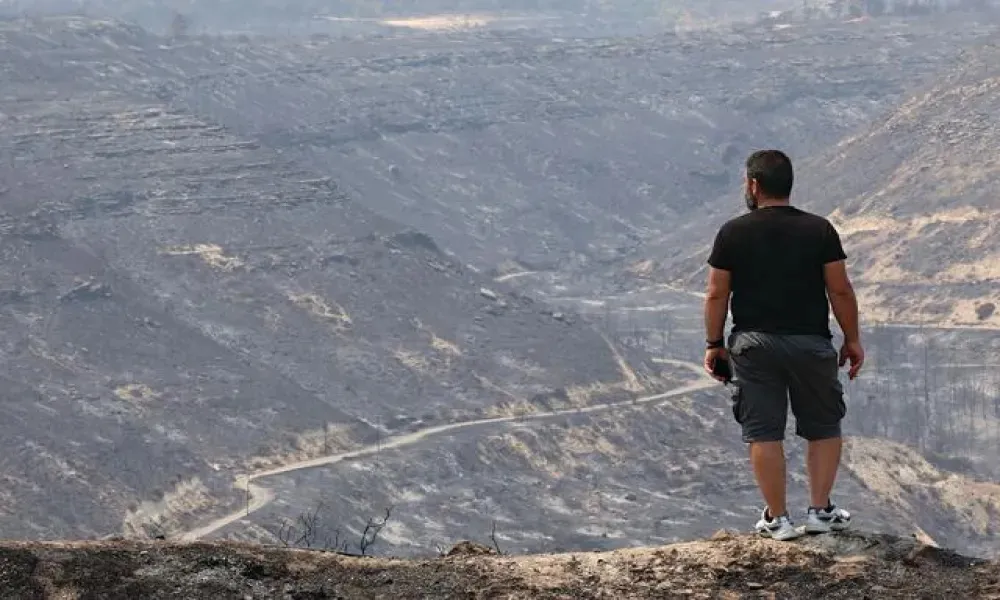
Nearly a year after the major wildfire that swept through Limassol district last July, the environmental scars it left across habitats of Cyprus’s wildlife remain open. The blaze devastated an area of about 124 square kilometres, leaving lasting damage that, in some locations, shows little sign of recovery.
This period normally marks a phase of intense vegetation growth, with green dominating the Cypriot landscape, helped this year by favourable rainfall. In some parts of the burned areas, new growth has indeed appeared, offering a measure of optimism. So too has recent news from the Game and Fauna Service about a pair of Bonelli’s eagles (Aquila fasciata) that refused to abandon their territory and chose to nest on a burned pine tree, successfully hatching two chicks.
At the same time, however, there are areas so severely affected by the fire that “not a single blade of grass” has regrown. This was confirmed to Politis by senior Game and Fauna Service officer Nikos Kassinis, who also provided photographic evidence from burned sites near the villages of Agios Therapon and Lofou.
Despite the encouraging example of the eagles, Kassinis said some zones experienced such extreme fire intensity that no vegetation is visible even now. “When a fire reaches such high levels of intensity, it creates a black layer on the ground, like a crust. If that crust is not broken, erosion follows,” he explained.
He said the appropriate response would be to cultivate certain affected areas, mainly mountain slopes and abandoned agricultural land. He confirmed that some of these zones fall within Natura 2000 protected areas. However, the inaccessibility of the terrain and the need to secure consent from owners of abandoned farmland have created objective difficulties. This contrasts with forest areas, where planting and seeding can be carried out more immediately.
Some areas will take years
In Kassinis’ assessment, some areas will need several years before vegetation reappears. He noted that ecosystem recovery after a wildfire depends on several factors, including the severity of the blaze – its scale and intensity – soil and vegetation nutrients, and, above all, weather conditions in the years that follow.
“To speed up the process, researchers recommend a range of techniques,” he said. These include covering soil with humus to protect it and retain moisture, planting fast-growing species to limit erosion, installing natural barriers such as logs or mesh on slopes, and introducing beneficial microorganisms that enhance soil fertility and structure.
Impact on wildlife
Kassinis also outlined the effects on fauna caused by a large-scale wildfire. These include direct loss of wildlife, destruction of nesting, feeding and shelter areas, and changes to habitat structure that favour some species while reducing or eliminating others.
Forest-dependent species are expected to decline because of habitat loss, while species adapted to more open environments may benefit. Large birds of prey may lose nesting trees or see their cliff nesting sites degraded. If their food base suffers, their presence in the area will diminish, leading to lower breeding success and chick survival.
Smaller species, including game animals, can recover relatively quickly, often within a few years, provided there is support through seeding, water points and area protection. Some species may also benefit from the installation of artificial nests, such as those used for scops owls, Eurasian magpies and little owls, once food availability begins to recover.
“Mediterranean ecosystems have evolved over millennia alongside fire and grazing, which gives them a capacity to recover,” Kassinis said. “The degree of recovery depends on the scale and intensity of the fire, climate change and weather conditions, and human intervention.”