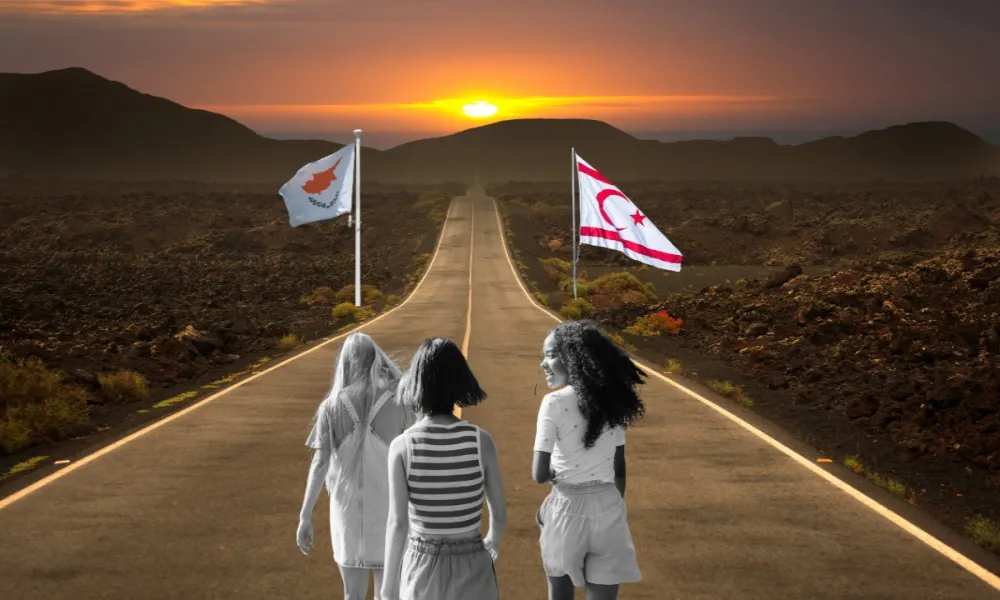
We are a group of five friends. We went through the same education system, sat in the same classrooms, and absorbed the same narrative, the status quo, a carved story: they are evil, we are good. These are your heroes. Worship them. Parade them. Religion. Hellenism. I suppose this is how nations cultivate national pride -a strong sense of identity that prepares people to fight for their country. However, the confusing part is that in our case it's all about foreign flags and foreign identities, more specifically the Greek and Turkish. We are not shaped to fight for the Cypriot identity, so my friends and I remain... confused. What is our identity?
Here we are, sitting together late at night, debating our conflicting opinions. Though we shared the same schooling, we were shaped by different homes, by the ideologies passed down from older generations, grandparents who lived through British rule, the coup, the invasion, and the painful aftermath, each in their own way.
Raised on stories, searching for identity
Let me introduce us not through names and hobbies, but through the weight of heritage and the ideologies we didn’t choose but inherited like stubborn family heirlooms.
My grandfather lost his home and his father’s shop in Morphou. He was a die-hard ENOSIS (political ideology advocating for the union of Cyprus with Greece, primarily championed by the Greek Cypriot community) man, ready to paint the town Hellenic blue, until life taught him the hard way that friendship and cooperation might actually be more productive than division and slogans. Major ideological U-turn. So, after hours of discussions at the dinner table, I also became very critical of how we handled our past and present. I’ve learned that moving forward means understanding that the Turkish Cypriot living a few hundred metres away is not my enemy.
Andrea’s grandmother? Left functionally a widow at 28 when her husband vanished in the war. No body, no grave, just the eternal waiting room of “missing.” Three generations later, Andrea, her mother, and her grandmother are still waiting for closure... or at least a decent explanation.
Konstantinos walks around haunted not just by the stories of torture his grandfather survived during the bicommunal conflicts of 63, but by the unspoken tally of Turkish Cypriots his grandfather didn’t let live. Ironically, he now hides his Turkish Cypriot girlfriend, Aylin, from that same grandfather, because introducing her would probably cause the man to combust into nationalistic flames and burn alive. Hiding such a big part of his life has resulted in a quiet but constant guilt, especially now that Konstantinos has gotten close to Aylins family. He’s torn between blindly agreeing with his grandfather for the sake of family peace and defending the people he’s getting close to.
And then there’s Antonis and Sofia: walking monuments of Greekness. Their grandfather was besties with Grivas, fought for ENOSIS like it was a full-time job, and passed on that passion with precision. Their Instagram bios? Greek flags, Orthodox icons, maybe a quote from Theodorakis for flair. Unsurprisingly, they’re having a very hard time accepting Aylin into the group. Identity crisis meets group chat politics.I have a friend, Hasan, and whenever I invite him out with us, it seems that Antonis and Sofia suddenly become busy and can’t make it. On the few occasions when Hasan did show up unexpectedly, he looked visibly uncomfortable with Antonis’s comments, and the feeling seemed mutual.
For some, memories of the past stir anger and resentment. For others, they evoke sorrow and a desperate need for peace. Both responses are valid, and both are passed down to our generation. And from this, young friendships marked by ideological diversity are born, friendships that argue passionately, yet listen intently. Friendships, that if not carefully cared for can easily break under the pressure of our broken society.
But the weight of history is heavy, and not all differences are equal. There are lines that, if crossed, make reconciliation impossible. Still, in the Cyprus we’ve inherited, where division is sustained by silence as much as by hostility, I’ve learned that sometimes keeping a friendship alive means knowing when to pause, when to leave a room, or when to crack a joke to defuse the heat. Not to excuse harmful beliefs, but to make sure the door stays open for another conversation tomorrow. Because if we lose every bridge, we also lose the chance to change what’s on the other side.
We were all shaped by the official narrative, told to identify as proud Greek Cypriots. Yet some of us feel the urge to question it, to poke at the bubble, just like when Konstantinos at the age of 17 decided to first cross the border, to see for himself who the ‘other’ side truly is. Just like I decided to truly learn the history of this beautifully intricate place, understand the faults of both and not walk on blindly. Others like Antonis and Sofia remain inside the bubble, thrive on it, drawn to the comfort it provides, avoiding the discomfort of deeper truths. Clinging to the familiar truth they know from both family and school, the simple truth of the good and the bad. But I believe that comfort may be costing us the inclusive Cypriot identity we never fully nurtured.
State, chruch & education shape us
The state frames its vision as reconciliation. Time and time again official statements talk about reaching bicommunal solutions and peace, and time and time again do these superficial intentions lead to formal meetings and discussions. Not a lot gets done, many empty words and promises are thrown around and next meetings are set, but nonetheless the official narrative is one of solution.
However, the education system has left a gaping hole regarding reconciliation. The teaching material and methods do not in any way represent the state’s so called positive intentions. Reconciliation, we’ve learned, hides behind a strong patriotic discourse, a contradiction that many are only just beginning to confront. Walk into most classrooms, and you’ll find history drawn in black and white, heroes and enemies, us versus them.
From an early age, we were taught emotions: pride, pain, and blame, and here I foolishly thought history was about facts and lessons. The education system on both sides reinforces this divide, presenting each community as the victim. There’s little space for understanding, or for the truths that don’t fit the narrative. In schools in the areas controlled by the Cyprus government, the pain caused by Turkish forces is central, commemorated and carved into memory. But the massacres and rapes by members of EOKA B in Tochni, Aloa, and Santalari are rarely mentioned. Without these stories, empathy can’t take root. And so, we carry a history we didn’t choose, but one that shapes how we see each other every day.
Another powerful force shaping our identity is the Orthodox Church. With close ties to the Ministry of Education, it influences textbooks, school rituals, and values. Faith, nationalism, and history are blended into a single identity. Similarly, in the north, religion plays a notable role in education through compulsory religious classes and recent debates, such as the hijab-in-schools controversy, reflecting how faith, politics, governance and education also intertwine there, shaping identity from the other side.
The statistics make it clear that we are not the only friend group that has these issues, if the official goal is reconciliation, then why is the society so separated? The intention of reconciliation cannot just be written on paper and official documents, but it must be pursued within the community. The society must heal and come together.
The abominably low numbers simply don't align with the official talk of peace. Why isn't there more effort? Only 7.2% of Greek Cypriot youth cross to the north regularly, compared to 41.4% of Turkish Cypriots. 38% of Greek Cypriot youth say they never cross at all. Only 16.8% have friends from the other community. The numbers are better in the north, 48.8%, but still not enough. After all these years, most teenagers still live in echo chambers-built decades before they were born.
A conversation that says it all
A warm summer evening. The five of us are crammed around a café table in the old town. Someone just mentioned going to the beach next weekend.
Andrea: What about going to Karpasia next weekend? Golden Beach? I haven’t been in years.
Antonis: (raises an eyebrow) Karpasia? So, the occupied territories now have weekend plans?
Konstantinos: (sighs) Here we go.
Me: Bro, it’s a beach. Not a military campaign. We’re not going to plant a flag; we just want to swim.
Sofia: I’m not swimming somewhere where my grandpa fought and bled.
Andrea: Okay, but my grandma waited fifty years for her husband to come back and still thinks peace is possible. If she can move on, maybe you can dip your toes in the sand.
Konstantinos: (checking his phone) Also, Aylin said she’s down to come if we go. Just FYI.
Antonis: (visibly uncomfortable) Oh. Well, then I’m probably busy that day.
Me: You’ve been ‘busy’ every time she’s around. What is it, a moral allergy?
Sofia: It’s not personal. It’s… complicated.
Andrea: Yeah, no one said it’s simple. But pretending people like Aylin don’t exist doesn’t make it less complicated, it just makes you less willing to deal with it.
Konstantinos: Imagine hiding your girlfriend from your grandfather like she’s a war crime.
Me: Ironic, since your grandfather committed war crimes.
Konstantinos: Exactly! That’s why I’m trying not to be him. Growth, people. Ever heard of it?
Me: Guys, let's take a breath. I know this is hard but let's not let it come between us. Sofia and Antonis, it pains me to know that the past is holding you back from getting to know all of this gorgeous island. Passing the border hurts, I won't lie. Handing over your passport may sting for a moment, but it’s all forgotten the instant you set eyes on Cyprus’ treasures. When you meet old friends of your grandparents that have endless childhood stories. When you walk the streets your ancestors once lived in and loved.
Andrea: That’s easy for you to say. Your family will welcome you back, ask if you enjoyed yourself, and you’ll smile and show them photos. For some of us, it's the exact opposite.
Antonis: Exactly! I posted a photo at Ledra crossing a couple years ago. I was contemplating if I should cross, this resulted in my uncle not talking to me for a whole month. Even though, after a while I turned around and left, I did not even cross. Imagine what could have happened if my younger, more curious mind had taken over
Andrea: Look, maybe we go, maybe we don’t. But we can't keep acting like seeing the other side is betrayal. Maybe it’s just... growing up. Maybe our parents never crossed because they were scared. And maybe we should cross because we’re not.
Sofia: Or maybe we should explore and fix our own side first. Me: Sure. But healing doesn’t mean ignoring the other person in the room. It means listening. Even when it’s uncomfortable. Especially when it’s uncomfortable.
Antonis: There are countless breathtaking beaches right here. I just don’t want to feel like I’m betraying my grandfather.
Konstantinos: Then don’t betray him. But don’t become him either.
Everyone goes quiet for a second. The sound of forks clinking. The low murmur of tourists nearby.
Andrea: So... is this a yes or no on Karpasia?
Me: Let’s go. One car, five confused Cypriots, and a cooler full of contradictions.
Konstantinos: And a girlfriend we’re smuggling across generations.
Sofia: (cracking a smile) Fine. But I’m bringing my own snacks. I don’t trust their hummus. And I'm not giving them 2 cents of my money.
Antonis: If I end up liking it there, I’m blaming all of you. Sofia, just a heads-up, get ready for plenty of judgment and family drama.
Sofia: Maybe it will be worth it. I hope it will be worth it.
This is us trying to navigate the complexities of the home we all love and cherish. We ended up going to Karpasia that weekend. We had a beautiful time. Aylin and Sofia bonded, they found out they have a very similar taste in music. However, change takes time, Sofia did not agree to eat dinner in Karpas, but that's okay. One step at a time. We all came back to the south and ate at a very nice tavern, while looking at pictures of our day at the beautiful Golden Coast.
Some of us are reaching across. But many more are frozen. Torn between what they were taught and what they sense might be true. On the one hand are those daring to question. On the other are those clinging tightly to the grief and pride of their grandparents. The fear is real. So is the hope.