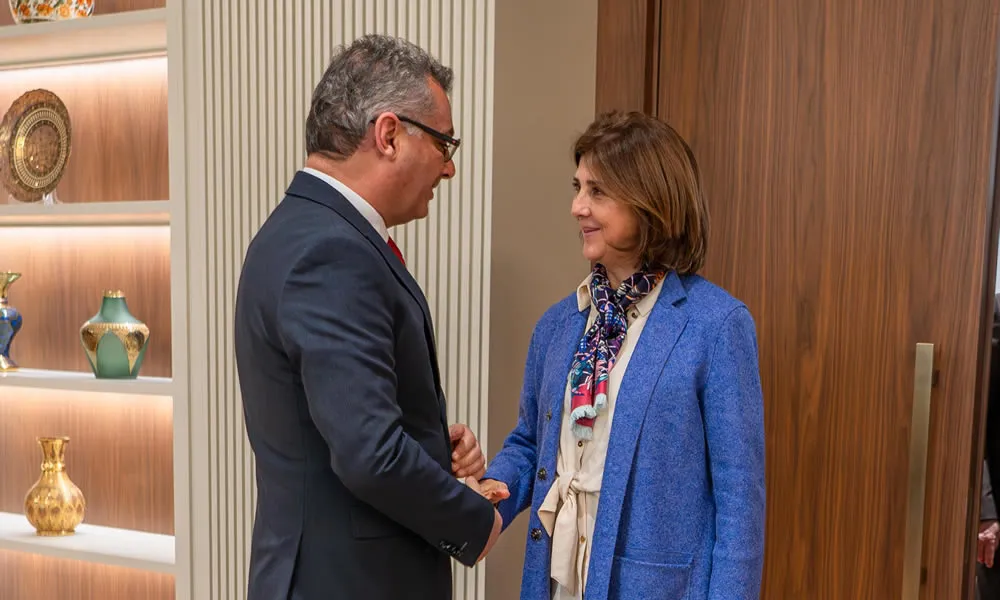
The submission of five points by the President of the Republic during the joint meeting with Tufan Erhürman and the UN Secretary-General’s Personal Envoy, María Ángela Holguín, was presented as a response to the four preconditions set by the Turkish Cypriot leader for the resumption of negotiations. At the same time, however, it revealed something deeper: a reluctance to enter substantive negotiations, as it effectively reopens the issue of convergences, namely what has already been agreed in the past.
What do Erhürman’s preconditions represent?
Erhürman’s preconditions do not so much concern the substance of the Cyprus problem as an attempt to impose a specific negotiating process, as perceived by the Turkish Cypriot side. These proposals primarily reflect the deep lack of trust felt by Turkey and the Turkish Cypriots following the negotiations of 2004 and 2017.
The Greek Cypriot side is accused of being able to enter each round of talks from a position of security, without risking the loss of international recognition, while Turkish Cypriots have remained, for 51 years, an unrecognised political entity. This asymmetry lies at the heart of Erhürman’s insistence on preconditions before entering substantive discussion.
There is, however, another reason for this insistence. Erhürman returned to the negotiating table, despite objections from Turkey, on the condition that he could convince Ankara that the Greek Cypriot side is ready for genuine dialogue. Even today, Turkey’s official position is that Greek Cypriots are unwilling to discuss political equality and merely participate in talks to buy time.
In practical terms, Erhürman began contacts without having Ankara’s full backing or trust. Members of his circle point out that under these circumstances he cannot fully reveal his positions, explicitly name a bi-zonal, bi-communal federation as the desired solution, accept the Crans-Montana map that provides for the return of Varosha, half of Mesaoria and Morphou, or clearly explain arrangements concerning Greek Cypriot properties in Turkish Cypriot-administered federal territory.
He insists that his preconditions are non-negotiable, with the fourth even providing for sanctions in the event of another collapse of talks attributed to Greek Cypriot responsibility. In essence, Erhürman seeks guarantees against a return to the status quo if negotiations fail. He wants assurances that Turkish Cypriots will not once again be trapped in stagnation, without progress or rights.
What troubles many Greek Cypriots in this stance is the familiar logic of the “bad cop” (Turkey) and the “good cop” (Erhürman), combined with persistent ambiguity over what is ultimately accepted and what is not. This ambiguity has exhausted public patience. Equally tiring is the constant narrative of Turkish Cypriot isolation, at a time when thousands of foreign nationals live in a new city in Trikomo, in houses and villas built on Greek Cypriot land.
Christodoulides’ five points
Despite doubts over Ankara’s final stance, Erhürman’s positions are reportedly viewed positively at the international level, including by the guarantor powers. Against this backdrop, President Christodoulides has sought to redirect the discussion, arguing that talks should focus on substance rather than procedure.
However, the second of his five points, concerning existing convergences, directly touches not only on the substance of the Cyprus problem but potentially on the very basis of the solution. Specifically, the President has asked the United Nations to compile all convergences up to Crans-Montana and divide them into two categories:
- Convergences relating to internal aspects to be shared with the two communities, with only those accepted by both remaining in the document.
- Convergences relating to external aspects to be shared with all five parties, with only those accepted by all five remaining in the document.
This proposal leaves open the possibility that existing convergences could be rejected and removed, either by one of the two communities or by the guarantor powers. For example, the Greek Cypriot side could declare that it no longer accepts rotating presidency or effective Turkish Cypriot voting. At the same time, Turkey could reject the agreed position that the 1960 system of guarantees is no longer viable and should be replaced. It could also dismiss the 2017 Geneva map or the 4:1 ratio for the naturalisation of Greek and Turkish nationals after a solution.
This raises a fundamental question: what remains of substantive negotiations if agreed convergences are reopened? And why do those close to the President describe Erhürman as “worse than Tatar”, when the Turkish Cypriot leader explicitly states in his third precondition that previously agreed issues should not be revisited?
By insisting that past agreements remain untouched, Erhürman implicitly accepts the bi-zonal, bi-communal federation, the Guterres Framework and the map. By contrast, what exactly does President Christodoulides accept when he proposes a review of convergences? Is he calling for a reassessment of everything agreed so far, and if so, from where do we start and where are we heading? Or does this approach risk undermining the accumulated negotiating acquis?
Time for clarity
One thing must be made clear. At this stage of the Cyprus problem, there is no room for ambiguity or constructive vagueness.
If we continue to pursue a bi-zonal, bi-communal federation, we must say so clearly, mean it and actively pursue it. Under Nicos Anastasiades, the term was effectively abandoned after 2022, while Nicos Christodoulides until recently avoided explicitly naming it as the desired solution.
If, on the other hand, we believe that under current conditions we should seek a return to a unitary state, a two-state solution or a confederation, then this position must also be stated openly. President Christodoulides should step forward honestly and courageously to justify such a choice.
Everyone understands that the status quo is worse than any of these options. Non-solution, at a time of profound geopolitical fluidity in the region, leaves the country exposed to geopolitical agendas that could ultimately threaten our very survival on this island.