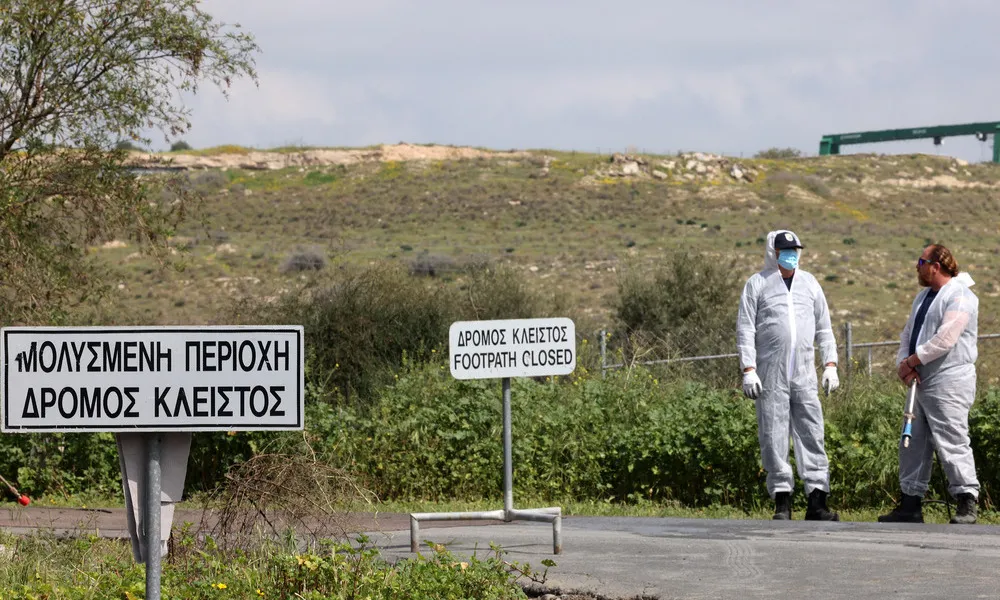
The need for direct intervention by President Nikos Christodoulides – both through communication with the Turkish Cypriot leader and at the level of the European Union – to exert pressure on north so that the entire island follows a single, unified policy for the prevention and management of foot‑and‑mouth disease was underlined on Tuesday by stakeholders, MPs and livestock farmers.
During the second meeting of the House Agriculture Committee, concerns were raised that the measures currently being implemented by the Veterinary Services – mass culling, vaccination and strict movement controls, all guided by the European Commission and accompanied by millions in compensation (€28 million so far) – may ultimately be futile as long as there is an ongoing risk of the virus spreading from the north.
Indicatively, Thomas Thoma, district secretary of the Union of Cyprus Farmers (EKA) Nicosia-Kyrenia branch, questioned whether President Christodoulides had discussed the issue with Turkish Cypriot leader Tufan Erhürman. Livestock farmer Giorgos Dimitriou, who was affected by the outbreak, urged the President to impose strict controls immediately to prevent recurrence of the disease, stressing that European funds must be utilised as effectively as possible in both the government‑controlled and occupied areas.
“If we don’t see Cyprus as a single space, then we’re done for,” he said. General secretary of Panagrotikos (described as the largest farmers’ organisation) Tasos Giapanis rejected the argument that the state has no leverage over the north. “The halloumi exported by Turkish Cypriots through our legal ports and airports – is that not leverage?” he asked.
Bicommunal Committee convenes
Just hours earlier, a meeting of the Bicommunal Technical Committee on Health took place, during which, at the request of the Greek Cypriot side, veterinarians from the Republic’s Veterinary Services – participating in their personal capacity – asked the Turkish Cypriot side to consider modifying its strategy and to apply EU protocols uniformly on both sides.
It is noted that the north has not carried out mass culling except in very severe cases, opting instead for protective vaccination. Greek Cypriot co‑chair Leonidas Phylactou noted that during the COVID‑19 pandemic the Technical Committee had adopted a uniform approach, and that Turkish Cypriot members requested time to review the proposed change of strategy and will respond.
Phylactou said both sides exchanged updates on the foot‑and‑mouth situation. Greek Cypriot veterinarians reported the latest cases detected in farms in Dali and Geri, while Turkish Cypriot veterinarians said the disease remains confined to the restricted area of Lapithos. Vaccination continues with the goal of covering the entire animal population in the north, with sampling under way in additional regions.
He added that the Committee has met at least four times since the first case was identified in the north last December and remains in continuous contact.
Goal: A joint committee
Addressing the House Agriculture Committee, Veterinary Services director Christodoulos Pipis, who took part in the bicommunal meeting, said: “We asked them to operate on the basis of the EU acquis for a unified policy. Through the Greek Cypriot negotiator, the aim is to create a joint committee to manage such situations uniformly under EU law.” He added that the Greek Cypriot side also requested that grazing be prohibited within the buffer zone.
“In the occupied areas they did not carry out culling; they proceeded directly with protective vaccination,” he noted. Turkish Cypriots themselves requested vaccines from the European Commission, Pipis said. The Commission then contacted the Republic of Cyprus, which responded that the 500,000 doses should first be delivered to the Republic and then forwarded to the north – mirroring the procedure used during the COVID‑19 pandemic.
AKEL MP Andreas Pasiourtides questioned why, given the identification of the problem in the north by EU experts, vaccines were not also delivered to the free areas. Pipis cited political and legal constraints, noting that the Republic does not exercise control in the occupied north. He also argued that there was no guarantee the disease would spread to the free areas, referring to previous examples of outbreaks.
He added that vaccination in the free areas was prohibited in December because no cases had been detected at that time. He emphasised that the EU has no control over the occupied territories, but noted that the European Commissioner said last Friday that efforts are being made to persuade Turkish Cypriots to comply with EU law through the funding provided to them – exactly the approach followed when vaccines were supplied last December.
DISY MP Charalambos Pazaros asked: “ Why have the occupied areas not carried out culling and why does the EU continue to provide assistance even when instructions are not followed?” Pipis conveyed information he had received: that the north did not implement the EU acquis because they had neither compensation funds nor the means for incineration or burial.
DISY MP Kyriakos Hadjiyiannis criticised the low penalties for illegal animal movement through gaps in the Green Line (€5,000), arguing they are not a deterrent. He called on the Ministry of Agriculture to submit a bill increasing the penalty.
Statement from Erhürman
Turkish Cypriot leader Tufan Erhürman wrote in a post that bicommunal technical committees should serve as tools for cooperation.
From his first day in office, he said, he requested that the committees meet regularly, remain results‑oriented and include qualified representatives from both sides. He expressed hope that the “south” would adopt a similar approach – committees with suitably qualified members, regular updates, focused work and resolution of daily problems without political motives.
“This should apply not only to foot‑and‑mouth disease but to every issue. This island is small, and diseases and common problems do not recognise borders,” Erhürman stressed. In the same post, he outlined actions taken by the Turkish Cypriot side, saying they provided all relevant information on the outbreak to the EU, the UN and the Republic of Cyprus as soon as it was detected. He added that when needed, the Turkish Cypriot side supplied foot‑and‑mouth vaccines to the Greek Cypriot side.
Cases rise to 42
Meanwhile, a new case detected in Dromolaxia, within the infected zone, raised the total number of affected units to 42, sparking concern about possible spread to new areas. So far, the outbreak remains concentrated mainly in the districts of Larnaca and Nicosia. The Dromolaxia unit includes 110 sheep and goats, which will be culled.
To date, 82% of cattle units across Cyprus have been vaccinated, along with 45.7% of sheep and goat units. The target is to complete the first vaccination dose island‑wide by the end of March, while second‑dose vaccinations begin today.
Farm organisations satisfied
Farmers’ organisations said the €28 million compensation package approved by the Cabinet is a step in the right direction. In a joint statement, PEK, EKA, Panagrotikos, Nea Agrotiki Kinisi and Euroagrotikos said the measures “create positive conditions and a solid basis for the recovery of livestock farming in our country”, addressing problems on multiple levels and aiming for their swiftest possible resolution.
They also described the appointment of Stavros Malas as head of the special scientific committee for the restructuring and upgrading of the livestock sector as “an important step in the right direction”. The organisations pledged to support Malas in his work through their active participation.