The fight against crime is no longer confined to courtrooms. Increasingly in recent years, it has shifted toward tracing the movement of money and identifying illegally acquired assets for confiscation. This trend is reflected in the rising value of “recoveries” from frozen and seized revenues or property linked to unlawful activity. As Maria Kyrmizi Antoniou, head of MOKAS (the Unit for Combating Money Laundering), explains in an interview with Politis, asset deprivation is a key form of punishment, cutting off the fuel for further criminal activity and preventing “dirty” money from entering the legitimate economy. At the same time, it is an essential pillar of crime prevention.
According to the head of MOKAS, the law enables the freezing of illegal proceeds even in the early stages of a criminal investigation. This occurs alongside the police’s economic investigation, which proceeds in parallel with the probe into the underlying offence. The effectiveness of the process, Antoniou notes, is strengthened through close cooperation between MOKAS, the Police and the Legal Service, as well as through collaboration with European and international authorities. Together, she says, these bodies form a robust network aimed at undermining the financial foundations of crime.
The process
MOKAS does not conduct criminal investigations, Antoniou clarifies. Rather, it provides the Police with financial intelligence and analysis derived from suspicious‑transaction reports. Once illegal proceeds are traced and identified during the police investigation, MOKAS – acting on behalf of the Attorney General – applies to the courts for freezing orders. Confiscation orders, by contrast, form part of the criminal trial and are issued by the court following a request from the Prosecution. The court determines the value of assets to be confiscated based on the evidence before it.
If the illegally obtained proceeds are not located, any liquidisable property belonging to the suspect or accused may be confiscated instead – equal in value to the proceeds of the offence – regardless of whether the assets were obtained legally or illegally. This may include movable and immovable property, crypto‑assets, investments, bank accounts, cash, shares, vehicles, homes, antiquities or jewellery. Antoniou emphasises that authorities also examine assets held by third parties to whom the suspect may have transferred property, for example through gifts.
New directive strengthens the framework
A new EU directive is set to reinforce the existing system for recovering illegal proceeds. The draft bill, now being promoted, includes – for the first time – provisions allowing the confiscation of unexplained wealth without a criminal conviction if it is linked to organised criminal activity.
Under the directive, Antoniou explains, courts must consider all circumstances of the case in determining whether assets should be confiscated. These include available evidence and specific factual indicators, such as:
a) assets whose value is substantially disproportionate to the person’s lawful income;
b) a lack of reasonable legal source for the assets; and
c) links between the individual and persons associated with organised crime.
Confiscating unexplained wealth linked to organised crime without the need for a conviction will, she adds, be a powerful new tool for law‑enforcement and prosecutors.
Significant results
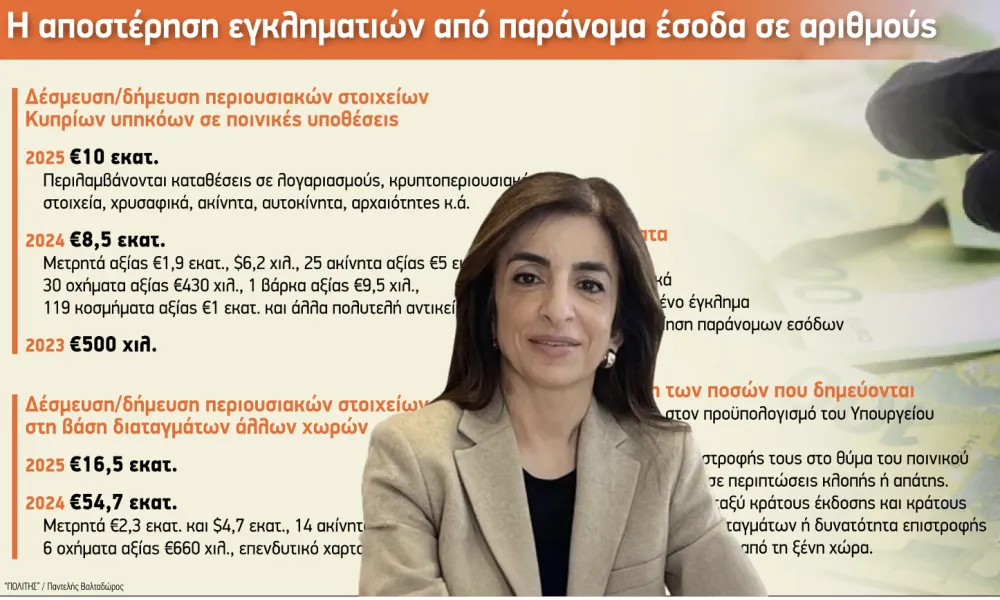
The initiative launched in 2024 by MOKAS and the Police to improve enforcement of asset recovery measures produced substantial results in both 2024 and 2025. As shown in the relevant data, Antoniou notes, “we expect these positive outcomes to continue growing through the collective efforts of all involved authorities,” highlighting a sharp increase in confiscations compared with previous years.
She further explains that authorities freeze and confiscate not only assets linked to domestic criminal cases but also assets located in Cyprus as part of cooperation with foreign authorities. MOKAS applies to Cypriot courts to register and execute foreign confiscation orders for illegal proceeds identified on the island.
The reverse also applies: Cypriot investigations may involve assets located abroad. In such cases, Cypriot courts issue freezing orders that are transmitted to foreign jurisdictions under international treaties and EU regulations. The aim is that, following conviction, the assets can be confiscated.
Where the money goes
Funds recovered through confiscation orders are deposited into the budget of the Ministry of Finance. However, they may also be returned to victims of the offence concerned – such as in cases of theft or fraud. For foreign confiscation orders, EU regulations determine how seized amounts are shared between the issuing and executing states, while still allowing the possibility of reimbursing victims if requested by the foreign authorities.
Antoniou concludes by stressing that “in an ever‑evolving financial environment, new products and technologies create emerging risks for moving illicit funds, which criminals can exploit to hide their proceeds. Our objective is to deprive criminals of their illegal earnings from criminal activity, ensuring that crime does not pay.”